
Syria Secunda is divided into two districts: …
Years: 388 - 531
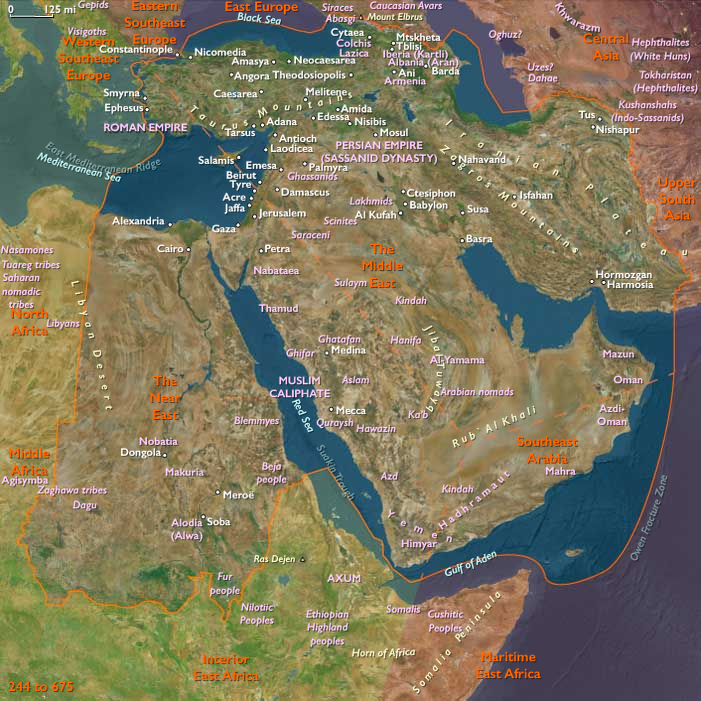
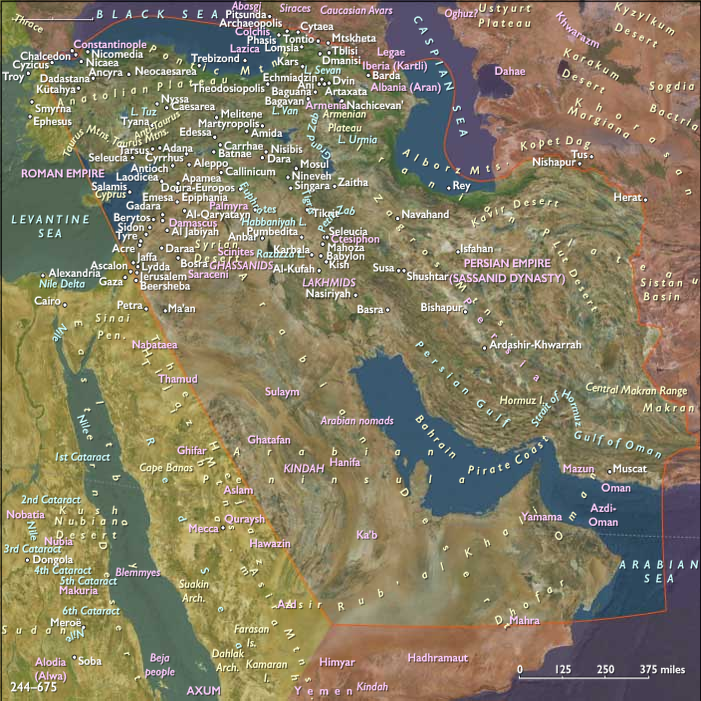
Syria Secunda is divided into two districts: Phoenicia Prima, with Tyre as the capital; and Phoenicia Secunda, ruled from Damascus.
The ruling families of Syria during this period are the Ghassanids, Christian Arabs loyal to Byzantium, from whom many Syrians now trace descent.
Locations
Groups
- Semites
- Aramaeans
- Phoenicians
- Arab people
- Phoenice (Roman province)
- Roman Empire: Valentinian dynasty (Rome)
- Roman Empire: Theodosian dynasty (Constantinople)
- Roman Empire, Eastern: Leonid dynasty
- Ghassan, Kingdom of
- Roman Empire, Eastern: Justinian dynasty
Subjects
Regions
Subregions
Related Events
Filter results
Showing 10 events out of 76 total
By contrast, Colombia's Muiscas—based in the present departments of Cundinamarca and Boyaca in the Cordillera Oriental—live in dwellings scattered through the countryside, and their temples and palaces are of perishable materials, but Muiscas, of whom there are perhaps six hundred thousand, are far more numerous than the Taironas and cover a wider territory, extending from the area of present-day Bogota northeastward to Tunja and beyond.
As in the case of the Taironas, Muisca local chiefdoms have consolidated into two separate confederations.
The Muisca territory also includes Laguna de Guatavita, site of the fabled ceremony of El Dorado, the gold-dusted dignitary who plunges into the crater lake along with a rain of golden offerings.
More than any other native people, the Muiscas have served as a model for later ideas of Colombia's pre-Columbian civilization.
In 1536 Gonzalo Jiménez de Quesada, a lawyer turned military commander who is comparable to Hernán Cortés, the conqueror of Mexico, or Francisco Pizarro in Peru, launches the most important of these expeditions.
He heads inland up the Magdalena toward the land of the Muiscas, which he reaches early in 1537 after losing more than half of his party to shipwreck at the mouth of the Magdalena and to disease, insects, and hunger on the march.
After easily overcoming armed resistance, Jiménez de Quesada and his lieutenants occupy the entire Muisca territory and on August 6, 1538, found the city of Santa Fe (present-day Bogotá, known as Santa Fe during the colonial period), as capital of the New Kingdom of Granada, as he calls this new possession after his birthplace in Spain.
One is led by Nikolaus Federmann, a German in Spanish service who arrives from western Venezuela, and the other by Sebastian de Belalcazar (or Benalcazar), a former lieutenant of Pizarro coming north from Quito who has founded Popayan and Cali on the way.
Instead of fighting among themselves for the spoils of the Muiscas, the three conquistadors refer the matter to authorities in Spain, who, not wanting any one conquistador to become too powerful, place a fourth party in charge instead.
However, Jimenez de Quesada is granted other privileges and is one of those who continues the work of exploration and conquest.
…finally penetrate the lands of the Muisca in the central plain of Colombia (at the site of present day Bogotá).
Only one hundred and sixty-six men out of nine hundred—and only seventy of the expedition leaving Santa Marta—have survived the eight month trek over four hundred and fifty miles (seven hundred and twenty-five kilometers), suffering terribly in the jungle: they have been forced to eat snakes, lizards, frogs, and even the leather torn from their harnesses and the scabbards of their swords.
At the site of Bogotá, Quesada resigns and calls for an election; he is elected captain-general, and throws off the last link that holds him to the governor.
They now set about about conquering the gold-rich Chibcha kingdoms.
The Muisca have two rulers.
One, the Zipa Tisquesusa, rules in Bogotá; the other, the Zaque Nemequene, rules in Tunja.
Taking advantage of a war between the two chiefdoms, Quesada's force subdue Bogotá, then successfully attack Tunja.
At this point it is time to establish a colony so that the earth itself might properly belong to Quesada and his men, and to facilitate the further accumulation of gold and emeralds.
They choose a spot next to the towering peaks of the east, where the land is high and the rains will quickly run off, where the mountains will protect them from attackers and the jungles below.
Quesada places his right foot on the bare earth and says simply, “I take possession of this land in the name of the most sovereign emperor, Charles V.” The settlement is at first called New City of Granada, but later they change it to Santa Fé de Bogotá, now known simply as Bogotá, from the chibcha language word Bacatá, the name of one of the two cacicazgos of the Muisca Confederation.
The city lies more than eighty-five hundred feet (two thousand five hundred and ninety meters) above sea level at the eastern edge of the Basin of Cundinamarca.
Quesada remains in the region until the arrival of two expeditions at the end of 1538: Sebastián de Belalcázar from Quito, Ecuador, one of the captains of Pizarro who had mutinied against his leader; and Nikolaus Federmann, who has rebelled against his leader Georg von Speyer.
Federmann, together with Belalcázar, re-founds the city of Bogotá on April 27, 1539, after Jiménez de Quesada fails to fulfill the official requirements of the Spanish Crown concerning the founding of a settlement when he attempted to establish a first Bogotá on August 6, 1538.
The three captains meet on the savanna of New Granada.
All three want to claim New Granada for themselves.
In order to resolve their dispute, Quesada persuades them to go back to Spain with him and to submit their rival territorial claims to the arbitration of the crown.
Spanish conquistador Gonzalo Jimenez de Quesada has been continually rebuffed by the Spanish crown because of rival claims to the territory that he has “discovered” for the West.
After nearly a dozen years of wandering disconsolately through the gaming halls of Europe, he finally receives only the honorary title of marshal of New Granada, to which he returns in 1550.
The crown has established an “audiencia” (tribunal) to administer the New Granada region.
The area consisting of the present states of Colombia, Ecuador, Panama, and Venezuela in 1564 becomes part of the viceroyalty of Peru as the New Kingdom of Granada, with its capital in Bogotá.
The Royal Audiencia, created by a royal decree of July 17, 1549, had been given authority over the provinces of Santa Marta, Río de San Juan, Popayán, Guayana and Cartagena de Indias.
The Audiencia was charged primarily with dispensing justice, but it was also to oversee the running of government and the settlement of the territory.
It held its first session on April 7, 1550, in a mansion on the Plaza Mayor (today, Plaza de Bolívar) at the site which today houses the Colombian Palace of Justice.
Initially all of the justices held executive power, but this proved ineffective.
Despite several royal inspectors (visitadores) sent to improve the audiencia's functioning, its performance had not improved.
Executive power is centralized in 1564 in one officer, the Audiencia "president", who is also made governor and captain general.
(For this reason the region is also referred to as a presidencia at this time.)
With these two offices, the president oversees the civilian government and holds the command over the kingdom's military forces.
The president is loosely dependent upon the Viceroy of Peru at Lima in administrative and military matters.
The jurisdictional boundaries of the Audiencia encompass the territory of the kingdom.
Gonzalo Jimenez de Quesada, after nearly a dozen years of wandering disconsolately through the gaming halls of Europe, had in 1550 returned to New Granada in 1550, where the former conquistador has settled down to live for nearly twenty years.
He is a respected colonist, becoming the most influential man in the colony.
As honorary marshal of New Granada, he protects his fellow colonists from the severity of the officials and restrains the comenderos' (large landholders) greed, but his own desire for wealth and gold continues to live inside him.
Having received a commission to conquer the Llanos to the east of the Colombian cordillera, Quesada, at the age of seventy-four, again strikes out from Bogotá in search of the fabled El Dorado.
From Bogotá in April 1569, he sets out with five hundred mounted soldiers, fifteen hundred natives, eleven hundred horses and pack animals, six hundred head of cattle, eight hundred pigs, a large number of enslaved Africans and eight priests.
Dominican monks are the founders of the first two universities of Bogotá, in 1563 and 1573.
Years: 388 - 531
Locations
Groups
- Semites
- Aramaeans
- Phoenicians
- Arab people
- Phoenice (Roman province)
- Roman Empire: Valentinian dynasty (Rome)
- Roman Empire: Theodosian dynasty (Constantinople)
- Roman Empire, Eastern: Leonid dynasty
- Ghassan, Kingdom of
- Roman Empire, Eastern: Justinian dynasty
