
The Thirty Years' War results from a …
Years: 1540 - 1683
The Thirty Years' War results from a local rebellion, but the admixture of religion transforms it into a European conflict that lasts for more than a generation and devastates Germany.
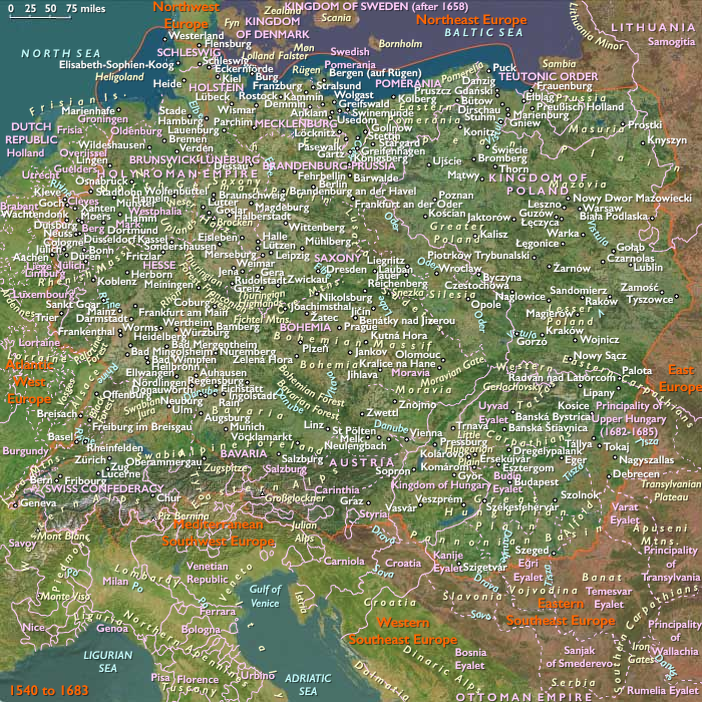
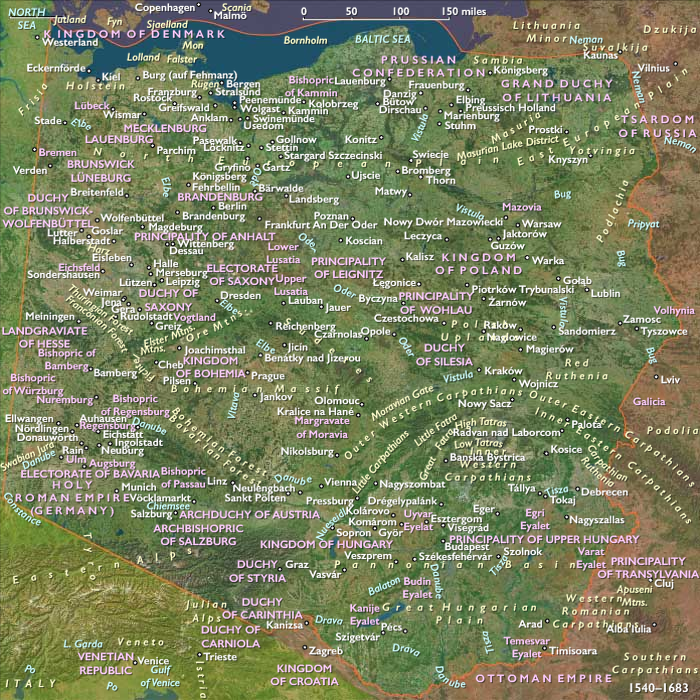
In 1618 Bohemian nobles oppose the decision of Emperor Matthias (r. 1608-19) to designate his Catholic cousin Ferdinand king of Bohemia.
Instead, the nobles elect Frederick of the Palatinate, a German Calvinist, to be their king.
In 1620, in an attempt to wrest control from the nobles, imperial armies and the Catholic League under General Johann von Tilly defeat the Protestant Bohemians at the Battle of White Mountain near Prague.
The Protestant princes, alarmed by the strength of the Catholic League and the possibility of Roman Catholic supremacy in Europe, decide to renew their struggle against Emperor Matthias.
They are aided by France, which, although Roman Catholic, is opposed to the increasing power of the Habsburgs, the dynastic family to which Matthias and Ferdinand belong.
Despite French aid, by the late 1620s imperial armies of Emperor Ferdinand II (r. 1619-37) and the Catholic League, under the supreme command of General Albrecht von Wallenstein, have defeated the Protestants and secured a foothold in northern Germany.
People
- Albrecht von Wallenstein
- Ferdinand II
- Frederick V, Elector Palatine
- Johann Tserclaes, Count of Tilly
- Matthias
Groups
- Germans
- Papal States (Republic of St. Peter)
- Mainz, Electoral Archbishopric of
- Christians, Roman Catholic
- Trier, Electoral Archbishop of
- Bohemia, Kingdom of
- Holy Roman Empire
- Cologne, Electorate of
- Palatinate, Electoral (Wittelsbach)
- Brandenburg, (Hohenzollern) Margravate of
- Bavaria, Wittelsbach Duchy of
- Lutheranism
- Protestantism
- Calvinists
- Protestant League (League of Evangelical Union)
- Catholic League, the (German)
Topics
- Protestant Reformation
- Counter-Reformation (also Catholic Reformation or Catholic Revival)
- Thirty Years' War
- White Mountain, Battle of
Subjects
Regions
Subregions
Years: 1540 - 1683
People
- Albrecht von Wallenstein
- Ferdinand II
- Frederick V, Elector Palatine
- Johann Tserclaes, Count of Tilly
- Matthias
Groups
- Germans
- Papal States (Republic of St. Peter)
- Mainz, Electoral Archbishopric of
- Christians, Roman Catholic
- Trier, Electoral Archbishop of
- Bohemia, Kingdom of
- Holy Roman Empire
- Cologne, Electorate of
- Palatinate, Electoral (Wittelsbach)
- Brandenburg, (Hohenzollern) Margravate of
- Bavaria, Wittelsbach Duchy of
- Lutheranism
- Protestantism
- Calvinists
- Protestant League (League of Evangelical Union)
- Catholic League, the (German)
Topics
- Protestant Reformation
- Counter-Reformation (also Catholic Reformation or Catholic Revival)
- Thirty Years' War
- White Mountain, Battle of
Subjects
Regions
Subregions