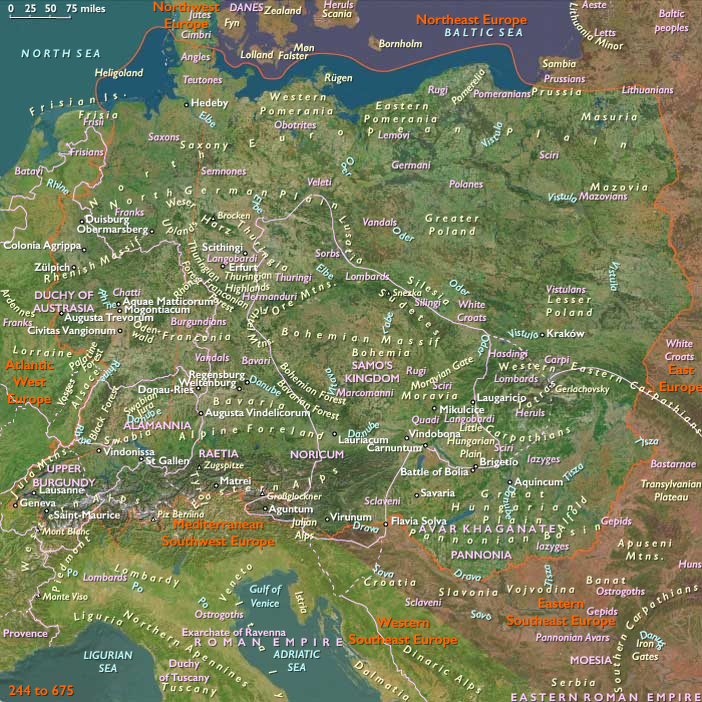
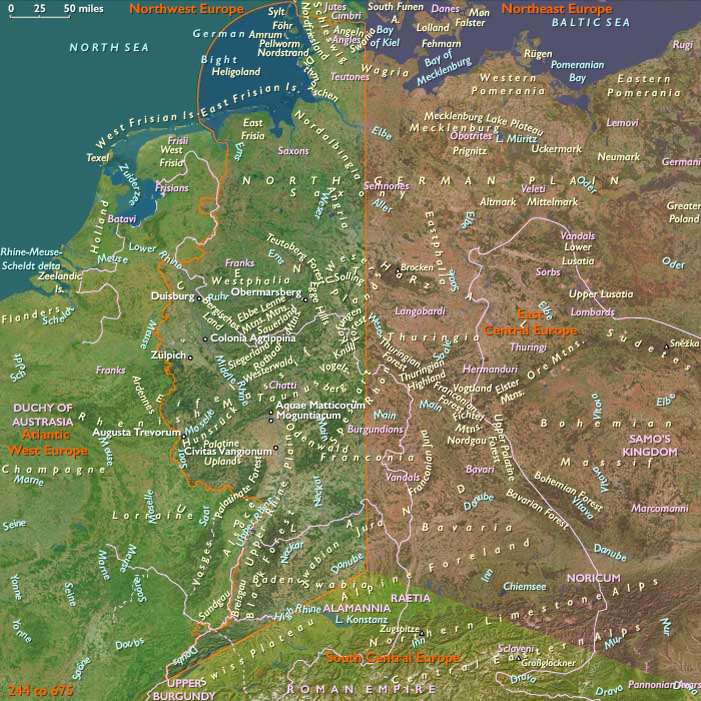
The Ripuarian Franks control Trier by about …
Years: 470 - 470
The Ripuarian Franks control Trier by about 470.
Locations
Groups
- Franks
- Gallia Belgica (Roman province)
- Gaul, Diocese of
- Gaul, Praetorian prefecture of
- Roman Empire, Western (Ravenna)
- Francia (Merovingians)
Topics
Subjects
Regions
Subregions
Related Events
Filter results
Showing 10 events out of 17 total
Alfonso issues the Sandhurst Manifesto, in which he sets the ideological basis of the Bourbonic Restoration, on December 1, 1874.
It is drafted in reply to a birthday greeting from his followers, a manifesto proclaiming himself the sole representative of the Spanish monarchy.
Brigadier General Arsenio Martínez Campos, who has long been working more or less openly for the king, leads some battalions of the central army to Sagunto when Field Marshal Serrano leaves Madrid to take command of the northern army in the Carlist War at the end of 1874, rallies to his own flag the troops sent against him, and enters Valencia in the king's name.
Thereupon the President resigns, and his power is transferred to the king's plenipotentiary and adviser, conservative politician Antonio Cánovas del Castillo.
The December 29, 1874, military coup of Martinez Campos in Sagunto ends the failed republic and enables the rise of the young Prince Alfonso.
Aresenio Martínez-Campos has taken command of Alfonso's forces against the Carlists and has made the fighting less brutal by signing agreements protecting the lives of the wounded and prisoners.
King Alfonso XII, who returns in early January, brings peace to a nation exhausted by civil conflicts, fear of revolution, and electoral manipulation, and will leave politics in the hands of his premiers, beginning with Antonio Cánovas del Castillo.
The protracted war has a profound effect on Cubans.
Many Creoles fight in parts of the island they had never even seen before.
Gradually, regionalism collapses and a common cause emerges; the little homeland (patria chica), with its stress on local loyalties, gives way to the fatherland.
The war also forces many to take sides on issues, thus accelerating the process of popular participation and integration.
Finally, the war provides numerous symbols that become part of Cuba's historical heritage.
The national anthem and flag as well as the national weapon, the machete, come out of this war.
In particular, the dedication of the mambises, who abandon position and comfort to fight Spanish power, become for future generations an example of unselfish sacrifice for the fatherland.
The war in Cuba has dragged on, with neither the Cubans nor the Spaniards able to win a decisive victory.
Finally, on February 11, 1878, the Pact of Zanjon ends the Ten Years' War.
Most of the generals of the Cuban army accept the pact; Maceo, however, refuses to capitulate and continues to fight with his now depleted army
On March 15, 1878, he holds a historic meeting, known as the "Protest of Baragua," with the head of the Spanish forces, Marshal Arsenio Martinez Campos, requesting independence for Cuba and complete abolition of slavery.
When these conditions are rejected, he again resumes fighting.
It is, however, a futile effort.
Years of bloodshed and war have left the Cuban forces exhausted.
Aid from exiles decreases, and Maceo now faces the bulk of the Spanish forces alone.
Realizing the hopeless situation, he leaves for Jamaica.
From there he travels to New York to raise money and weapons necessary to continue fighting.
He soon joins he activities of Major General Calixto Garcia, now organizing a new rebellion.
This uprising in 1879-80, known as the Little War (La Guerra Chiquita), will also end in disaster.
Maceo is kept in exile for fear of antagonizing the conservative elements in Cuba, and Garcia is captured soon after he lands on the island.
Exhausted and disillusioned after the long, bitter strug-gle and faced with a powerful and determined Spain, the Cubans ae in no mood to join this new and ill-prepared attempt.
The Cubans, after more than ten years of strife, are unable to overthrow Spanish power on the island.
The reasons for this failure are to be found partially in internal dissension, regionalism, and petty jealousies among the leaders, and partially in lack of internal organization and external support, which results in chronic shortages of supplies and ammunition.
The odds against the Cubans are also almost insurmountable.
They are fighting well-disciplined, well-organized, and well-equipped forces augmented steadily by reinforcements from Spain.
The Spaniards also control the seas, preventing the smuggling of reinforcements and weapons from abroad.
The Cubans are thus forced to carry on guerrilla operations in the hope of demoralizing the Spanish army or creating an international situation favorable to their cause.
The impact of the Ten Years War is particularly felt in the economic realm.
The destruction caused by the fighting does away with the fortunes of many Cuban families.
Although the struggle is concentrated in eastern Cuba and many sugar plantations escape the ravages of war, the continuous development of a landed slavocracy in Cuba suffers a severe blow.
Numerous participants and sympathizers with the Cuban cause lose their properties.
Most Peninsulars side with Spain, and many estates pass from Creole to loyalist hands.
Because they have backed the Spanish cause, some Creole loyalists also profit from the losses of their brethren.
The growth and power of the Creole propertied class id further undermined in 1886 with the abolition of slavery.
The sophisticated and prosperous sugar industry in Cuba has long employed chattel slavery to produce 720,250 metric tons of sugar in 1868, more than forty percent of cane sugar reaching the world market that year.
Slavery had been maintained in Cuba, however, while abolition was underway elsewhere.
Independence from Spain had been the motive for the rebellion led by Carlos Manuel de Céspedes, a sugar planter, who had freed his slaves to fight with him for a free Cuba.
On December 27, 1868, he had issued a decree condemning slavery in theory but accepting it in practice and declaring free any slaves whose masters present them for military service.
The result of the rebellion has been a prolonged conflict known as the Ten Years' War.
The two thousand Cuban Chinese have joined the rebels.
The United States has declined to recognize the new Cuban government, although many European and Latin American nations have done so.
Following the end of the third Carlist civil war in 1876, Spain had dispatched additional troops to Cuba until they number more than two hundred and fifty thousand.
The impact of the Spanish measures on the liberation forces is severe.
Neither side in the war has been able to win a single concrete victory, let alone crush the opposing side to win the war.
After almost two years, General Arsenio Martínez Campos, in charge of applying the new policy, finally convinces most of the rebels to accept the Pact of Zanjón on February 10, 1878, signed by a negotiating committee.
The document contains most of the promises made by Spain, pledging various reforms throughout the island that will improve the financial situation of Cuba.
Perhaps the most significant is the pledge to free all slaves who had fought Spain.
A major conflict throughout the war has been the desire of both the rebels and the people loyal to Spain to abolish slavery.
The Maceo brothers refuse to sign the treaty and continue fighting until they take to exile to return later.
Calixto Garcia is released from Spanish prison.

The rebellion in Cuba has made difficulties for all governments in power in Spain after 1868 and forced abandonment of the most popular of the pledges made by the rebels between 1868 and 1878: the abolition of the arbitrary and socially selective recruitment system.
Like the Carlist Wars, the Cuban War tends to favor the monarchical reaction.
Martínez Campos applies his humane policy in Cuba, ending the Ten Years' War by the Convention of El Zanjón (February 1878), in which Spain promises amnesty and political reform.
The Cortes accepts a new constitution, a compromise between those of 1845 and 1869.
Years: 470 - 470
Locations
Groups
- Franks
- Gallia Belgica (Roman province)
- Gaul, Diocese of
- Gaul, Praetorian prefecture of
- Roman Empire, Western (Ravenna)
- Francia (Merovingians)