
Bunei, the son of Chuzan’s longtime king, …
Years: 1403 - 1403
Bunei, the son of Chuzan’s longtime king, Satto, had succeeded his father in 1395, and has overseen the continuation of the policies and developments of his father's reign.
Relations with China have grown stronger, and a number of institutions have been established to cater to Chinese envoys to Chūzan.
Trade is booming, and relations with other countries have likewise continued to expand.
Although China accepts tributary missions from Hokuzan and Nanzan as well at this time, they officially recognize only the King of Chūzan as a head of state in Ryukyu.
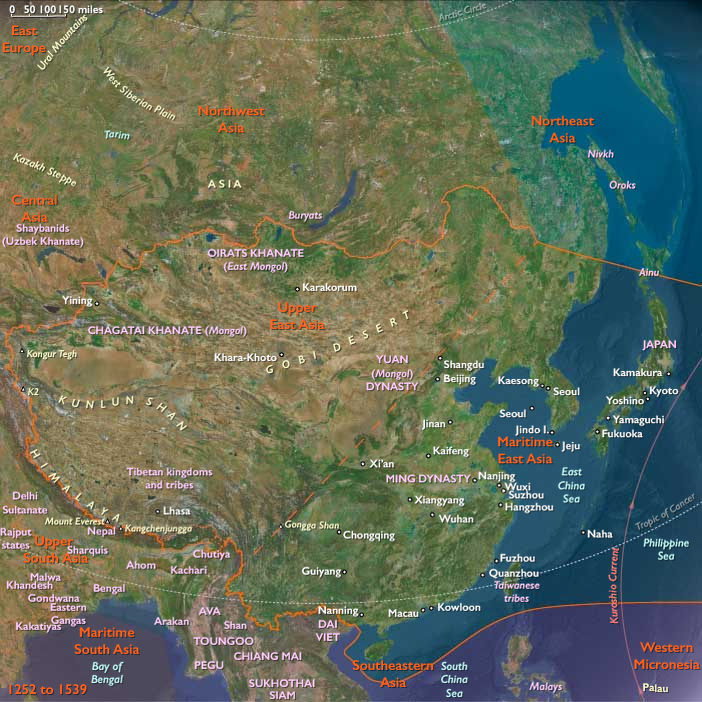
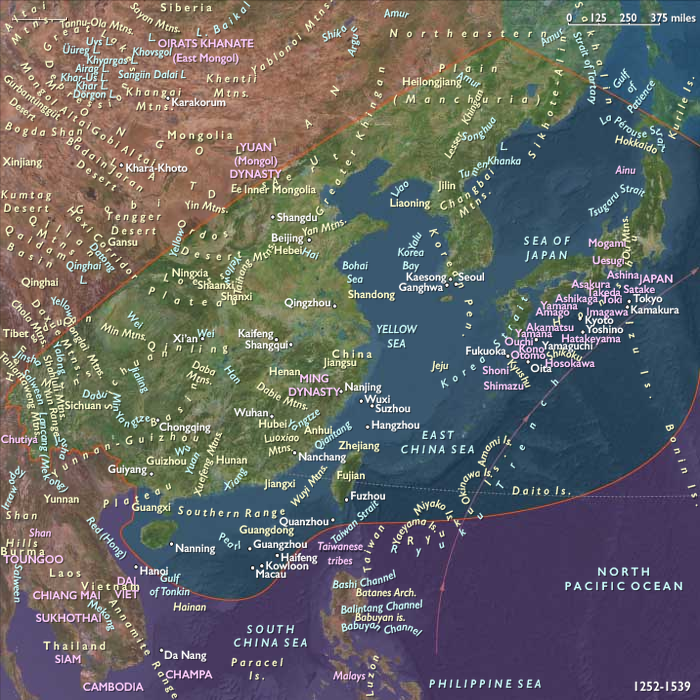
Chūzan continues to enjoy formal diplomatic relations with Ayutthaya and Korea, and trade relations with Java, Sumatra, and other states, as do the other two Ryukyuan kingdoms.
However, only Chūzan has managed to establish formal relations with Japan's Ashikaga shogunate, having sent a mission in 1403.
These political advantages, coupled with control of Naha, the most active port on Okinawa, have allowed Chūzan to gain significant political and economic superiority over its two neighbors.
It has also benefited greatly culturally; trade always brings cultural exchange along with it, and many of the states in the region have experiences great cultural surges as a result.
In particular, it is believed that Buddhism from Korea and Shintō from Japan are first introduced to Okinawa to a significant extent at this time.
Students and other travelers to Korea have returned with texts, statues, rituals, and other Buddhist objects and ideas, and in exchange, King Bunei has promised to send shipwrecked Koreans, and those who have been the victims of Japanese pirates (wakō), back home safely.
Domestically, Bunei's reign has seen significant development in the organization and formalization of the royal administration, and increased literacy and education among the administrative officials.
Government documents, particularly those concerning trade and diplomacy, are first compiled in 1403.
However, this increased organization has not been accompanied by political stability; the kings of Nanzan and Hokuzan, along with the emperor of China, had all died between 1395 and 1398.
These events have heightened tensions between the three kingdoms, all of which seek the favor of the Ming court, which has largely been unresponsive.
As a result of these political instabilities, the anji (local territorial lords) have begun to seize more power for themselves within their tiny local domains.
Locations
People
Groups
- Buddhism
- Shinto
- Japanese people
- Nanzan, Kingdom of
- Hokuzan, Kingdom of
- Chuzan, Kingdom of
- Japan, Muromachi Period
- Ayutthaya (Siam), Thai state of
- Chinese Empire, Ming Dynasty
- Joseon (Yi) kingdom of
Subjects
Regions
Subregions
Years: 1403 - 1403
Locations
People
Groups
- Buddhism
- Shinto
- Japanese people
- Nanzan, Kingdom of
- Hokuzan, Kingdom of
- Chuzan, Kingdom of
- Japan, Muromachi Period
- Ayutthaya (Siam), Thai state of
- Chinese Empire, Ming Dynasty
- Joseon (Yi) kingdom of
Subjects
Regions
Subregions