
Buddhism had long since splintered into different …
Years: 106 - 106
Buddhism had long since splintered into different schools by the time of the Fourth Buddhist councils.
The Theravada tradition had had a Fourth Buddhist Council in 29 BCE in Tambapanni, i.e.
Sri Lanka, under the patronage of King Vattagamani.
It is said to have been devoted to committing the entire Pali Canon to writing, which had previously been preserved by memory.
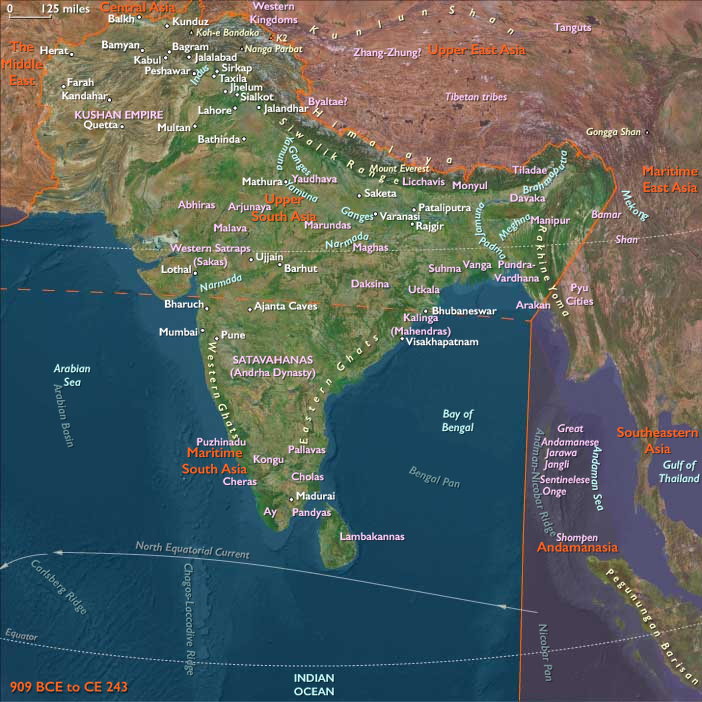
Another Fourth Buddhist Council is held in the Sarvastivada tradition, said to have been convened by the Kushan emperor Kanishka, around 100 CE at Jalandhar or in Kashmir.
The Fourth Council of Kashmir is not recognized as authoritative in Theravada; reports of this council can be found scriptures which were kept in the Mahayana tradition.
It is said that Kanishka gathered five hundred Bhikkhus in Kashmir, headed by Vasumitra, to systematize the Sarvastivadin Adhidharma texts, which were translated form earlier Prakrit vernacular languages (such as Gandhari in Kharosthi script) into the classical language of Sanskrit.
It is said that during the council three hundred thousand verses and over nine million statements were compiled, a process which took twelve years to complete.
Although the Sarvastivada are no longer extant as an independent school, its traditions would be inherited by the Mahayana tradition.
The late Monseigneur Professor Etienne Lamotte, an eminent Buddhologist, held that Kanishka's Council was fictitious.
However, David Snellgrove, another eminent Buddhologist, considers the Theravada account of the Third Council and the Sarvastivada account of the Fourth Council "equally tendentious," illustrating the uncertain veracity of much of these histories.
Locations
Groups
Topics
Subjects
Regions
Subregions

Years: 106 - 106
Locations
Groups
Topics
Subjects
Regions
Subregions