
The Sui Period, named for the native …
Years: 580 - 591
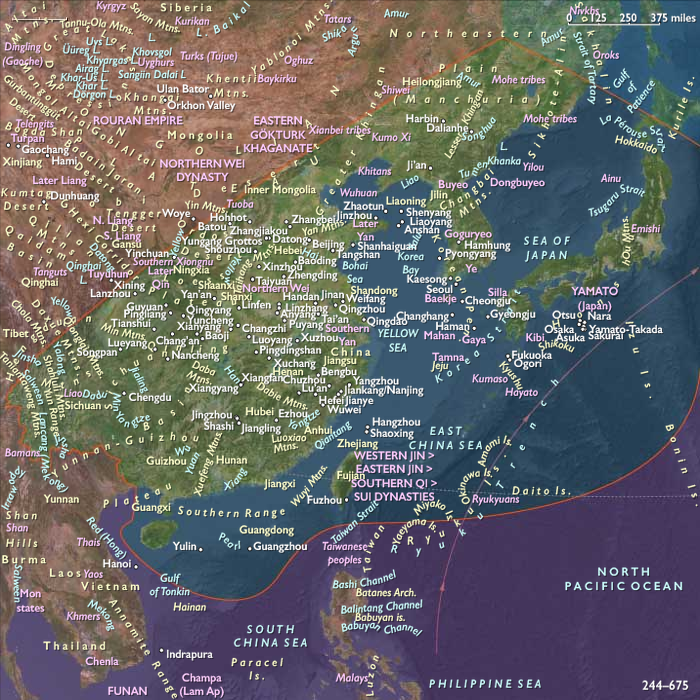
The Sui Period, named for the native Sui Dynasty, sees order reestablished in China.
Sui Wen Di directs several large construction projects, such as repair of the Great Wall and a canal system linking the fertile central region with the northern plain.
The Sui dynasty reintroduces civil service examinations according to the Confucianist philosophy.
Groups
Topics
Commodoties
Subjects
Regions

Subregions
Related Events
Filter results
Showing 10 events out of 57370 total
Cham king Sambhuvarman, seeing an opportunity in the anarchic conditions obtaining under China’s new Sui dynasty, ends Champa’s subjugation to the Chinese, but, when confronted by the newly vigorous empire and its soldiers, renews tribute payments to the empire.
The Soga intermarry with the imperial family and by 587 Soga Umako, the Soga chieftain, is powerful enough to install his nephew as emperor and later to assassinate him and replace him with the Empress Suiko.
Suiko, the first of eight sovereign empresses, is merely a figurehead for Umako and Prince Regent Shotoku Taishi (574-622).
Shotoku, recognized as a great intellectual of this period of reform, is a devout Buddhist well-read in Chinese literature.
He is influenced by Confucian principles, including the Mandate of Heaven, which suggests that the sovereign rules at the will of a supreme force.
Under Shotoku 's direction, Confucian models of rank and etiquette are adopted, and his Seventeen Article Constitution (Kenpojushichijd) prescribes ways to bring harmony to a society chaotic in Confucian terms.
In addition, Shotoku adopts the Chinese calendar, develops a system of highways, builds numerous Buddhist temples, has court chronicles compiled, sends students to China to study Buddhism and Confucianism, and establishes formal diplomatic relations with China.
Buddhism becomes firmly established in Japan.
The alliances between Japan and Korea break down in the latter part of the sixth century, but the influence leads to the codification of Shinto as the native religion in opposition to the extreme outside influences of the mainland.
Shinto up to this time has been largely a clan ('uji') based religious practice, exclusive to each clan.
The Göktürk civil war (or Turkic interregnum), an important crisis in Central Asia during the 580s, results in the split of the Göktürk Khaganate and the creation of separate western and eastern khaganates.
The First Perso-Turkic War, fought during 588-589 between the Sassanid Persians and Hephthalite principalities and its suzerain, the Göktürks, starts with the invasion of the Persian Empire by the Turks and ends with a decisive Sassanid victory and the conquest of the Eastern Turks.
East Central Europe (580–591 CE): Expansion of the Avar Khaganate, Emergence of Bohemia and Moravia, and Continued Slavic Consolidation
Between 580 and 591 CE, East Central Europe—encompassing Poland, Czechia, Slovakia, Hungary, and those portions of Germany and Austria lying east of 10°E and north of a line stretching from roughly 48.2°N at 10°E southeastward to the Austro-Slovenian border near 46.7°N, 15.4°E—experienced significant political consolidation and cultural differentiation. The Avar Khaganate reached the zenith of its early expansion, exerting profound influence over the Carpathian Basin and its surrounding territories. Concurrently, the historical regions of Bohemia and Moravia began clearly emerging as distinct geopolitical and cultural entities, predominantly inhabited by Slavic tribes. This era also saw continued consolidation and differentiation of Slavic communities across the region, firmly establishing distinct cultural identities and laying the groundwork for future medieval states.
Political and Military Developments
Avar Expansion and Regional Dominance
-
Under aggressive leadership, the Avar Khaganate expanded significantly, achieving dominance over most territories previously held by Germanic tribes. They firmly controlled the Carpathian Basin, extending their influence northward and westward, pressuring both Bavarian and emerging Slavic territories.
Emergence of Bohemia and Moravia
-
In the territories of modern Czechia and Slovakia, two distinct Slavic political and cultural centers began taking form:
-
Bohemia emerged clearly as a regional entity, inhabited primarily by early West Slavic tribes—ancestors of the later Czech people—who established stable settlements, fortified strongholds, and structured communities within its basin region.
-
To its east, Moravia also began to emerge as a distinct territorial entity, similarly settled by West Slavic communities. Moravia soon became strategically important, serving as a frontier territory interacting closely with both Avars to the south and Bavarians to the west.
-
Bavarian–Moravian–Avar Interactions
-
The Bavarians (Baiuvarii) increasingly interacted diplomatically, commercially, and occasionally militarily with emerging Moravian Slavic groups and the Avars, navigating complex relationships between Frankish dominance in the west and Avar pressures in the east.
Economic and Technological Developments
Expansion of Regional Trade Networks
-
Bohemia and Moravia became crucial nodes in expanding regional trade networks, linking the Avar-controlled south and east, Bavarian-controlled west, and emerging Slavic territories to the north. Trade routes notably increased in significance, transporting goods like metals, furs, amber, and agricultural products.
Continued Avar Infrastructure Development
-
The Avars maintained and enhanced existing infrastructure, including roads, fortifications, and strategically positioned settlements that improved trade, military mobility, and regional administration.
Cultural and Artistic Developments
Bohemian and Moravian Cultural Differentiation
-
Distinctive West Slavic cultural identities clearly formed in Bohemia and Moravia, marked by unique settlement patterns, ceramics, burial customs, and emerging local traditions, clearly distinguishable archaeologically.
Avar Cultural Influence
-
The Avars continued introducing steppe-influenced cultural expressions into East Central Europe, visibly impacting regional art and craftsmanship, particularly in metallurgy and jewelry-making.
Settlement and Urban Development
Consolidation of Bohemian and Moravian Settlements
-
Bohemia and Moravia saw significant growth of fortified settlements and stable agricultural villages, reflecting increasing social organization and political cohesion among early West Slavic populations.
Avar-Dominated Urban Centers
-
Important regional settlements such as Augusta Vindelicorum (Augsburg), Vindobona, and Aquincum remained crucial administrative, military, and economic hubs under firm Avar control.
Social and Religious Developments
West Slavic Social Organization
-
In Bohemia and Moravia, early Slavic societies developed clearer hierarchical structures, including tribal leaders, warrior elites, and communal decision-making practices. These communities laid the foundations for future regional polities and medieval duchies.
Avar Hierarchical Structures
-
The Avars maintained highly structured hierarchical societies, centered around their Khagan and military elites, further consolidating their hold over extensive territories and diverse populations.
Long-Term Consequences and Historical Significance
The era 580–591 CE represented a crucial formative period in East Central European history. The emergence of distinct Slavic entities—Bohemia and Moravia—significantly reshaped regional dynamics, creating stable demographic and political foundations for future medieval states. Simultaneously, the expansive power of the Avar Khaganate continued shaping the geopolitical landscape, influencing cultural interactions, settlement patterns, and regional economic development. The interactions among Bavarians, Moravians, Bohemians, and Avars set enduring historical patterns that profoundly impacted the future of East Central Europe.
Eastern Southeast Europe (580–591 CE): Resilience Amidst Heightened Challenges
Settlement and Migration Patterns
Increased Migration Pressures
Between 580 and 591 CE, Eastern Southeast Europe experienced heightened migratory pressures from various groups, notably the Slavs and Avars. These migrations intensified regional demographic shifts and necessitated further strategic adjustments in settlement planning and urban fortifications.
Robust Urban Adaptations
Cities such as Constantinople, Philippopolis, Adrianople, and Serdica enhanced their defensive capabilities significantly in response to external threats. Increased fortifications and reinforced urban infrastructure supported effective management of new migratory influxes.
Economic and Technological Developments
Sustained Economic Resilience
Despite increased external pressures, the regional economy maintained resilience. Stable agricultural production and active trade routes, primarily anchored by Constantinople, ensured ongoing regional economic stability and resource availability.
Advanced Defensive Innovations
Technological developments continued emphasizing military fortifications, advanced defensive strategies, and enhanced logistics. These innovations reinforced security and contributed to maintaining economic continuity amid heightened external pressures.
Cultural and Artistic Developments
Cultural Persistence
Cultural activities maintained vibrancy, reflecting the resilience of societal traditions. Artistic endeavors continued integrating classical and Christian themes, emphasizing community cohesion and regional identity amid challenging times.
Intellectual Continuity
Educational and intellectual institutions remained robust, actively preserving and promoting classical and theological knowledge. Scholarly activity adapted effectively to changing conditions, ensuring intellectual vitality and cultural continuity.
Social and Religious Developments
Effective Provincial Administration
Administrative systems continued adapting efficiently to external challenges, enhancing local governance, civic management, and defense coordination. Provincial governance played a crucial role in ensuring societal stability and effective resource distribution.
Deepening Role of Christianity
Christianity's societal role deepened significantly, with religious institutions becoming crucial centers for community support and resilience. Churches and monastic communities further expanded their societal influence, enhancing social cohesion and communal solidarity.
Long-Term Consequences and Historical Significance
The period from 580 to 591 CE represented a critical phase of resilience amidst heightened migratory challenges. Sustained economic stability, enhanced urban defenses, and robust cultural and administrative adaptability significantly influenced Eastern Southeast Europe's ability to effectively manage external pressures and maintain historical continuity
The Second Major Wave of the Plague (588 CE): Devastation in the Frankish Kingdom and the Mediterranean
In 588 CE, a second major wave of plague spreads across the Mediterranean and into Gaul (modern-day France), echoing the Plague of Justinian (541–542 CE). This pandemic causes widespread mortality, economic collapse, and political instability, further weakening the already fragmented Merovingian Frankish kingdoms.
1. The Scale of the Epidemic
- The estimated death toll reaches up to twenty-five million, making this one of the most catastrophic outbreaks in early medieval Europe.
- The plague follows trade and military routes, devastating coastal cities and riverine settlements first before spreading inland.
- Areas most affected include:
- Byzantine territories in Italy, North Africa, and Spain
- Frankish Gaul, particularly cities with strong Mediterranean connections
2. Impact on Frankish Gaul
- The epidemic weakens the Frankish economy, as major trade centers experience population collapse.
- Nobles and clergy succumb to the plague, causing disruptions in administration and Church leadership.
- Peasant populations decline, exacerbating labor shortages and hastening the transition to a more localized, feudal economy.
- Chroniclers such as Gregory of Tours note that entire towns and villages were depopulated, further fragmenting Frankish political power.
3. The Plague’s Role in Medieval History
- This second wave of bubonic plague is part of the longer Justinianic Plague cycle, which persists in waves until the 8th century.
- The devastation contributes to the continued decline of Mediterranean urban centers, reinforcing the transition to rural economies and decentralized power.
- The loss of manpower and resources weakens both the Frankish Kingdom and the Byzantine Empire, setting the stage for later power shifts in Europe and the Middle East.
Conclusion: A Pandemic That Reshapes Western Europe
The 588 CE plague wave is one of the deadliest outbreaks in early medieval history, decimating populations, crippling economies, and accelerating the political transformation of post-Roman Europe. The epidemic’s role in the fragmentation of Merovingian Gaul and the long-term decline of Mediterranean trade marks it as a pivotal event in the shaping of medieval Western civilization.
The Middle East: 580–591 CE
The Byzantine–Sassanian War and Cultural Developments
Prolonged Imperial Conflict
From 580 to 591 CE, the conflict between the Eastern Roman Empire (Byzantine Empire) and the Sassanian Empire of Persia, known as the Byzantine–Sassanian War (572–591), continues with relentless intensity. This war forms part of a broader pattern of hostilities spanning the sixth and early seventh centuries, notable for battles largely confined to frontier regions including Mesopotamia, Greater Armenia, and Syria. Despite continuous military engagements, neither empire manages to sustain a decisive hold over territories deep within enemy lines, marking this era as the final stage of relatively restricted frontier warfare before wider-ranging conflicts emerge in the subsequent decades.
Treaty and Territorial Realignments
The long conflict culminates with the restoration of the Persian king Khosrau II to his throne in 591 CE. In return for the crucial support from Constantinople, Khosrau II cedes most of Persian-controlled Armenia and the western half of Caucasian Iberia to the Byzantines. This significant territorial realignment stabilizes the region temporarily, reestablishing spheres of influence that would profoundly shape subsequent political and military interactions.
Cultural Achievements Amid Turbulence
Remarkably, the period witnesses minimal artistic production due to sustained instability and warfare. Nevertheless, one significant cultural artifact survives: the Rabula Gospels, an illuminated manuscript completed in 586 CE at Zagba in Syria. Distinguished by its elaborate architectural and floral motifs, the manuscript exemplifies a vibrant yet sketchy, informal style characteristic of early Byzantine illuminated manuscripts—rare survivors of this turbulent era.
Ghassanid Influence and Cultural Patronage
Amidst imperial conflicts, the Ghassanids, Arab allies of Constantinople, continue to prosper culturally and economically. They engage in substantial religious and public construction and actively patronize poets such as Nabighah adh-Dhubyani and Hassan ibn Thabit. Nonetheless, their Monophysite beliefs draw suspicion from orthodox Byzantine leaders, resulting in reduced autonomy and direct imperial intervention. This cultural and religious friction underscores the complex interplay of local autonomy and imperial control characteristic of the region during this transformative period.
Years: 580 - 591
Groups
Topics
Commodoties
Subjects
Regions
Subregions