
Buckingham had directed the marriage negotiations, but …
Years: 1624 - 1624
September
Buckingham had directed the marriage negotiations, but when Charles’s betrothal to Henrietta Maria of France is announced in 1624, the choice of a Catholic is widely condemned.
Locations
People
Groups
- Christians, Roman Catholic
- Protestantism
- Huguenots (the “Reformed”)
- Spain, Habsburg Kingdom of
- France, (Bourbon) Kingdom of
- England, (Stuart) Kingdom of
- Habsburg Monarchy, or Empire
Topics
- Protestant Reformation
- Counter-Reformation (also Catholic Reformation or Catholic Revival)
- England: Famine of 1623-24
Subjects
Regions
Subregions
Related Events
Filter results
Showing 10 events out of 32911 total
The "Christian problem" is, in effect, a problem in control- ling both the Christian daimyo in Kyushu and trade with the Europeans.
By 1612 the shogun's retainers and residents of Tokugawa lands have been ordered to foreswear Christianity.
More restrictions come in 1616 (the restriction of foreign trade to Nagasaki and Hirado, an island northwest of Kyushu), 1622 (the execution of one hundred and twenty missionaries and converts), 1624 (the expulsion of the Spanish), and 1629 (the execution of thousands of Christians).
Finally, in 1635, an edict prohibits any Japanese from traveling outside Japan or, if someone leaves, from ever returning.
In 1636 the Portuguese are restricted to Deshima, a man-made islet—and thus, not true Japanese soil—in Nagasaki's harbor.
Opium, taken orally to relieve tension and pain, is used in limited quantities until the seventeenth century, when the Native American practice of smoking tobacco in pipes spreads from North America to China.
The Portuguese, eager for a commodity to barter for Chinese silks, import tobacco from their Brazilian colony halfway around the world.
The Chinese frustrate the Portuguese by growing their own tobacco, but the pipe itself, which had been introduced by the Spanish, turns out to be the key to China's markets.
Some smokers begin to mix Indian opium with tobacco in their pipes, and smoking gradually becomes the preferred method of taking opium, as the effects are instantaneous.
The Portuguese, while trading along the East China Sea, introduce opium smoking into China from Java in the seventeenth century; the practice spreads rapidly.
The Chinese authorities, viewing the practice barbaric and subversive, react by prohibiting the sale of opium, but these edicts are largely ignored.
Portuguese merchants carrying cargoes of Indian opium through Macao direct its trade flow into China.
East Europe (1624–1635 CE): Consolidation under the Early Romanovs
Political and Military Developments
Stabilization and Governance Reforms
Between 1624 and 1635 CE, the Romanov dynasty continued to consolidate political control and administrative stability. Tsar Michael Romanov's governance was marked by methodical reforms aimed at enhancing efficiency, reducing corruption, and centralizing authority.
Diplomatic Engagements and Regional Peace
Muscovy maintained careful diplomatic relations with its neighbors, particularly Poland-Lithuania and Sweden, aiming to avoid renewed hostilities. Strategic marriages and treaties supported regional peace and Muscovite sovereignty.
Military Preparedness and Border Security
Muscovy prioritized military preparedness, continuing to enhance border defenses and fortifications. Military tactics evolved, reflecting the necessity for preparedness against potential threats, and further solidifying territorial integrity.
Economic and Technological Developments
Economic Stability and Growth
The economy continued its recovery, bolstered by renewed trade and commerce. Urban centers, notably Moscow and key trade cities, experienced steady growth and economic prosperity due to stable governance and efficient management of resources.
Technological and Infrastructure Development
Technological advancements persisted, particularly in military infrastructure and urban development. Enhanced fortification construction and improvements in transportation infrastructure supported trade and security.
Cultural and Artistic Developments
Continued Cultural Flourishing
Cultural and artistic patronage by the Romanov dynasty facilitated ongoing developments in architecture, religious art, and secular cultural expressions. Muscovy’s cultural identity strengthened through significant creative achievements.
Intellectual and Literary Contributions
Intellectual and literary activities remained robust, with chroniclers and scholars extensively documenting political developments, social changes, and cultural achievements, thus reinforcing historical consciousness and regional identity.
Settlement Patterns and Urban Development
Urban Expansion and Development
Cities continued to grow and expand, supported by systematic urban planning, improved infrastructure, and enhanced administrative oversight. Moscow and other major urban areas experienced increased population growth and economic activity.
Enhanced Fortifications and Urban Security
Continued improvements in urban fortifications ensured robust defenses, providing essential security and stability amidst regional diplomatic and military dynamics.
Social and Religious Developments
Strengthening Social Cohesion
Societal cohesion improved as administrative reforms facilitated more effective governance. The integration of diverse ethnic communities remained a priority, enhancing administrative unity and social harmony.
Orthodox Church’s Enduring Influence
The Orthodox Church continued to play a pivotal societal role, influencing education, social values, and community cohesion, thus significantly contributing to overall stability and cultural continuity.
Long-Term Consequences and Historical Significance
The era from 1624 to 1635 CE saw significant consolidation under the early Romanovs, marked by political stabilization, economic prosperity, and cultural achievements. These developments provided essential groundwork for the long-term growth, governance effectiveness, and cultural enrichment of the Russian state.
The immediate task of the new dynasty is to restore order.
Fortunately for Muscovy, its major enemies, Poland and Sweden, are engaged in a bitter conflict with each other, which provides Muscovy the opportunity to make peace with Sweden in 1617 and to sign a truce with Poland in 1619.
After an unsuccessful attempt to regain the city of Smolensk from Poland in 1632, Muscovy makes peace with Poland in 1634.
Polish king Wladyslaw IV, whose father and predecessor Sigismund III had manipulated his nominal selection as tsar of Muscovy during the Time of Troubles, renounces all claims to the title as a condition of the peace treaty.
Northeast Europe (1636–1647 CE): Swedish Military Dominance, Diplomatic Realignments, and Cultural Flourishing
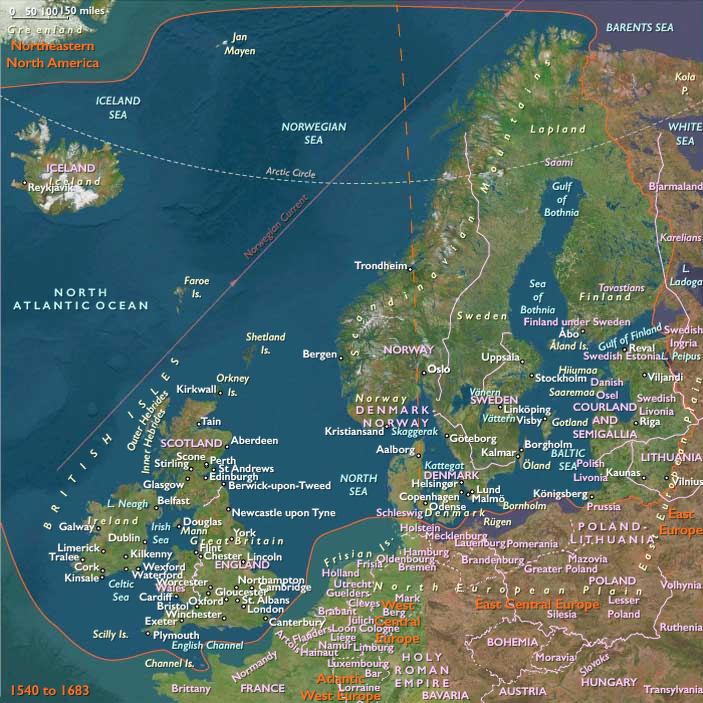
Between 1636 and 1647 CE, Northeast Europe experienced significant geopolitical changes, marked by Sweden’s military ascendancy during the latter stages of the Thirty Years’ War, shifting diplomatic alliances, economic resilience, and substantial cultural and intellectual advancements. Under the dynamic leadership of Queen Christina of Sweden and her influential chancellor, Axel Oxenstierna, Sweden emerged prominently as a leading European power.
Swedish Military Ascendancy in the Thirty Years’ War
Under the rule of the young Queen Christina (r. 1632–1654), guided by Chancellor Axel Oxenstierna, Sweden solidified its military dominance in Northern Europe. Swedish forces secured crucial victories in northern Germany, significantly altering regional geopolitics and asserting Sweden's influence beyond the Baltic. Strategic victories, notably at the Battle of Wittstock in 1636, reinforced Sweden’s continental position, despite ongoing logistical and financial pressures of extended warfare.
Diplomatic Realignments and Alliance Management
Amid shifting military fortunes, intricate diplomatic negotiations shaped Northeast Europe's political landscape. Sweden managed complex alliances within the Protestant coalition, engaging actively with France against the Habsburg Empire. These diplomatic efforts, led effectively by Oxenstierna, helped preserve and strengthen Swedish influence while navigating the shifting allegiances of various German principalities.
Denmark–Norway’s Strategic Neutrality and Economic Strength
King Christian IV of Denmark–Norway maintained cautious neutrality following earlier involvement in the Thirty Years' War. Leveraging stable diplomatic ties, Denmark–Norway strengthened internal governance, economic growth, and military readiness. Despite neutrality, Danish–Swedish tensions persisted, rooted deeply in competing Baltic territorial ambitions and historical rivalries.
Stability and Diplomatic Prudence in Prussia
Under Elector George William (r. 1619–1640), succeeded by Frederick William (the "Great Elector") in 1640, Brandenburg-Prussia adopted a cautious diplomatic approach during the latter stages of the war. Prioritizing internal stability and economic development, notably in Königsberg, the region effectively mitigated wartime disruptions and laid foundations for subsequent economic and military reforms under Frederick William’s leadership.
Economic Resilience in Urban Centers
Major urban centers including Reval (Tallinn), Riga, Königsberg, and Visby continued demonstrating significant economic resilience despite the disruptions of extended warfare. Stable governance, robust merchant networks, and ongoing maritime commerce sustained regional economic prosperity and provided stability amidst broader geopolitical instability.
Cultural and Intellectual Flourishing
This era was marked by considerable cultural and intellectual growth, notably within Sweden and Prussia. Queen Christina’s patronage turned Sweden into a prominent cultural and scholarly hub, attracting renowned European intellectuals such as René Descartes. Academic and intellectual networks expanded, significantly enhancing regional cultural prestige, education, and scholarly innovation.
Continuity and Development in Finland
Finland, under continued Swedish governance, enjoyed relative stability and economic development. Expansion of educational institutions, strengthening of regional administration, and improved economic integration enhanced Finland's strategic importance to Sweden, contributing significantly to broader regional stability and prosperity.
Impact of Religious and Educational Reforms
Lutheran and Protestant educational reforms continued shaping societal and cultural life. Protestant academies and universities, strengthened by the era’s educational advancements, promoted increased literacy, intellectual inquiry, and cultural development, leaving a lasting cultural legacy across Northeast Europe.
Legacy of the Era
The era from 1636 to 1647 CE profoundly reshaped Northeast Europe’s geopolitical and cultural landscape through sustained military success, strategic diplomatic realignments, and substantial intellectual advancements. Sweden's strengthened international position, Denmark–Norway’s strategic prudence, Prussia’s diplomatic caution, and cultural flourishing defined regional identities, diplomatic relationships, and territorial alignments for subsequent decades.
East Central Europe (1624–1635 CE): Escalation of the Thirty Years' War, Imperial Victories, Swedish Intervention, and Devastating Warfare
Between 1624 and 1635 CE, East Central Europe—comprising modern-day Poland, Czechia, Slovakia, Hungary, and eastern Germany and Austria—experienced intensified military and political upheaval amid the escalating Thirty Years' War. The conflict, originally sparked by religious and political tensions within the Holy Roman Empire, expanded dramatically, drawing in external powers such as Sweden and France. This era witnessed Imperial dominance under Ferdinand II, severe devastation across German territories, the pivotal entry and successes of Sweden under King Gustavus Adolphus, and deepening social and economic crises throughout the region.
Political and Military Developments
Habsburg and Catholic Imperial Ascendancy
-
Following the decisive victory at the Battle of White Mountain (1620), Emperor Ferdinand II consolidated Habsburg dominance across Bohemia, Moravia, and Austria. His harsh Catholicization policies intensified religious tensions, leading to further Protestant resistance elsewhere in Germany.
-
Ferdinand’s military commander, Albrecht von Wallenstein, achieved significant military victories across Germany, notably at Dessau Bridge (1626) and Wolgast (1628), reinforcing Imperial authority and devastating Protestant regions.
Edict of Restitution (1629)
-
Ferdinand II issued the controversial Edict of Restitution in 1629, which sought to restore Catholic properties and institutions lost to Protestants since 1552. The Edict dramatically intensified Protestant opposition, notably within influential territories such as Saxony, Brandenburg, and other northern German principalities.
Swedish Intervention under Gustavus Adolphus (1630)
-
The conflict entered a new phase in 1630 with the entry of Swedish King Gustavus Adolphus, who intervened in support of beleaguered German Protestants. His arrival marked a turning point, challenging Imperial dominance through swift and effective military campaigns.
-
Gustavus Adolphus achieved significant victories, notably at the Battle of Breitenfeld (1631), which decisively reversed earlier Imperial gains, and the subsequent victory at the Battle of Lützen (1632), though Gustavus himself was killed in action.
Temporary Peace: Peace of Prague (1635)
-
Exhausted by relentless warfare, the Imperial and Protestant states negotiated the Peace of Prague (1635), temporarily reconciling key German princes—including Saxony—with Emperor Ferdinand II. Although it did not end the wider war, this treaty significantly altered alliances and shifted the war’s dynamics toward greater foreign intervention (primarily by France).
Economic and Technological Developments
Economic Collapse and Agricultural Devastation
-
Continuous warfare devastated agriculture, trade, and industry throughout East Central Europe. Armies repeatedly ravaged territories, causing widespread famine, depopulation, and economic collapse, particularly severe in Bohemia, Moravia, and eastern Germany.
-
Rampant inflation and scarcity of basic goods exacerbated the crisis, severely destabilizing regional economies.
Innovations in Warfare Technology and Tactics
-
Military innovations during Gustavus Adolphus’s campaigns significantly transformed warfare tactics and technology. Swedish forces employed combined arms tactics, notably integrating infantry, cavalry, and artillery with unprecedented coordination and discipline.
-
Enhanced fortification techniques and improved firearms proliferated widely, reshaping future European warfare.
Cultural and Artistic Developments
Cultural Decline and Artistic Suppression
-
The pervasive violence severely disrupted artistic patronage, cultural institutions, and educational establishments, particularly in heavily contested regions like Bohemia, Moravia, and Saxony. Intellectual and artistic activity sharply declined due to wartime instability and population displacement.
Spread of Baroque as a Tool of Catholic Renewal
-
Despite widespread devastation, the Catholic Church continued promoting Baroque architecture and art as symbols of religious authority and renewal. Notably, Vienna and other Habsburg-held cities saw Baroque church construction intended to reaffirm Catholic dominance.
Settlement and Urban Development
Extensive Urban and Rural Destruction
-
Major cities and towns in Bohemia, Moravia, and eastern Germany—including Prague, Dresden, Magdeburg, Leipzig, and others—faced devastating sieges, battles, and pillaging by both Imperial and Protestant forces. The sack of Magdeburg (1631) by Imperial troops became infamous for its brutality and human cost.
-
Population displacement was widespread, resulting in abandoned villages, depopulated rural areas, and significant demographic disruption.
Social and Religious Developments
Heightened Religious Persecution and Polarization
-
Religious persecution and forced conversions intensified under Ferdinand II’s policies, particularly following the Edict of Restitution (1629). Protestant communities across Bohemia, Moravia, and Austria either converted, emigrated, or faced persecution, profoundly reshaping regional demographics and religious life.
Social Upheaval and Peasant Hardship
-
Constant warfare drastically affected peasants and urban populations, with rampant disease, starvation, forced conscription, and mass displacement devastating social stability. This suffering reshaped social structures, leading to long-term demographic and economic impacts across East Central Europe.
Long-Term Consequences and Historical Significance
The era 1624 to 1635 CE represented one of the most devastating phases in East Central European history. The relentless military campaigns, heightened religious persecution, economic collapse, and widespread social upheaval fundamentally reshaped the region. Gustavus Adolphus’s intervention temporarily reversed Imperial victories, but his death at Lützen left the conflict unresolved, leading to prolonged warfare. Although the Peace of Prague (1635) temporarily realigned regional alliances, the Thirty Years' War continued, setting the stage for intensified foreign intervention, notably by France, and ensuring continued turmoil and devastation across East Central Europe into subsequent decades.
East Central Europe (1624–1635 CE): Escalation of the Thirty Years' War, Imperial Victories, Swedish Intervention, and Devastating Warfare
Between 1624 and 1635 CE, East Central Europe—comprising modern-day Poland, Czechia, Slovakia, Hungary, and eastern Germany and Austria—experienced intensified military and political upheaval amid the escalating Thirty Years' War. The conflict, originally sparked by religious and political tensions within the Holy Roman Empire, expanded dramatically, drawing in external powers such as Sweden and France. This era witnessed Imperial dominance under Ferdinand II, severe devastation across German territories, the pivotal entry and successes of Sweden under King Gustavus Adolphus, and deepening social and economic crises throughout the region.
Political and Military Developments
Habsburg and Catholic Imperial Ascendancy
-
Following the decisive victory at the Battle of White Mountain (1620), Emperor Ferdinand II consolidated Habsburg dominance across Bohemia, Moravia, and Austria. His harsh Catholicization policies intensified religious tensions, leading to further Protestant resistance elsewhere in Germany.
-
Ferdinand’s military commander, Albrecht von Wallenstein, achieved significant military victories across Germany, notably at Dessau Bridge (1626) and Wolgast (1628), reinforcing Imperial authority and devastating Protestant regions.
Edict of Restitution (1629)
-
Ferdinand II issued the controversial Edict of Restitution in 1629, which sought to restore Catholic properties and institutions lost to Protestants since 1552. The Edict dramatically intensified Protestant opposition, notably within influential territories such as Saxony, Brandenburg, and other northern German principalities.
Swedish Intervention under Gustavus Adolphus (1630)
-
The conflict entered a new phase in 1630 with the entry of Swedish King Gustavus Adolphus, who intervened in support of beleaguered German Protestants. His arrival marked a turning point, challenging Imperial dominance through swift and effective military campaigns.
-
Gustavus Adolphus achieved significant victories, notably at the Battle of Breitenfeld (1631), which decisively reversed earlier Imperial gains, and the subsequent victory at the Battle of Lützen (1632), though Gustavus himself was killed in action.
Temporary Peace: Peace of Prague (1635)
-
Exhausted by relentless warfare, the Imperial and Protestant states negotiated the Peace of Prague (1635), temporarily reconciling key German princes—including Saxony—with Emperor Ferdinand II. Although it did not end the wider war, this treaty significantly altered alliances and shifted the war’s dynamics toward greater foreign intervention (primarily by France).
Economic and Technological Developments
Economic Collapse and Agricultural Devastation
-
Continuous warfare devastated agriculture, trade, and industry throughout East Central Europe. Armies repeatedly ravaged territories, causing widespread famine, depopulation, and economic collapse, particularly severe in Bohemia, Moravia, and eastern Germany.
-
Rampant inflation and scarcity of basic goods exacerbated the crisis, severely destabilizing regional economies.
Innovations in Warfare Technology and Tactics
-
Military innovations during Gustavus Adolphus’s campaigns significantly transformed warfare tactics and technology. Swedish forces employed combined arms tactics, notably integrating infantry, cavalry, and artillery with unprecedented coordination and discipline.
-
Enhanced fortification techniques and improved firearms proliferated widely, reshaping future European warfare.
Cultural and Artistic Developments
Cultural Decline and Artistic Suppression
-
The pervasive violence severely disrupted artistic patronage, cultural institutions, and educational establishments, particularly in heavily contested regions like Bohemia, Moravia, and Saxony. Intellectual and artistic activity sharply declined due to wartime instability and population displacement.
Spread of Baroque as a Tool of Catholic Renewal
-
Despite widespread devastation, the Catholic Church continued promoting Baroque architecture and art as symbols of religious authority and renewal. Notably, Vienna and other Habsburg-held cities saw Baroque church construction intended to reaffirm Catholic dominance.
Settlement and Urban Development
Extensive Urban and Rural Destruction
-
Major cities and towns in Bohemia, Moravia, and eastern Germany—including Prague, Dresden, Magdeburg, Leipzig, and others—faced devastating sieges, battles, and pillaging by both Imperial and Protestant forces. The sack of Magdeburg (1631) by Imperial troops became infamous for its brutality and human cost.
-
Population displacement was widespread, resulting in abandoned villages, depopulated rural areas, and significant demographic disruption.
Social and Religious Developments
Heightened Religious Persecution and Polarization
-
Religious persecution and forced conversions intensified under Ferdinand II’s policies, particularly following the Edict of Restitution (1629). Protestant communities across Bohemia, Moravia, and Austria either converted, emigrated, or faced persecution, profoundly reshaping regional demographics and religious life.
Social Upheaval and Peasant Hardship
-
Constant warfare drastically affected peasants and urban populations, with rampant disease, starvation, forced conscription, and mass displacement devastating social stability. This suffering reshaped social structures, leading to long-term demographic and economic impacts across East Central Europe.
Long-Term Consequences and Historical Significance
The era 1624 to 1635 CE represented one of the most devastating phases in East Central European history. The relentless military campaigns, heightened religious persecution, economic collapse, and widespread social upheaval fundamentally reshaped the region. Gustavus Adolphus’s intervention temporarily reversed Imperial victories, but his death at Lützen left the conflict unresolved, leading to prolonged warfare. Although the Peace of Prague (1635) temporarily realigned regional alliances, the Thirty Years' War continued, setting the stage for intensified foreign intervention, notably by France, and ensuring continued turmoil and devastation across East Central Europe into subsequent decades.
Eastern Southeast Europe (1624–1635 CE): Declining Ottoman Influence and Internal Rivalries
Settlement and Migration Patterns
Socioeconomic Transformation in Wallachia and Moldavia
Between 1624 and 1635 CE, significant socioeconomic changes reshaped Wallachia and Moldavia. Previous land grants made by princes to loyal boyars (nobles) in exchange for military service had depleted available land, prompting the nobility to encroach upon peasant holdings. This shift exacerbated serfdom, intensified poverty among rural populations, and created an intermediary class of impoverished minor nobles. Political instability intensified as aspiring princes required substantial funds to secure their positions from Ottoman authorities, further burdening the peasants.
Political Dynamics and Regional Rivalries
Ascension of Matei Basarab in Wallachia (1632)
In 1632, Matei Basarab became the prince of Wallachia, representing the last prominent member of the principality’s predominant ruling family. His rule marked an attempt to stabilize Wallachia amidst growing political and economic challenges, including escalating internal conflicts among competing boyar factions.
Rivalry with Moldavia under Vasile Lupu (1634)
Vasile Lupu, of Albanian descent, ascended to Moldavia’s throne in 1634, intensifying rivalry with Wallachia’s Matei Basarab. Although both rulers were enlightened patrons of religion and the arts—establishing printing presses and publishing religious books and legal codes—their mutual ambitions drained resources and weakened political coherence in both principalities during a critical period of declining Ottoman authority.
Economic and Technological Developments
Rural Economic Struggles
Peasant populations suffered economically due to increased taxation, land loss, and growing obligations to boyar landholders. As serfdom became widespread, rural economic activity stagnated, while the financial obligations of securing political authority from the Porte further strained both Wallachian and Moldavian treasuries.
Cultural and Artistic Developments
Patronage under Matei Basarab and Vasile Lupu
Both Matei Basarab and Vasile Lupu provided significant cultural patronage. They sponsored religious institutions, supported the establishment of printing presses, and facilitated the publication of religious literature and legal codes, contributing to a brief yet vibrant cultural and intellectual revival within their respective territories.
Social and Religious Developments
Increased Serfdom and Rural Hardship
The expansion of serfdom deeply affected the social structure, reducing the freedoms and economic opportunities of rural communities. Peasant life grew increasingly difficult under heavy taxation, strict feudal obligations, and land encroachment by ambitious boyars.
Dissemination of Western Political Ideas in Bulgaria
As central Ottoman authority weakened, local despotism intensified in Bulgaria. Many Bulgarians, particularly those in urban and trading centers along the Danube, began to embrace progressive Western political ideas brought through trade and travel routes. These new ideas gradually seeded discontent with Ottoman rule, fueling aspirations for autonomy and reform.
Key Historical Events and Developments
-
1632: Matei Basarab ascends to power in Wallachia, marking an effort to restore political stability amidst internal rivalry.
-
1634: Vasile Lupu becomes Prince of Moldavia, sparking significant rivalry with Wallachia and leading to internal resource exhaustion.
-
Early 1630s: Increasing exposure to Western political concepts in Bulgaria due to growing discontent with declining Ottoman administration and rising local corruption.
Long-Term Consequences and Historical Significance
The period from 1624 to 1635 CE marked significant political instability and socioeconomic changes in Wallachia and Moldavia, exacerbated by the competing ambitions of regional rulers. Simultaneously, increasing serfdom and rural hardship intensified social tensions, while growing exposure to Western political ideals in Bulgaria set the stage for later national awakenings. These developments collectively weakened Ottoman influence, laid the groundwork for future political and cultural transformations, and shaped emerging national consciousness throughout Eastern Southeast Europe.
The distribution of land in Wallachia and Moldavia had changed dramatically during the brief tenure of Michael the Brave and the early years of Turkish suzerainty.
Wallachian and Moldavian princes over the years have made land grants to loyal boyars in exchange for military service so that by the seventeenth century hardly any land is left.
Boyars in search of wealth have begun encroaching on peasant land and their military allegiance to the prince weakens.
As a result, serfdom has spread, successful boyars become more courtiers than warriors, and an intermediary class of impoverished lesser nobles develops.
Would-be princes are forced to raise enormous sums to bribe their way to power, and peasant life grows more miserable as taxes and exactions increase.
Any prince wishing to improve the peasants' lot risks a financial shortfall that could enable rivals to out-bribe him at the Porte and usurp his position.
Matei Basarab becomes in 1632 the last of Wallachia's predominant family to take the throne.
Years: 1624 - 1624
September
Locations
People
Groups
- Christians, Roman Catholic
- Protestantism
- Huguenots (the “Reformed”)
- Spain, Habsburg Kingdom of
- France, (Bourbon) Kingdom of
- England, (Stuart) Kingdom of
- Habsburg Monarchy, or Empire
Topics
- Protestant Reformation
- Counter-Reformation (also Catholic Reformation or Catholic Revival)
- England: Famine of 1623-24
Subjects
Regions
Subregions