
Bruno of Egisheim-Dagsburg, a native of Eguisheim, …
Years: 1049 - 1049
Bruno of Egisheim-Dagsburg, a native of Eguisheim, Upper Alsace, was born into family was of noble rank, and his father, Count Hugh, was a cousin of Emperor Conrad II (1024–1039).
He had been educated at Toul, where he had successively become canon and, in 1026, bishop.
In the latter capacity, he had rendered important political services to his relative Conrad II, and afterwards to Emperor Henry III.
He has become widely known as an earnest and reforming ecclesiastic by the zeal he showed in spreading the rule of the order of Cluny.
On the death of Pope Damasus II in 1048, Bruno had been selected as his successor by an assembly at Worms in December.
Both the Emperor and the Roman delegates had concurred.
However, Bruno apparently favored a canonical election and stipulated as a condition of his acceptance that he should first proceed to Rome and be freely elected by the voice of the clergy and people of Rome.
Setting out shortly after Christmas, he meets with abbot Hugh of Cluny at Besançon, where he is joined by the young tuscan Benedictine monk Ildebrando, or Hildebrand, the future Pope Gregory VII.
Arriving in pilgrim garb at Rome in the following February, he is received with much cordiality, and at his consecration assumed the name Leo IX.
With Leo IX’s appointment to the papacy, the movement of church reform, which had been gathering momentum in Burgundy and Lorraine, finally comes to Rome.
Leo has brought several reform-minded churchman to Rome, including Ildebrando, who, together with the diplomat and reformer Humbert of Silva Candida, and the Benedictine reformer Peter Damian, assist the new pope in his extensive reform program.
Leo IX favored traditional morality in his reformation of the Catholic Church.
One of his first public acts is to hold the well-known Easter synod of 1049, at which celibacy of the clergy (down to the rank of subdeacon) is required anew.
Also, the Easter synod is where the Pope at least succeeds in making clear his own convictions against every kind of simony.
Benedict IX refuses to appear on charges of simony in 1049 and is excommunicated.
Locations
People
- Henry III, Holy Roman Emperor
- Hugh of Cluny
- Humbert of Silva Candida
- Peter Damian
- Pope Benedict IX
- Pope Gregory VII
- Pope Leo IX
Groups
- Christianity, Chalcedonian
- Benedictines, or Order of St. Benedict
- Papal States (Republic of St. Peter)
- German, or Ottonian (Roman) Empire
- Italy, Kingdom of (Holy Roman Empire)
- Benevento, Lombard Duchy of
Commodoties
Subjects
Regions
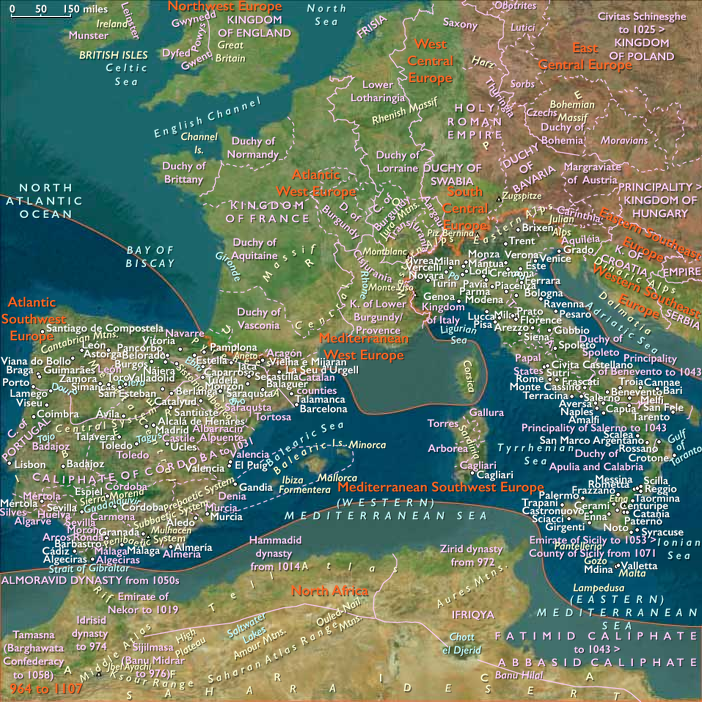
Subregions
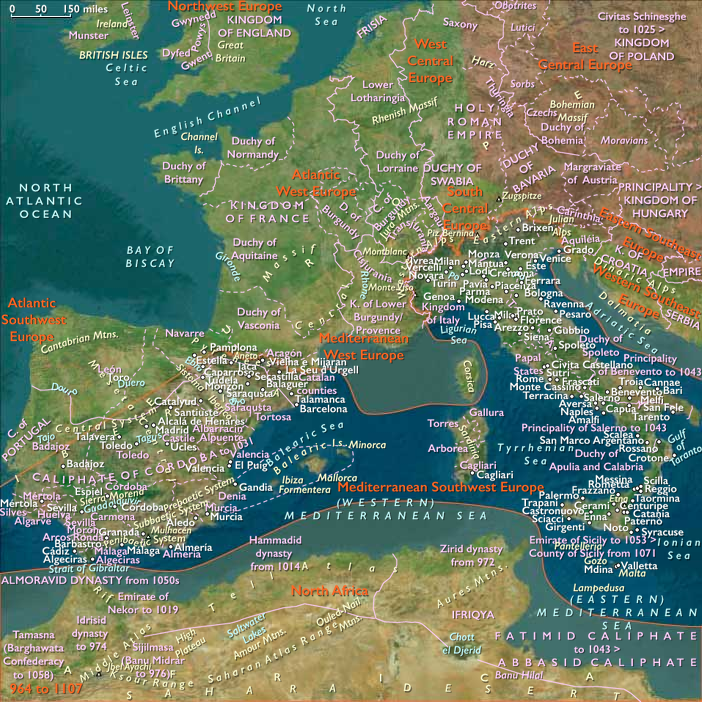
Related Events
Showing 2 events out of 2 total
Years: 1049 - 1049
Locations
People
- Henry III, Holy Roman Emperor
- Hugh of Cluny
- Humbert of Silva Candida
- Peter Damian
- Pope Benedict IX
- Pope Gregory VII
- Pope Leo IX
Groups
- Christianity, Chalcedonian
- Benedictines, or Order of St. Benedict
- Papal States (Republic of St. Peter)
- German, or Ottonian (Roman) Empire
- Italy, Kingdom of (Holy Roman Empire)
- Benevento, Lombard Duchy of
Commodoties
Subjects
Regions
Subregions