
Bruno of Cologne had been appointed chancellor …
Years: 1084 - 1084
Bruno of Cologne had been appointed chancellor of the Diocese of Reims in 1075, involving him in the daily administration of the diocese.
The pious Bishop Gervais de Château-du-Loir, a friend to Bruno, had meanwhile been succeeded by Manasses de Gournai, a violent aristocrat with no real vocation for the Church.
Suspended at a council at Autunn 1077 at the urging of Bruno and the clergy at Reims, de Gournai had responded, in typical eleventh century fashion, by having his retainers pull down the houses of his accusers.
He had confiscated their goods, sold their benefices, and even appealed to the pope.
Bruno had discreetly avoided the cathedral city until in 1080 a definite sentence, confirmed by popular riot, had compelled Manasses to withdraw and take refuge with Emperor Henry IV, the fierce opponent of the ambitious current papacy of Gregory VII.
Upon the verge of being made bishop himself, Bruno had instead followed a vow he had made to renounce secular concerns and withdrew, along with two of his friends, Raoul and Fulcius, also canons of Reims.
Bruno's first thought on leaving Reims seems to have been to place himself and his companions under the direction of an eminent solitary, Saint Robert, who had recently (1075) settled at Sèche-Fontaine, near Molesme in the Diocese of Langres, together with a band of other hermits, who were later on (in 1098) to form the Cistercian Order, but he had soon found that this was not his vocation.
After a short stay he goes with six of his companions to Saint Hugh of Châteauneuf, Bishop of Grenoble.
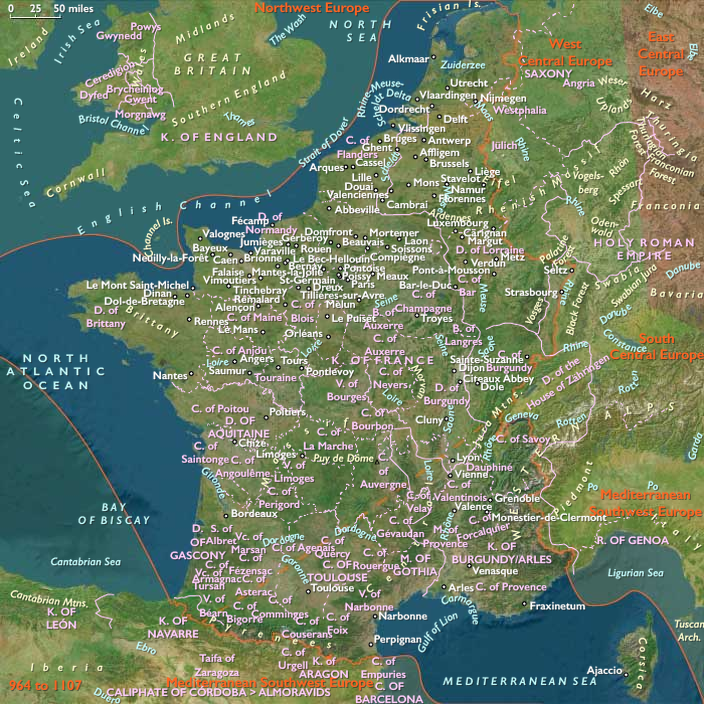
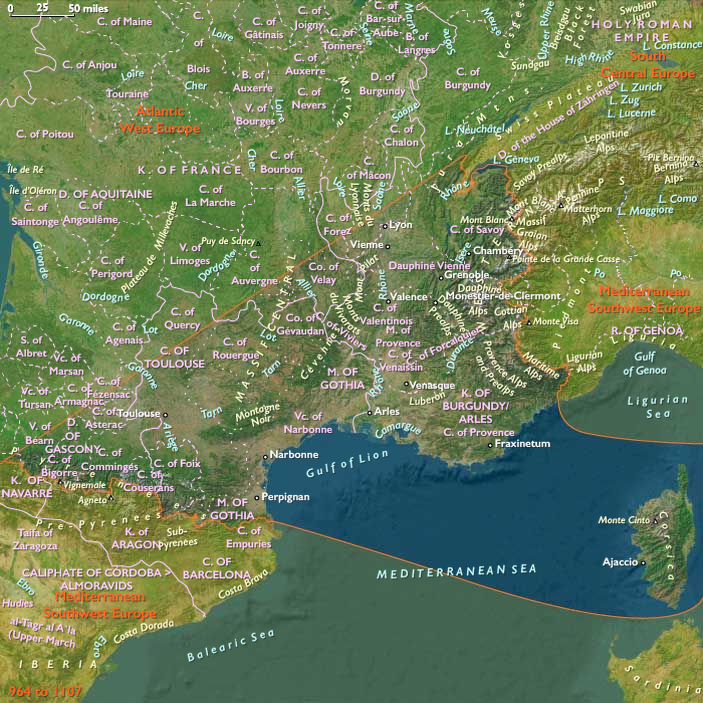
The bishop, according to the pious legend, had recently had a vision of these men, under a chaplet of seven stars, and he installs them himself in 1084 in a mountainous and uninhabited spot in the lower Alps of the Dauphiné, in a place named Chartreuse, not far from Grenoble.
With St. Bruno are Landuin, Stephen of Bourg, and Stephen of Die, canons of St. Rufus, and Hugh the Chaplain, and two laymen, Andrew and Guerin, who afterwards will become the first lay brothers.
They build a little retreat where they live isolated and in poverty, entirely occupied in prayer and study, for these men have a reputation for learning, and are frequently honored by the visits of St. Hugh who becomes like one of them.
This is the beginning of the Carthusian Order, also called the Order of Saint Bruno, a Roman Catholic religious order of enclosed monastics.
Founded in 1084, the Carthusians will grow to include both monks and nuns.
The order has its own Rule, called the Statutes, rather than the Rule of Saint Benedict, and combines eremitical and cenobitic life.
Contemplatives who lead solitary lives in hermitages, the Carthusians come together only for certain religious ceremonies.
The name Carthusian is derived from the Chartreuse Mountains; Saint Bruno builds his first hermitage in the valley of these mountains in the French Alps.
The word charterhouse, which is the English name for a Carthusian monastery, is derived from the same source.
The same mountain range lends its name to the alcoholic cordial Chartreuse produced by the monks since the 1740s which itself gives rise to the name of the color.
The motto of the Carthusians is Stat crux dum volvitur orbis, Latin for "The Cross is steady while the world is turning."
Locations
People
Groups
Subjects
Regions
Subregions
Related Events
Showing 10 events out of 50478 total
Years: 1084 - 1084
Locations
People
Groups
Subjects
Regions
Subregions