
Brunei, following the Portuguese seizure of Malacca, …
Years: 1512 - 1512
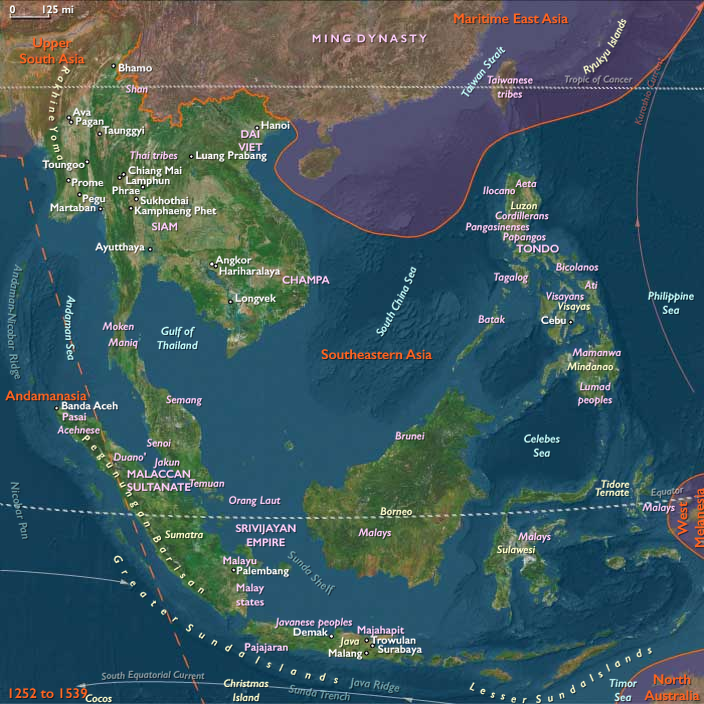
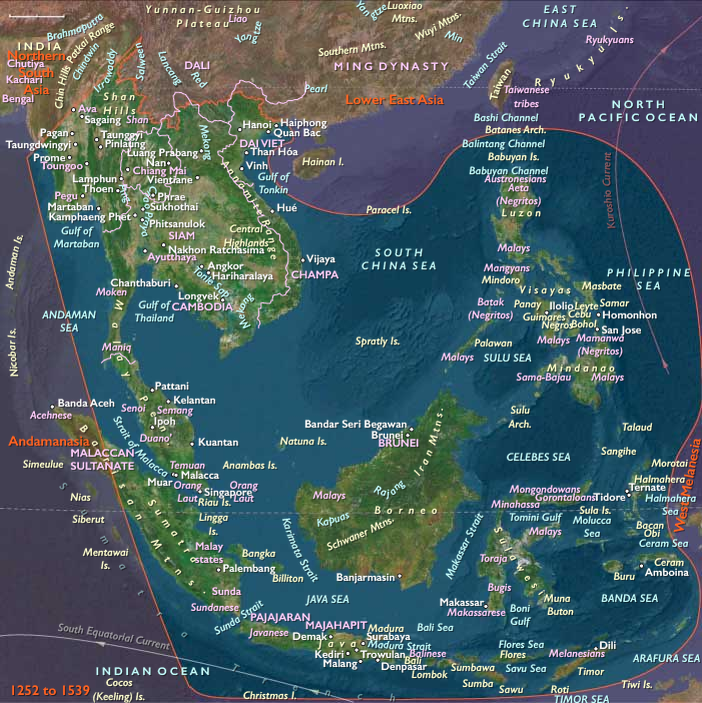
Brunei, following the Portuguese seizure of Malacca, flourishes as the most powerful Muslim state in Southeast Asia.
Chinese records began in CE 977 to use the term Po-ni,which some scholars believe to refer to Borneo.
A Chinese official, Chau Ju-Kua (Zhao Rugua), reported in 1225, that Po-ni had one hundred warships to protect its trade, and that there was a lot of wealth in the kingdom.
In the fourteenth century, the Javanese manuscript Nagarakretagama, written by Prapanca in 1365, mentioned Barune as the vassal state of Majapahit, which had to make an annual tribute of forty katis of camphor.
The Sulus in In 1369 attacked Po-ni, looting it of treasure and gold.
A fleet from Majapahit succeeded in driving away the Sulus, but Po-ni had been left weaker after the attack.
A Chinese report from 1371 describes Po-ni as poor and totally controlled by Majapahit.
However, scholars claim that the power of the Sultanate of Brunei is at its peak between the fifteenth and seventeenth centuries, with its power extending from northern Borneo to the southern Philippines.
By the sixteenth century, Islam is firmly rooted in Brunei, and the country has built one of its biggest mosques.
Locations
Groups
Subjects
Regions
Subregions
Related Events
Filter results
Showing 10 events out of 39269 total
Raja Muzaffar Shah, the son of Mahmud Shah, the defeated sultan of Malacca, erects an independent sultanate at Perak, near the Siamese border.
Ferdinand Magellan, with a rich plunder, had been promoted after the conquest of Malacca and, in the company of a Malay he had indentured and baptized Enrique of Malacca, he returns to Portugal in 1512.
In the same year, Albuquerque, having learned of the route to the Banda Islands and other 'Spice Islands', sends an exploratory expedition of three vessels under the command of António de Abreu, Simão Afonso Bisigudo and Francisco Serrão.
Banda is the world's only source of nutmeg and mace, spices used as flavorings, medicines, preserving agents, that are highly valued in European markets.
The Portuguese seek to dominate the source, rather than relying on Arab traders who sell it to the Venetians for exorbitant prices.
Malay pilots had guided the expedition east via Java and along the Lesser Sundas before steering them north to Banda via Ambon.
When Serrão's ship berthed at Gresik on Java, he had married a Javanese woman as his wife, who has accompanied him on the expedition's further journey.
His vessel, with nine Portuguese crew and nine Indonesians, had foundered in a squall and had broken up on a reef off a small island.
When the island's inhabitants, who are notorious shipwreck scavengers, surveyed the wreck from a boat, Serrão's crew had posed as unarmed and helpless but wealthy castaways.
As the scavengers drew near, the Portuguese attacked and commandeered both their craft and crew.
Their inadvertent rescuers were then forced to take them to Ambon, where they disembark in Luco-Pino island (Hitu), north of Ambon.
Serrão's armor, muskets, and marksmanship impresses the powerful chiefs of Hitu, who are warring against Luhu, the principal settlement on Seram's Hoamal Peninsula near Hitu.
The visitors are recruited as military allies and their subsequent exploits are heard in the rival neighbors of Ternate and Tidore, who both rush emissaries to induce the visitors to assist.
The Portuguese are also welcomed in the area as buyers of food and spices during a lull in the spice trade due to a temporary disruption to Javanese and Malay sailings to the area following the 1511 conflicts in Malacca.
The expedition remains in Banda for about one month, purchasing and filling their ships with nutmeg and mace, as well as and cloves in which Banda has a thriving entrepôt trade.
Serrão leaves Banda in a Chinese junk purchased from a regional trader to replace his lost ship.
D'Abreu sails through Ambon while Serrão goes ahead towards the Maluku islands.
Maluku is a cosmopolitan society where spice traders from across the region take residence in settlements, or in nearby enclaves, including Arab and Chinese traders who visit or live in the region.
Social organization is usually local, and relatively flat—a general populace guided by a council of elders or rich men, or orang kaya which is Indonesian word can be translated as "rich man".
The earliest archaeological evidence of human occupation of the Maluku Islands is about thirty-two thousand years old, but evidence of even older settlements in Australia may mean that Maluku had earlier visitors.
Evidence of increasingly long-distance trading relationships and of more frequent occupation of many islands, begins about ten to fifteen thousand years later.
Onyx beads and segments of silver plate used as currency on the Indian subcontinent around 200 BCE have been unearthed on some of the islands.
In addition, local dialects employ derivations of the Malay word then in use for 'silver'.
Arabic merchants had begun to arrive in the fourteenth century, bringing Islam.
Peaceful conversion to Islam has occurred in many islands, especially in the centers of trade, while aboriginal animism persists in the hinterlands and more isolated islands.
Archaeological evidence here relies largely on the occurrence of pigs' teeth, as evidence of pork eating or abstinence therefrom.
The most significant lasting effects of the Portuguese presence is the disruption and reorganization of the Southeast Asian trade, and in eastern Indonesia—including Maluku—the introduction of Christianity.
After the Portuguese annexed Malacca in August 1511, one Portuguese diary noted 'it is thirty years since they became Moors'—giving a sense of the competition taking place at this time between Islamic and European influences in the region.
The rulers of the competing island states of Tidore and …
…Ternate also seek Portuguese assistance.
The spice trade soon revives but the Portuguese will be unable to fully monopolize or disrupt this trade.
Serrão, allying himself with Ternate's ruler, Bayan Sirrullah, constructs a fortress on this tiny island and serves as the head of a mercenary band of Portuguese seamen under the service of one of the two local feuding sultans who control most of the spice trade.
He makes no efforts to return to Malacca.
His letters to Magellan will prove decisive, giving information about the spice-producing territories.
However, before they can meet one another again, both Serrão and Magellan will perish in the same year, on opposite sides of the world.
The defeated sultan of Malacca successfully reestablishes his court on the island of Bintan (near present Singapore).
Babur, after his defeat at the Battle of Kul Malek, had applied for assistance from Biram Khan Karamanlu, the commander serving the Safavid Persian Shah Ismail I at Balkh.
With additional support from Biram's detachment, Babur eventually causes the Uzbeks to withdraw from the country of Hissar.
After this victory, and in response to his defeat at Kul Malek, Babur personally visits Shah Ismail I to solicit an additional force that he can use to finally defeat the Uzbeks in Mawarannahr (Transoxiana).
The Shah accordingly calls on Najm-e Sani, his minister of finance, whom he has entrusted with the settlement of Khurasan.
Ismail gives him instructions to render assistance to Babur in recovering the dominions he had previously possessed.
On reaching Balkh, Najm resolves to march in person into Mawarannahr, taking with him the governor of Herat, the Amirs of Greater Khorasan, and Biram Khan of Balkh.
Najm passes the Amu Darya during his journey and is soon joined by Babur, creating an army that is said to have been sixty thousand strong.
Early in the autumn, the army advances to Khozar, ultimately seizing the city.
They now proceeded to Qarshi, which has been strongly fortified and garrisoned by Sultan Ubaydullah Sultan, the chief of Bukhara.
It is proposed to leave Qarshi behind as had been done with success in preceding campaigns, but Najm, believing it is Sultan Ubaydullah Sultan's lair, declares that it must be taken.
The city is therefore besieged and carried by storm with all inhabitants, Uzbek or not, being put to the sword regardless of age, sex, or sanctity.
The circumstances of this massacre disgust Babur, who finds himself playing a subordinate role in an army that is ostensibly acting under his authority.
In his desire to save the inhabitants, who are Chaghatai Turks of his own race and sect, he earnestly beseeches Najm to comply with his wishes, but the unrelenting Persian, deaf to his entreaties, looses the fury of war on the devoted city.
Among the casualties of the indiscriminate slaughter, along with many Syeds and holy men, is the poet Maulana Binai, one of the most eminent minds of his time, who happens to be in the town when it falls From this time forward, Najm will fail to prosper in any more of his undertakings.
The Uzbek chiefs, after the massacre at Karshi, appear for some time to have retired and fortified themselves in their strongholds.
Najm eventually moves on to attack Ghazdewan, on the border of the desert, without having taken Bukhara.
The Uzbek sultans now have time to assemble under the command of Ubaydullah Sultan.
Joined by Timur Sultan from Samarkand, they throw themselves into the fort the very night that Babur and Najm had taken their ground before it, preparing their engines and ladders for an assault.
In the morning, the Uzbeks draw out their army and take up a position among the houses and gardens in the suburbs of the town, with the confederates advancing to meet them.
The Uzbeks, who are protected by the broken ground and by the walls of the enclosures and houses, have posted archers in every corner to pour a shower of arrows on the Qizilbashes as they approach.
Once Biram Khan, the chief military command of the Qizilbash troops falls off his horse and is wounded, the main body of the army falls into disorder.
In the course of an hour, the invaders are routed, with most of them falling in the field.
This defeat puts an end to Safavid expansion and influence in Transoxania and leaves the northeastern frontiers of the kingdom vulnerable to nomad invasions.
Babur, routed and discomfited, flees back to Hissar.
It is said that the Qizilbash chiefs, disgusted with the haughtiness and insolence of Najm, did not use their utmost efforts to assist him: he is eventually taken prisoner and put to death.
Many of the Persian chiefs who flees from the battle cross the Amu Darya at Kirki and enter Greater Khorasan.
The Uzbeks now not only recover the country that they had lost in Transoxiana, but also make incursions into Greater Khorasan, ravaging the northern part of the province.
Shah Ismail I, on hearing of this disaster, resolves to return.
On his approach, the Uzbeks retreat in alarm.
He causes several of the officers who had escaped from the battle to be seized and some of them to be executed for deserting their commander.
Certain inhabitants of the province, accused of having shown attachment to the Uzbeks and their creed and of having vexed the Shias, are consumed in the fire of his wrath.
The relationship between Muscovy and Lithuania has remained tense despite the mutual peace signed by the two countries.
Sigismund I has demanded extradition of Michael Glinski for trial, while Vasili III demands better treatment of his widowed sister Helena.
Vasili also discovers that Sigismund is paying Khan Meñli I Giray to attack the Grand Duchy of Moscow.
Albert of Prussia has at the same time become the Grand Master of the Teutonic Knights and is unwilling to acknowledge Poland's suzerainty as required by the Second Peace of Thorn (1466).
The tension will eventually result in the Polish–Teutonic War (1519–21) and ally Maximilian I, Holy Roman Emperor with Vasili III.
Muscovy had in December 1512 invaded the Grand Duchy of Lithuania with a goal to capture Smolensk, a major trading center.
Luther had been ordained to the priesthood in 1507, and in 1508, von Staupitz, the first dean of the newly founded University of Wittenberg, had sent for Luther to teach theology.
Luther, having received a bachelor's degree in Biblical studies on March 9, 1508, and another bachelor's degree in the Sentences by Peter Lombard in 1509. is on October 19, 1512, awarded his Doctor of Theology and two days later is received into the senate of the theological faculty of the University of Wittenberg, having been called to the position of Doctor in Bible.
He will spend the rest of his career here in this position.
Dürer has worked from 1507 and 1511 on some of his most celebrated paintings: Adam and Eve (1507), The Martyrdom of the Ten Thousand (1508, for Frederick the Wise), Virgin with the Iris (1508), the altarpiece Assumption of the Virgin (1509, for Jacob Heller of Frankfurt), and Adoration of the Trinity (1511, for Matthaeus Landauer).
During this period he has also completed two woodcut series, the Great Passion and the Life of the Virgin, both published in 1511 together with a second edition of the Apocalypse series.
The post-Venetian woodcuts show Dürer's development of chiaroscuro modeling effects, creating a mid-tone throughout the print to which the highlights and shadows can be contrasted.
Other works from this period include the thirty-seven woodcut subjects of the Little Passion, published first in 1511, and a set of fifteen small engravings on the same theme in 1512.
Maximilian, Holy Roman emperor, appoints Dürer court painter in 1512.
