The Hyksos, who are possibly related to …
Years: 1773BCE - 1630BCE
The Hyksos, who are possibly related to the Amorites, seem to be connected with the general migratory movements elsewhere in the Middle East at this time; they apparently destroy the Amorite rule in Byblos, then use their effective, spoke-wheeled war chariots to bring Egypt's Middle Kingdom to an end; perhaps peacefully, perhaps not.
“Hyksos,” probably an Egyptian term for “rulers of foreign lands,” almost certainly designates the foreign dynasts rather than a whole nation.
Little is known about the Hyksos' origin, but they seem to have been ethnically mixed, including a considerable Semitic element, since the Phoenician deities El, Baal, and Anath figure in their pantheon.
Although most of the Hyksos names seem to be Semitic, there may also be a Hurrian element among them.
People
Groups
Topics
- Middle Bronze Age II B (Near and Middle East)
- Hurrian Conquests
- Indo-Aryan migration
- Hyksos 'Invasion' of Egypt
Commodoties
Subjects
Regions
Subregions
Related Events
Filter results
Showing 10 events out of 67790 total
Mount Veniaminof, located on the Alaska Peninsula, experiences a colossal (VEI 6) eruption around 1750 BCE, which leaves a large caldera.
Maritime East Asia (1773–1630 BCE): Decline of the Xia Dynasty and Early Innovations
Between 1773 BCE and 1630 BCE, Maritime East Asia—comprising lower Primorsky Krai, the Korean Peninsula, the Japanese Archipelago below northern Hokkaido, Taiwan, and southern, central, and northeastern China—undergoes significant transitions, particularly in ancient China, as the legendary Xia Dynasty faces internal decline, setting the stage for dynastic transformation. Concurrently, early cultural innovations, notably the development of traditional Chinese ink, contribute to regional cultural sophistication.
Kong Jia and the Decline of the Xia Dynasty
According to ancient textual sources such as the Bamboo Annals, the Xia Dynasty—traditionally considered China’s earliest hereditary dynasty—experiences substantial internal decline under its fourteenth ruler, Kong Jia, who reigns approximately from 1789 BCE to 1758 BCE. Governing from the Xia capital located at West River, Kong Jia is remembered unfavorably as a ruler excessively preoccupied with superstition, indulgence in alcohol, and pursuits of pleasure.
His ineffective governance and neglect of administrative responsibilities lead to a gradual weakening of centralized royal authority. During and after Kong Jia’s rule, regional vassal kings gain increasing autonomy and power, undermining Xia dominance. This progressive decentralization of authority continues throughout subsequent generations, ultimately leading to the dynasty’s downfall when the powerful vassal king, Tang of Shang, overthrows the last Xia ruler, Jie, establishing the Shang Dynasty in approximately 1618 BCE.
Early Chinese Ink Traditions
Around the same era, notable cultural advancements occur within Lower East Asia, specifically in the early development of Chinese ink. Historical evidence traces ink-making traditions back to approximately the 18th century BCE, featuring the use of naturally derived inks made from plants (plant dyes), animals, and mineral sources such as graphite. These materials are ground with water to produce inks applied using specially crafted brushes, laying critical foundations for future literary, artistic, and cultural expression throughout China and, eventually, broader East Asia.
The emergence of these early inks underscores the increasing sophistication of cultural practices within the region, marking significant steps toward later artistic and literary traditions.
Legacy of the Era: Dynastic Transition and Cultural Innovation
Thus, the period 1773–1630 BCE marks a critical era in Maritime East Asia’s early historical trajectory. The gradual collapse of the Xia Dynasty—symbolized by Kong Jia’s ineffective reign—paves the way for major political transformations, while concurrent innovations such as early ink-making practices highlight the region’s advancing cultural complexity. These developments significantly shape the historical and cultural evolution of Lower East Asia in subsequent periods.
Major states have become wealthier and more stable, law codes begin to be more complex, and colonial regimes having become well-established, some becoming independent states in their own right.
Societies now place a greater emphasis on culture, with fashions in clothing and uniforms, ornament and decoration, and even hairstyles becoming more complicated as quality of materials and standards of artistry and craftwork grow higher.
Kong Jia, the fourteenth ruler of China’s quasi-legendary Xia dynasty according to the Bamboo Annals, lives in the Xia capital of West River, reigning from 1789 BCE to 1758 BCE.
Said to have been very superstitious, he cares only about alcohol and beautiful women.
From his time on, the power of Xia will begin to decline and Xia’s vassal kings will grow increasingly powerful until one of them, Tang of Shang, finally overthrows Jie, the last ruler of the Xia dynasty, and establishes the Shang dynasty in 1618 BCE.
The history of Chinese inks can be traced back to the eighteenth century BCE, with the utilization of natural plant (plant dyes), animal, and mineral inks based on such materials as graphite that are ground with water and applied with ink brushes.
The design of axes becomes more efficient as bronzesmiths of the second millennium master more complex casting techniques.
The Bronze Age had begun to spread throughout Europe from about 1800, partly through the influence of the Unetice culture, the name given to an early Bronze Age culture, preceded by the Beaker culture and followed by the Tumulus culture.
The eponymous site is located at Únetice, northwest of Prague, and is focused around the Czech Republic, southern and central Germany, and western Poland.
The Unetice culture represents a farming and metalworking people living close to the ore sources; their culture had in about 2300 BCE supplanted the earlier European copper workers associated with the Beaker culture.
From 1950 BCE, the culture has produced daggers with metal hilts, flanged axes, halberds, pins with perforated spherical heads, and solid bracelets.
The Unetice culture is succeeded in around 1650 BCE by the Tumulus culture, distinguished by the practice of burying the dead beneath burial mounds (tumuli).
Eastern Southeast Europe (1773–1630 BCE): Continued Urban Growth
Urban growth driven by agricultural prosperity and expanded trade.
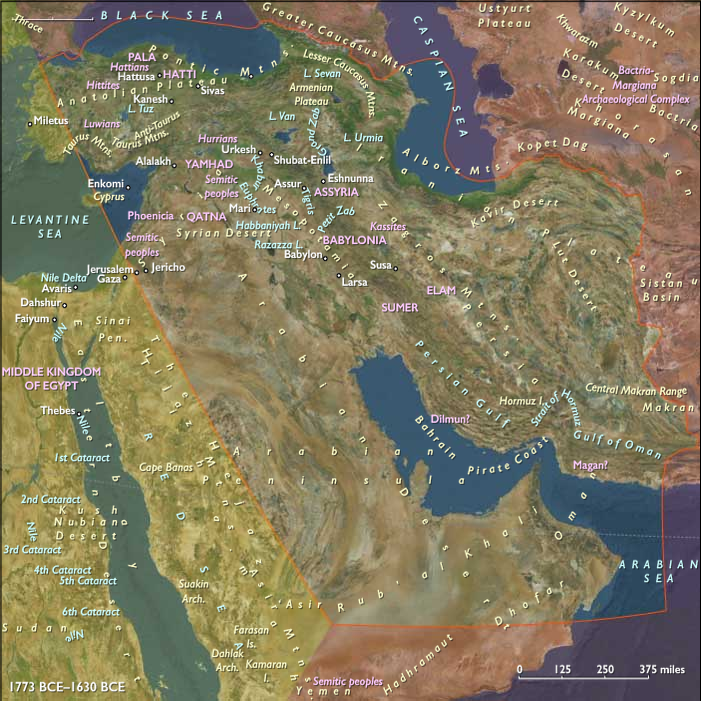
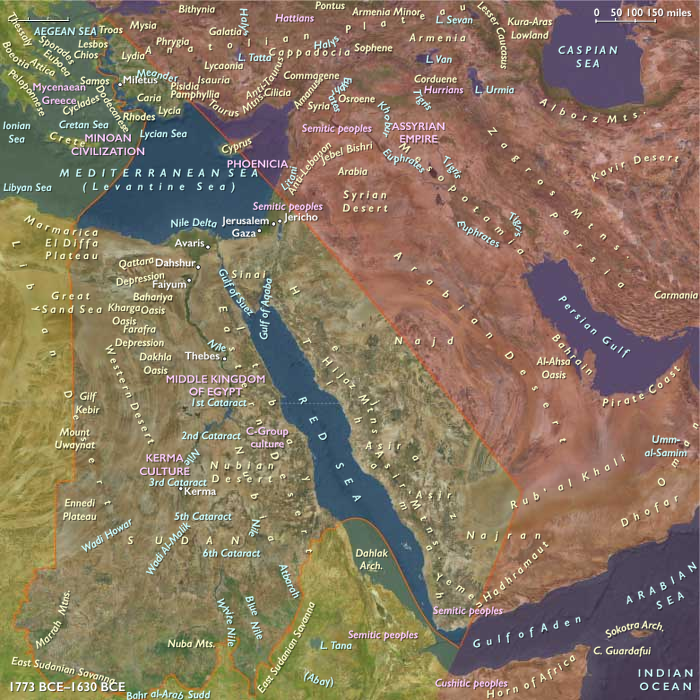
The Middle East: 1773–1630 BCE
Hammurabi's Legacy, Cultural Integration, and Expanding Influence
Hammurabi’s Legal and Cultural Innovations
The civilizing trends initiated at Sumer evolved dramatically during the reign of Hammurabi (1792–1750 BCE). His sophisticated legal principles, encapsulated in the Code of Hammurabi, reflect a highly advanced civilization, revealing social interactions extending far beyond kinship bonds. Hammurabi's laws, encompassing commerce, land tenure, marital laws, inheritance, debt, public order, and labor conditions, illustrate a diversified economy and extensive trade networks. Politically, Hammurabi's code further delineates religious authority from secular governance, signifying a maturation of Mesopotamian administrative complexity.
Babylon's Cultural and Urban Ascendancy
Babylon, capital of Babylonia, becomes the world's largest city by approximately 1770 BCE, surpassing Thebes in Egypt. Babylonian scholars significantly advance astronomy, and cuneiform evolves into a more flexible syllabic script, enhancing literacy and communication across the region. Babylonian architecture also flourishes, characterized by massive brick platforms and the iconic ziggurat structures.
Amorite Integration and Linguistic Evolution
By 1700 BCE, the Semitic Amorite language fully replaces Sumerian, though Akkadian cuneiform remains the lingua franca of the Near East, influencing other regional languages, including those of the Kassites, Hittites, Hurrians, and later Persians. Amorite culture integrates deeply with surviving Sumerian traditions, preserving administrative, architectural, and economic institutions.
Rise and Fall of Mari under Zimrilim
Mari experiences a second golden age under King Zimrilim (c. 1701 BCE), who expands the city-state’s influence along the Euphrates and Khabur valleys. Zimrilim’s extensive palace, boasting over three hundred rooms, exemplifies the prosperity of Mari, vividly decorated with murals. Despite earlier alliances, Mari is ultimately destroyed by Hammurabi around 1687 BCE, marking the end of its prominence.
Trade Networks and Regional Dynamics
Trade networks continue to evolve, illustrated by the wealth of maritime trade centers such as Dilmun, though its economic significance declines around 1800 BCE due to emerging alternative routes linking India directly with Mediterranean ports through the Red Sea. Meanwhile, Cyprus (Alashiya) becomes a key player in Mediterranean trade, exporting copper and fostering cosmopolitan settlements.
Assyrian Decline and Anatolian Transformations
In Anatolia, significant upheaval occurs around 1740 BCE when the prosperous trade city Kanesh (Kültepe) is again destroyed by fire, disrupting Assyrian trading colonies (karum) that had thrived since its re-establishment in 1798 BCE. Concurrently, the Indo-European-speaking Hittites consolidate control, adopting Akkadian cuneiform for inscriptions, notably under rulers such as Anitta of Nesa.
Hurrian Expansion and Influence
The Hurrians, originally from the Khabur River Valley and speaking a distinct agglutinative language, expand westward into northern Syria by 1725 BCE, notably into cities such as Alalakh (Tell Atchana). Their adoption of Akkadian cuneiform script integrates them further into regional culture, significantly influencing the linguistic and cultural landscapes.
Kassite Incursions and Elamite Influence
The Kassites, originating in the Zagros Mountains, begin periodic incursions into Mesopotamia around the mid-second millennium BCE. Initially repelled by Babylonian rulers like Samsu-iluna (1749–1712 BCE), their continued presence heralds future political shifts. Simultaneously, Elamite influence peaks under the Epartid dynasty (c.1900–1700 BCE)in Susa, notably under rulers like Siwe-Palar-Khuppak and Kudur-Nahhunte, before being driven back by Babylon.
Babylonian Cultural and Scientific Contributions
Babylonians excel in mathematics, capable of solving quadratic and cubic equations. Their base-60 arithmetic system greatly simplifies computations, surpassing contemporary Egyptian methods. Babylonian astrology, encapsulated in texts like the Enuma Anu Enlil, also emerges prominently during this period, emphasizing celestial phenomena and their purported influences.
Religious Developments and Urban Life
The worship of Marduk, Babylon’s chief deity, gains prominence during Hammurabi’s reign, centralizing Babylonian religious identity around the myth of creation detailed in the Enuma Elish. In daily life, Babylonians adopt garments such as ankle-length tunics and fringed shawls, influencing later cultures significantly. Veterinary practices also emerge in written records, underscoring the civilization's complexity and attention to practical needs.
This era sees an integration of diverse cultures, significant scientific advancements, and substantial political restructuring, setting the stage for subsequent empires and cultural evolution in the ancient Middle East.

The civilizing trend begun at Sumer had evolved to a new level of complexity in Hammurabi's legal code.
The sophisticated legal principles contained in the code reflect a highly advanced civilization in which social interaction extends far beyond the confines of kinship.
The large number of laws pertaining to commerce reflect a diversified economic base and an extensive trading network.
In politics, Hammurabi's code is evidence of a more pronounced separation between religious and secular authority than had existed in ancient Sumer.
In addition to Hammurabi's legal code, the Babylonians make other important contributions, notably to the science of astronomy, and they increase the flexibility of cuneiform by developing the pictogram script so that it stands for a syllable rather than an individual word.
Years: 1773BCE - 1630BCE
People
Groups
Topics
- Middle Bronze Age II B (Near and Middle East)
- Hurrian Conquests
- Indo-Aryan migration
- Hyksos 'Invasion' of Egypt