
The Mughal Empire had fallen apart after …
Years: 1797 - 1797
The Mughal Empire had fallen apart after the death of Aurangzeb in 1707, and had declined in its ability to tax or govern most of the Indian subcontinent.
In the northwestern region, particularly the Punjab, the creation of the Khalsa community of Sikh warriors by Guru Gobind Singh had accelerated the decay and fragmentation of the Mughal power in the region.
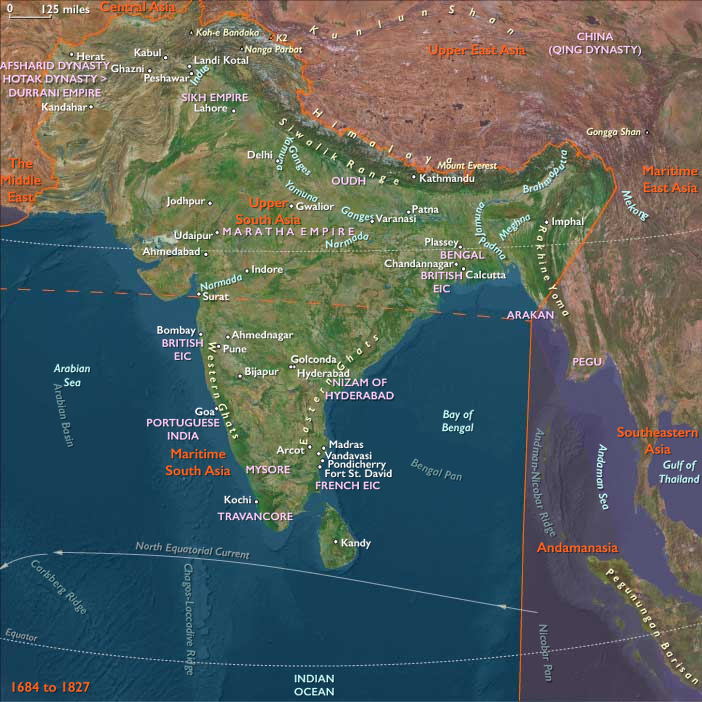
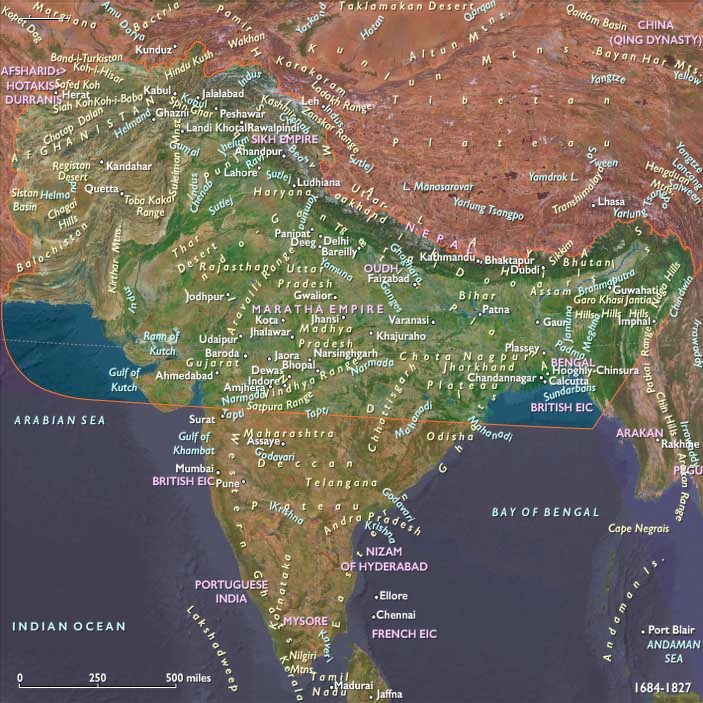
Raiding Afghans have attacked the Indus river valleys but met resistance from both organized armies of the Khalsa Sikhs as well as irregular Khalsa militias based in villages.
The Sikhs had appointed their own zamindars, replacing the previous Muslim revenue collectors, which provide resources to feed and strengthen the warriors aligned with Sikh interests.
Meanwhile, colonial traders and the East India Company had begun operations in India on its eastern and western coasts.
By the second half of the eighteenth century, the northwestern parts of the Indian subcontinent (now Pakistan and parts of north India) are a collection of fourteen small warring regions.
Of the fourteen, twelve are Sikh-controlled misls (confederacies), one named Kasur (near Lahore) is Muslim controlled, and one in the southeast is led by an Englishman named George Thomas.
This region constitutes the fertile and productive valleys of the five rivers—Jhelum, Chenab, Ravi, Bias and Sutlej.
The Sikh misls were all under the control of the Khalsa fraternity of Sikh warriors, but they are not united and constantly war with each other over revenue collection, disagreements, and local priorities; however, in the event of external invasion such as from the Muslim armies of Ahmed Shah Abdali from Afghanistan, they usually unite.
Towards the end of eighteenth century, the five most powerful misls are those of the Sukkarchakkia, Kanhayas, Nakkais, Ahluwalias and Bhangi Sikhs.
Ranjit Singh belongsto the first, and through marriage has a reliable alliance with Kanhayas and Nakkais.
Among the smaller misls, some, such as the Phulkias misl, switch loyalties in the late eighteenth century and support the Afghan army invasion against their Khalsa brethren.
The Kasur region, ruled by a Pathan-Muslim, always supports the Afghan invasion forces and joins them in plundering Sikh misls during the war.
Ranjit Singh's fame grows in 1797, at age seventeen, when the Afghan Muslim ruler Shah Zaman, of the Ahmad Shah Abdali dynasty, attempts to annex Panjab region into his control through his general Shahanchi Khan and twelve thousand soldiers.
The battle is fought in the territory that falls in Ranjit Singh controlled misl, whose regional knowledge and warrior expertise help resist the invading army.
This victory gains him recognition.
In the northwestern region, particularly the Punjab, the creation of the Khalsa community of Sikh warriors by Guru Gobind Singh had accelerated the decay and fragmentation of the Mughal power in the region.
Raiding Afghans have attacked the Indus river valleys but met resistance from both organized armies of the Khalsa Sikhs as well as irregular Khalsa militias based in villages.
The Sikhs had appointed their own zamindars, replacing the previous Muslim revenue collectors, which provide resources to feed and strengthen the warriors aligned with Sikh interests.
Meanwhile, colonial traders and the East India Company had begun operations in India on its eastern and western coasts.
By the second half of the eighteenth century, the northwestern parts of the Indian subcontinent (now Pakistan and parts of north India) are a collection of fourteen small warring regions.
Of the fourteen, twelve are Sikh-controlled misls (confederacies), one named Kasur (near Lahore) is Muslim controlled, and one in the southeast is led by an Englishman named George Thomas.
This region constitutes the fertile and productive valleys of the five rivers—Jhelum, Chenab, Ravi, Bias and Sutlej.
The Sikh misls were all under the control of the Khalsa fraternity of Sikh warriors, but they are not united and constantly war with each other over revenue collection, disagreements, and local priorities; however, in the event of external invasion such as from the Muslim armies of Ahmed Shah Abdali from Afghanistan, they usually unite.
Towards the end of eighteenth century, the five most powerful misls are those of the Sukkarchakkia, Kanhayas, Nakkais, Ahluwalias and Bhangi Sikhs.
Ranjit Singh belongsto the first, and through marriage has a reliable alliance with Kanhayas and Nakkais.
Among the smaller misls, some, such as the Phulkias misl, switch loyalties in the late eighteenth century and support the Afghan army invasion against their Khalsa brethren.
The Kasur region, ruled by a Pathan-Muslim, always supports the Afghan invasion forces and joins them in plundering Sikh misls during the war.
Ranjit Singh's fame grows in 1797, at age seventeen, when the Afghan Muslim ruler Shah Zaman, of the Ahmad Shah Abdali dynasty, attempts to annex Panjab region into his control through his general Shahanchi Khan and twelve thousand soldiers.
The battle is fought in the territory that falls in Ranjit Singh controlled misl, whose regional knowledge and warrior expertise help resist the invading army.
This victory gains him recognition.
Locations
People
Groups
- Durrani (Pashtun tribal confederacy)
- Muslims, Sunni
- Sikhs
- Britain, Kingdom of Great
- India, East India Company rule in
- Durrani Empire
- Sikh Empire
Topics
Subjects
Regions
Subregions
Related Events
Showing 10 events out of 23144 total
Years: 1797 - 1797
Locations
People
Groups
- Durrani (Pashtun tribal confederacy)
- Muslims, Sunni
- Sikhs
- Britain, Kingdom of Great
- India, East India Company rule in
- Durrani Empire
- Sikh Empire
Topics
Subjects
Regions
Subregions