
British legislation forbids ships under British registry …
Years: 1828 - 1828
British legislation forbids ships under British registry to engage in the slave trade, but the restriction is applied generally to all flags and is intended to shut down all traffic in slaves coming out of West African ports.
Other countries have more or less hesitantly followed the British lead.
The United States, for example, had also prohibited the slave trade in 1807 (Denmark actually was the first country to declare the trade illegal in 1792).
Attitudes change slowly, however, and not all countries cooperate in controlling the activity of their merchant ships.
American ships, for instance, are notorious for evading the prohibition and going unpunished under United States law.
It should be noted, moreover, that the abolition movement had concentrated on the transatlantic trade for more than five decades before eventually becoming a full-fledged attack on slave trading within Africa itself.
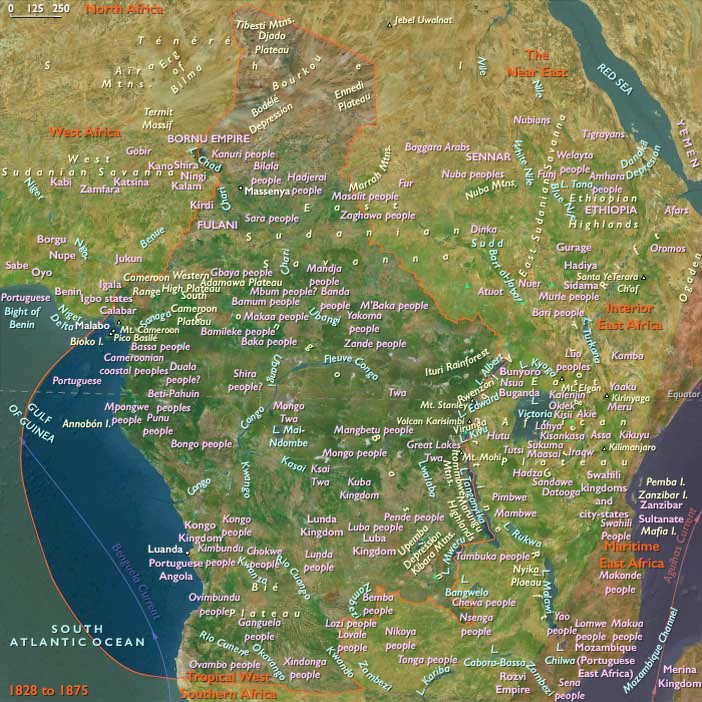
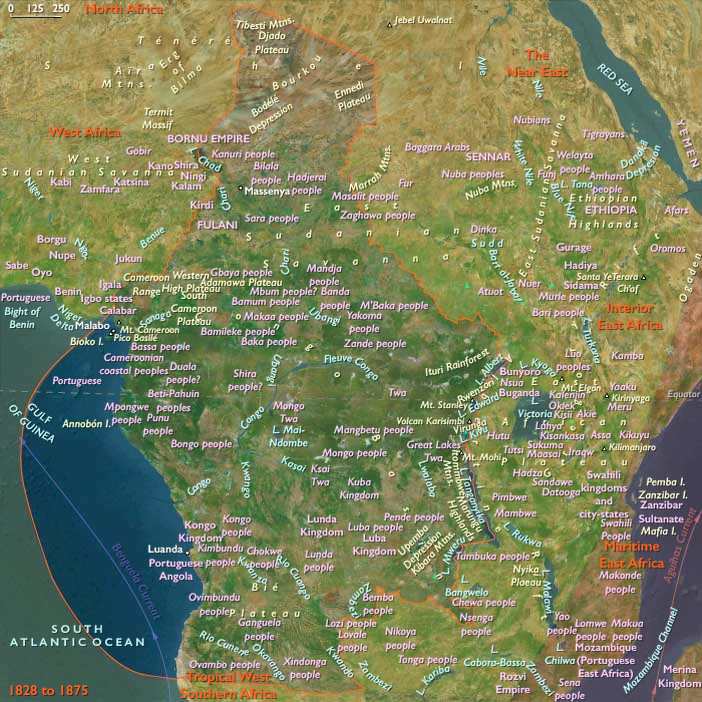
The Royal Navy maintains a prevention squadron to blockade the coast, and in 1827 a permanent station had been established at the Spanish colony of Fernando Po, off the Nigerian coast, with responsibility for patrolling the West African coast.
Slaves rescued at sea are usually taken to Sierra Leone, where they are released.
British naval crews ware permitted to divide prize money from the sale of captured slave ships.
Apprehended slave runners are tried by naval courts and are liable to capital punishment if found guilty.
Locations
Groups
- Equatorial Guinea, Spanish colony of
- Britain (United Kingdom of Great Britain and Ireland)
- Freetown (Sierra Leone), British Crown Colony of
Commodoties
Subjects
Regions
Subregions
Years: 1828 - 1828
Locations
Groups
- Equatorial Guinea, Spanish colony of
- Britain (United Kingdom of Great Britain and Ireland)
- Freetown (Sierra Leone), British Crown Colony of
Commodoties
Subjects
Regions
Subregions