
European explorers make their last great, often …
Years: 1852 - 1863
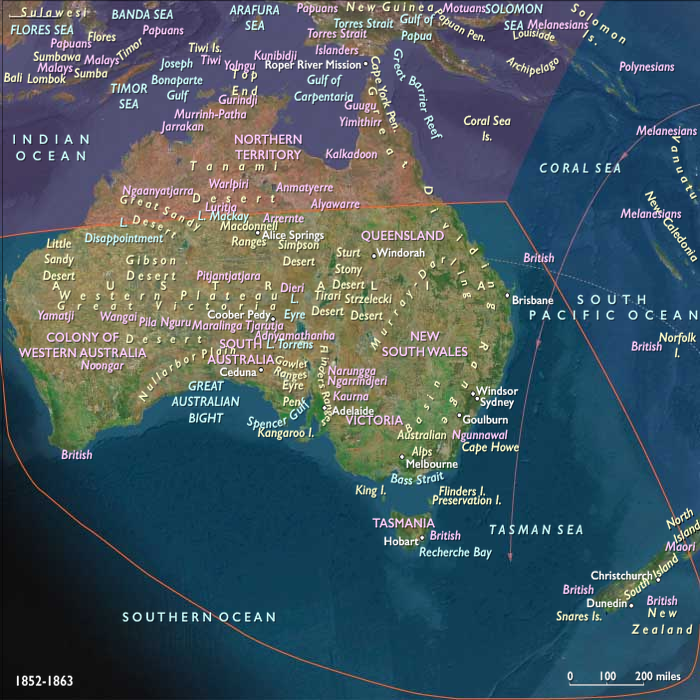
European explorers make their last great, often arduous and sometimes tragic expeditions into the interior of Australia during the second half of the nineteenth century—some with the official sponsorship of the colonial authorities and others commissioned by private investors.
Large areas of the inland are still unknown to Europeans in mid-century.
Trailblazers like Edmund Kennedy and the Prussian naturalist Ludwig Leichhardt had met tragic ends attempting to fill in the gaps during the 1840s, but explorers remain ambitious to discover new lands for agriculture or answer scientific inquiries.
Surveyors also act as explorers and the colonies send out expeditions to discover the best routes for lines of communication.
The size of expeditions vary considerably from small parties of just two or three to large, well-equipped teams led by gentlemen explorers assisted by smiths, carpenters, laborers and Aboriginal guides accompanied by horses, camels or bullocks.
In 1860, the ill-fated Burke and Wills leads the first north-south crossing of the continent from Melbourne to the Gulf of Carpentaria.
Lacking bushcraft and unwilling to learn from the local Aboriginal people, Burke and Wills die in 1861, having returned from the Gulf to their rendezvous point at Coopers Creek only to discover the rest of their party had departed the location only a matter of hours previously.
Though an impressive feat of navigation, the expedition was an organizational disaster that continues to fascinate the Australian public.
In 1862, John McDouall Stuart succeeds in traversing Central Australia from south to north.
His expedition maps out the route that is later followed by the Australian Overland Telegraph Line.
Groups
Topics
Commodoties
Subjects
Regions
Subregions
Related Events
Showing 10 events out of 16184 total
Years: 1852 - 1863
Groups
Topics
Commodoties
Subjects
Regions
Subregions