
Filters:
The war in central Europe is by …
Years: 1763 - 1763
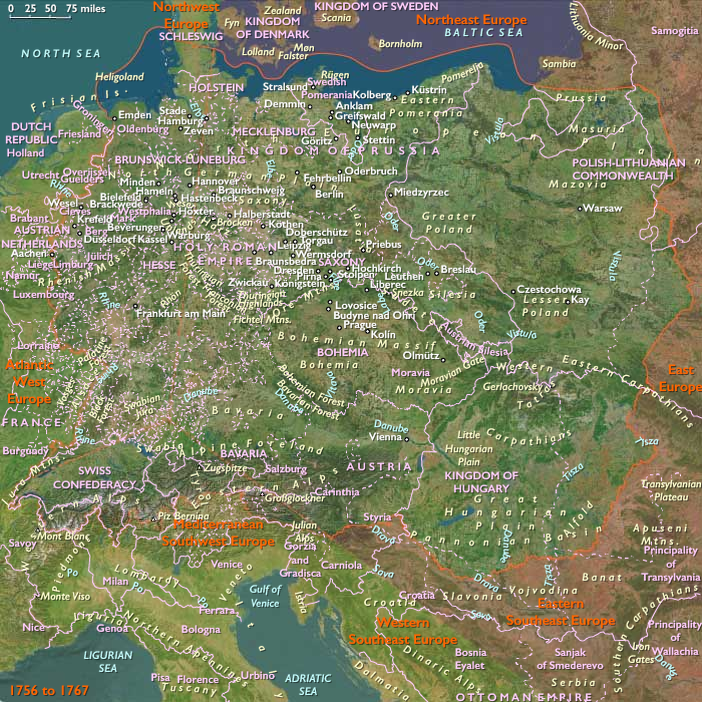
The war in central Europe is by 1763 essentially a stalemate between Prussia and Austria.
Prussia has retaken nearly all of Silesia from the Austrians, and after Frederick's 1762 victory at the Battle of Burkersdorf he holds most of Saxony but not its capital, Dresden.
His financial situation is not dire, but his kingdom is devastated and his army severely weakened.
His manpower has dramatically decreased, and he has lost so many effective officers and generals that an offensive against Dresden seems impossible.
British subsidies have been stopped by the new prime minister, Lord Bute, and the Russian emperor has been overthrown by his wife, Catherine, who ends Russia's alliance with Prussia and withdraws from the war.
Austria, however, like most participants, is facing a severe financial crisis and has to decrease the size of its army, something which greatly affects its offensive power.
Indeed, after having effectively sustained a long war, its administration is in disarray.
By this time, it still holds Dresden, the southeastern parts of Saxony, and the county of Glatz in southern Silesia, but the prospect of victory is dim without Russian support and Maria Theresa has largely given up her hopes of re-conquering Silesia.
After protracted negotiations between the war-weary powers, peace was made among Prussia, Austria, and Saxony at Hubertusburg, a Rococo palace in Saxony, and among Great Britain, France, and Spain at Paris.
Prussia has retaken nearly all of Silesia from the Austrians, and after Frederick's 1762 victory at the Battle of Burkersdorf he holds most of Saxony but not its capital, Dresden.
His financial situation is not dire, but his kingdom is devastated and his army severely weakened.
His manpower has dramatically decreased, and he has lost so many effective officers and generals that an offensive against Dresden seems impossible.
British subsidies have been stopped by the new prime minister, Lord Bute, and the Russian emperor has been overthrown by his wife, Catherine, who ends Russia's alliance with Prussia and withdraws from the war.
Austria, however, like most participants, is facing a severe financial crisis and has to decrease the size of its army, something which greatly affects its offensive power.
Indeed, after having effectively sustained a long war, its administration is in disarray.
By this time, it still holds Dresden, the southeastern parts of Saxony, and the county of Glatz in southern Silesia, but the prospect of victory is dim without Russian support and Maria Theresa has largely given up her hopes of re-conquering Silesia.
After protracted negotiations between the war-weary powers, peace was made among Prussia, Austria, and Saxony at Hubertusburg, a Rococo palace in Saxony, and among Great Britain, France, and Spain at Paris.
People
Groups
- Austria, Archduchy of
- Saxony, Electorate of
- Sweden, (second) Kingdom of
- France, (Bourbon) Kingdom of
- Prussia, Kingdom of
- Britain, Kingdom of Great
- Pomerania, Swedish
- Russian Empire
Topics
Subjects
Regions
Subregions

Years: 1763 - 1763
People
Groups
- Austria, Archduchy of
- Saxony, Electorate of
- Sweden, (second) Kingdom of
- France, (Bourbon) Kingdom of
- Prussia, Kingdom of
- Britain, Kingdom of Great
- Pomerania, Swedish
- Russian Empire
Topics
Subjects
Regions
Subregions