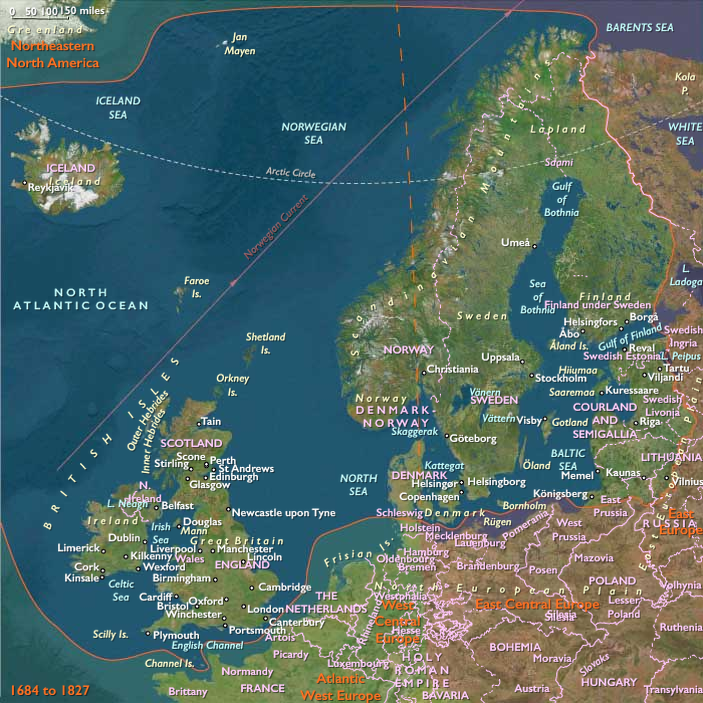
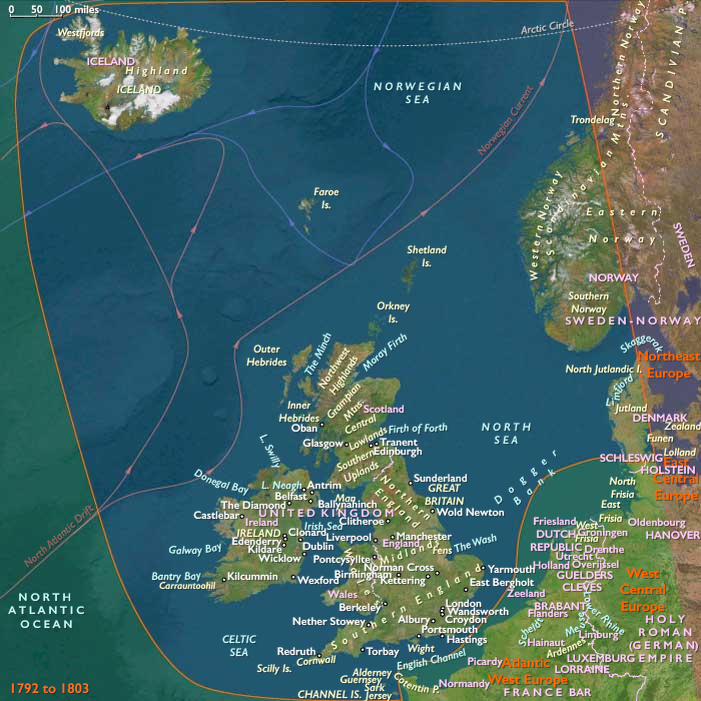
Ireland has chiefly been controlled by the minority Anglican Protestant Ascendancy since 1691 and the end of the Williamite war.
Constituting members of the established Church loyal to the British Crown, it governs through a form of institutionalized sectarianism codified in the Penal Laws, which discriminate against both the majority Irish Catholic population and non-Anglican Protestants (for example Presbyterians).
Liberal elements among the ruling class in the late eighteenth century are inspired by the example of the American Revolution (1776–1783) and seek to form common cause with the Catholic populace to achieve reform and greater autonomy from Britain.
As in England, the majority of Protestants, as well as all Catholics, are barred from voting because they do not pass a property threshold.
Another grievance is that Ireland, although nominally a sovereign kingdom governed by the monarch and Parliament of the island, in reality has less independence than had most of Britain's North American colonies, due to a series of laws enacted by the English, such as Poynings' law of 1494 and the Declaratory Act of 1720, the former of which had given the English veto power over Irish legislation, and the latter of which had given the British the right to legislate for the kingdom.
When France joined the Americans in support of their Revolutionary War, London had called for volunteers to join militias to defend Ireland against the threat of invasion from France (since regular British forces had been dispatched to America).
Many thousands had joined the Irish Volunteers.
In 1782, they had used their newly powerful position to force the Crown to grant the landed Ascendancy self-rule and a more independent parliament ("Grattan's Parliament").
The Irish Patriot Party, led by Henry Grattan, had pushed for greater enfranchisement.
In 1793, parliament passes laws allowing Catholics with some property to vote, but they can neither be elected nor appointed as state officials.
Liberal elements of the Ascendancy seeking a greater franchise for the people, and an end to religious discrimination, are further inspired by the French Revolution, which has taken place in a Catholic country.
The prospect of reform had inspired a small group of Protestant liberals in Belfast to found the Society of United Irishmen in 1791.
The organization crosses the religious divide with a membership comprising Roman Catholics, Presbyterians, Methodists, other Protestant "dissenters" groups, and some from the Protestant Ascendancy.
The Society openly puts forward policies of further democratic reforms and Catholic emancipation, reforms which the Irish Parliament has little intention of granting.
The outbreak of war with France earlier in 1793, following the execution of Louis XVI, has forced the Society underground and toward armed insurrection with French aid.
The avowed intent of the United Irishmen is to "break the connection with England".
It links up with Catholic agrarian resistance groups, known as the Defenders, who had started raiding houses for arms in early 1793.