Brian Boru, king of Munster from 978, …
Years: 1002 - 1002
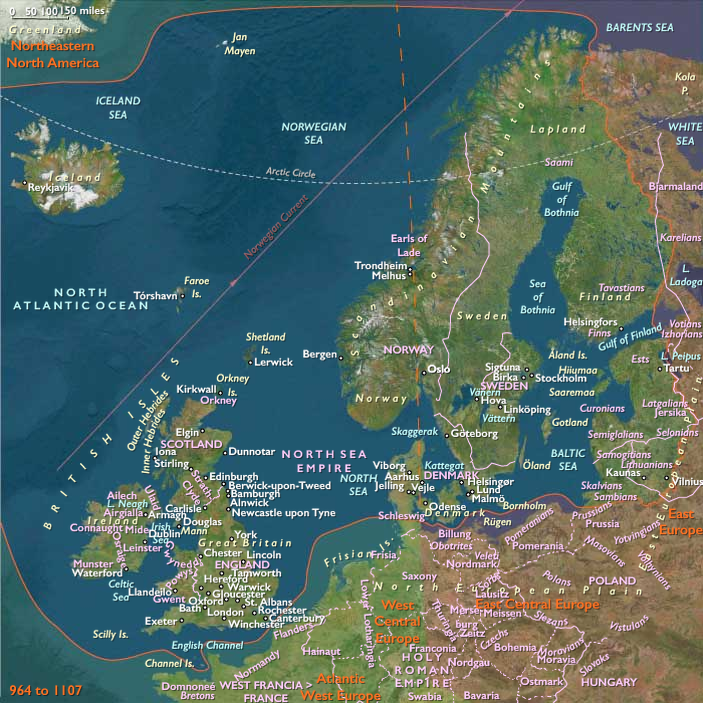
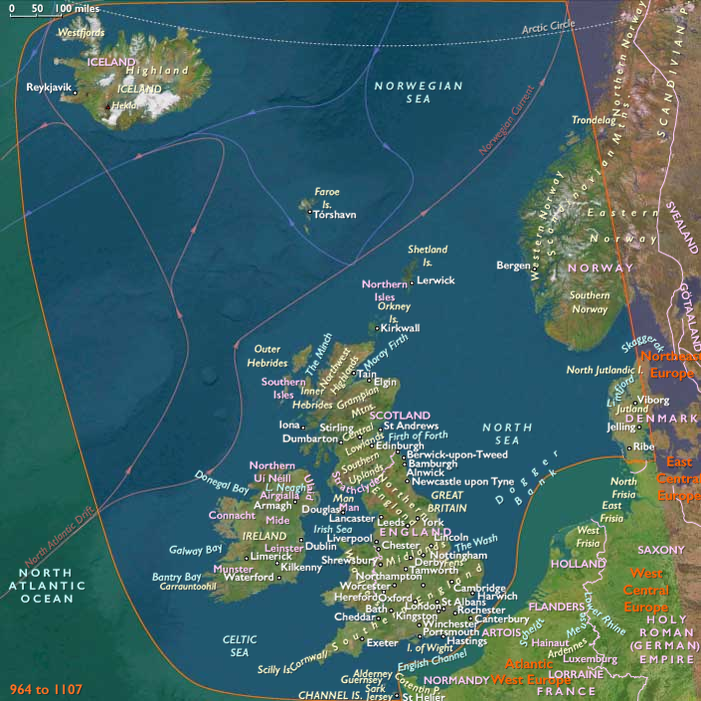
Brian Boru, king of Munster from 978, has defeated other Irish rulers and the Norse to win acknowledgment as high king of Ireland in 1002, breaking the Uí Néill monopoly on the title.
Not satisfied with the submission of Máel Sechnaill mac Domnaill, Brian Boru makes an expedition to the north to take hostages from the northern states.
Locations
People
Groups
Commodoties
Subjects
Regions
Subregions
Related Events
Filter results
Showing 10 events out of 51969 total
There is no clear successor after the reign of Khmer monarch Udayadityavarman I, which ends around 1000.
Two kings, Jayaviravarman and Suryavarman I, both claim the throne.
The aristocratic families had dominated Jayavarman V's court.
Atmashiva, who had served under the two previous kings, was his purohita, chaplain.
And Narayana, who had also served under King Rajendravarman, was his hotar, high priest.
However, the most influential and powerful ruling family is the house of Saptadevakula, which dominates most of the royal affairs, and helps King Suryavarman I come to power in 1002.
Henry the Strong is the son of Leopold I, the first Margrave of Austria, and Richardis of Sualafeldgau.
At the time of Henry's investiture in 996, the land between the Bisamberg and the March river had not yet been settled by Germans.
The name Ostarrîchi, from which the modern German name of Austria—Österreich—develops, is first mentioned in a preserved document from 996.
Henry faces his most significant threat from the north.
Following the death of Duke Boleslaus II of Bohemia in 999, the area north of the Eastern March had become unstable due to the brutality of his successor, Duke Boleslaus III the Red.
Basil himself, operating from Thessalonica, had been able to regain control of Vodena, Verrhoia, and Servia in 1001.
The following year he bases his army in Philippopolis and occupies the length of the military road from the western Haemus Mountains to the Danube, thereby cutting off communications between Samuel's Macedonian heartland and Moesia.
Khalaf's son Tahir is mentioned as having invaded Buyid Kerman in 1000, although he was ultimately unsuccessful in making any lasting gains.
Soon afterwards he, like 'his brother Amr before him, had rebelled against Khalaf.
The rebellion ends with Tahir's capture; he is imprisoned and dies not long after, in 1002.
With Tahir's death Khalaf is no longer left with any suitable heirs.
Khalaf's reign has grown increasingly unpopular over the years; his unpopularity has especially grown after Tahir's rebellion.
After Tahir dies, the commander of his army sends a message to Mahmud of Ghazna, stating that the people of Zaranj want him to become the ruler of Sistan.
Mahmud responds by sending an advance force to secure Sistan.
Khalaf resists, barricades himself in Taq and withstands a siege by the Ghaznavid force, so Mahmud decides to come personally in November 1002.
Mahmud's army is reinforced by the townspeople of Zaranj, eager to see the Saffarid defeated.
Khalaf is forced to surrender by December of 1002 and is sent to Farighunid Guzgan, where he will live until 1006 or 1007.
Emperor Basil II enlists Venetian help in protecting the Dalmatian coast and Adriatic waters from Bulgarian aggression.
Gregory I, Count of Tusculum, holds the cities of Galeria, Arce, and Preneste and the title count palatine, the palace referred to being that of the Lateran.
He is the first to carry the title "Count of Tusculum" and he will pass it to all his descendants.
They also will receive the titles of excellentissimus vir' (most excellent man) and apostolic rector of Sant'Andrea, which Gregory had received in 980.
In 981, Gregory had borne the title Romanorum consul, dux et senator: "Consul, duke, and senator of the Romans."
As well as being an intimate and ally of the popes, especially Sylvester II, Gregory had also served as praefectus navalis of Holy Roman Emperors Otto I and Otto II.
Gregory had been named "Head of the Republic" on February 6, 1001, for leading the revolt against Otto III and expelling the Crescentii.
In 1002, the latter returns to power and Gregory has to renounce his title.
Danish raids have ravaged England every year from 997 to 1001, and in 1002 the king is told that the Danish men in England "would faithlessly take his life, and then all his councilors, and possess his kingdom afterwards."
In response, he "ordered slain all the Danish men who were in England." (Anglo-Saxon Chronicle, Abingdon ms, quoted in Ryan Lavelle, Aethelred II: King of the English, The History Press, 2008, p. 104)
Frustration and, possibly, promises of support from Normandy, lead Æthelred in 1102 to decree the so-called St. Brice’s Day Massacre, described in the chronicle of John of Wallingford.
The name St. Brice apparently refers to bishop Bricius of Tours, whose memorial day is November 13.
Historians believe there was significant loss of life.
Among those thought to have been killed were Gunhilde, who may have been the sister of King Sweyn I of Denmark.
Her husband Pallig Tokesen, the Danish Ealdorman of Devonshire, may also have died in the massacre; or according to a different version, his defection to join raiders ravaging the south coast may have played a part in provoking it.
Historians have generally viewed the massacre as a political crime which helped to provoke Sweyn's invasion of 1003.
Simon Keynes in his Oxford Online DNB article on Æthelred described it as a "so-called" massacre, a reaction of people who had been slaughtered and pillaged for a decade, directed not at the inhabitants of the Danelaw but at the mercenaries who had turned on their employers.
Æthelred's biographer, Ryan Lavelle, also questions its extent, arguing that it could not have been carried out in the Danelaw, where the Danes would have been too strong, and that it was probably confined to frontier towns such as Oxford, and larger towns with small Danish communities, such as Bristol, Gloucester and London.
He views the massacre not so much as a royally executed order as an exploitation of popular ethnic hatred and millenarianism.
Audrey MacDonald sees it as leading on to the onslaught which eventually led to Danish conquest. (Audrey MacDonald, St Brice's Day Massacre, The Oxford Companion to British History)

Eckard I, Margrave of Meissen, is of noble east Thuringian stock, the eldest son of Margrave Gunther of Merseburg.
In 985, the young King Otto III of Germany had appointed him to succeed Margrave Rikdag in Meissen, following severe Saxon setbacks against the Slavic Lutici tribes.
He was later elected Duke of Thuringia by the magnates of the region, an event which has been taken as evidence of the principle of tribal ducal election.
Eckard is high in the favor of the Emperor Otto III, who has rewarded him handsomely by converting many of his benefices (fiefs) into proprietas (allods).
In Otto's conflict with his rival cousin Duke Henry II of Bavaria, Eckard's military responsibilities as holder of the Meissen march consists primarily of containment of the neighboring Polish and Bohemian duchies.
Duke Boleslaus II of Bohemia had allied with Duke Henry and had taken the occasion to occupy the Albrechtsburg in 984; he nevertheless had had to withdraw the next year, after Otto III had prevailed.
Margrave Eckard had had to restore Thiadric, Bishop of Prague to his see after his expulsion by Boleslaus II of Bohemia.
When in January 1002 Otto III dies without issue and the German princes meet at Frohse (today part of Schönebeck) to elect a new king, Eckard even aims at the German crown, because the late emperor's Ottonian relative Henry of Bavaria, son of Duke Henry II, who is the preeminent candidate, meets with strong opposition.
Eckard is at this time the most obvious Saxon candidate, but the nobles are opposed to him.
They only agree to meet again at the Kaiserpfalz of Werla and to support no candidate before then.
Otto III, after summoning his army in late 1001, had headed south to Rome to ensure his rule over the city.
During the travel south, however, the emperor suffers a sudden and severe fever.
Shortly before the Bavarian troops arrive at Otto’s headquarters near Viterbo, the emperor dies in a castle near Civita Castellana on January 24, 1002.
He is twenty-one years old and had reigned as an independent ruler for just under six years, having nominally reigned for nearly nineteen years.
The princess Zoe, second daughter of Emperor Constantine VIII, had just disembarked in Puglia on her way to marry him.
Otto III's death has been attributed to various causes.
Medieval sources speak of malaria, which he had caught in the unhealthy marshes that surrounded Ravenna.
Following his death, the Roman people suggest that Stefania, the widow of Crescentius II, had made Otto III fall in love with her and then poisoned him.
The Emperor's body is carried back to Germany by his soldiers, as his route is lined with Italians who hurled abuses at his remains.
He will be buried in Aachen Cathedral alongside the body of Charlemagne.
The emperor, dealing with a revolt against his reign in Italy in 1001, had sent word for Duke Henry of Bavaria to join him with reinforcements from Germany.
In the Ottonian dynasty, succession to the throne has been drawn from the Saxon branch, not the Bavarian line of which Henry is a member.
As the funeral procession moves through the Duchy of Bavaria in February 1002, Henry meets the procession in Polling, just north of the Alps.
To legitimize his claims, Henry demands Archbishop Heribert of Cologne give him the imperial regalia, chief among them being the Holy Lance.
Heribert, however, had sent these ahead of the procession, possibility out of distrust of Henry and possibly because he favors the succession of his relative Duke Herman II of Swabia as the next king.
In order to force Herman II to relinquish the Holy Lance to him, Henry imprisons the Archbishop and his brother the Bishop of Wurzburg.
With neither the symbols of imperial authority, the crown jewels, nor the cooperation of Heribert, Henry is unable to persuade the nobles attending Otto III's funeral procession to elect him as king.