Branford, which joins the New Haven Colony …
Years: 1643 - 1643
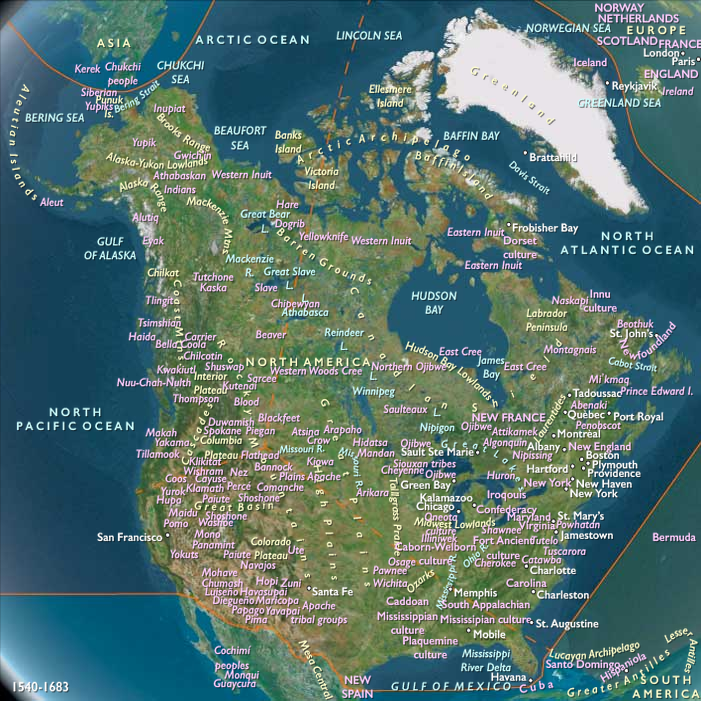
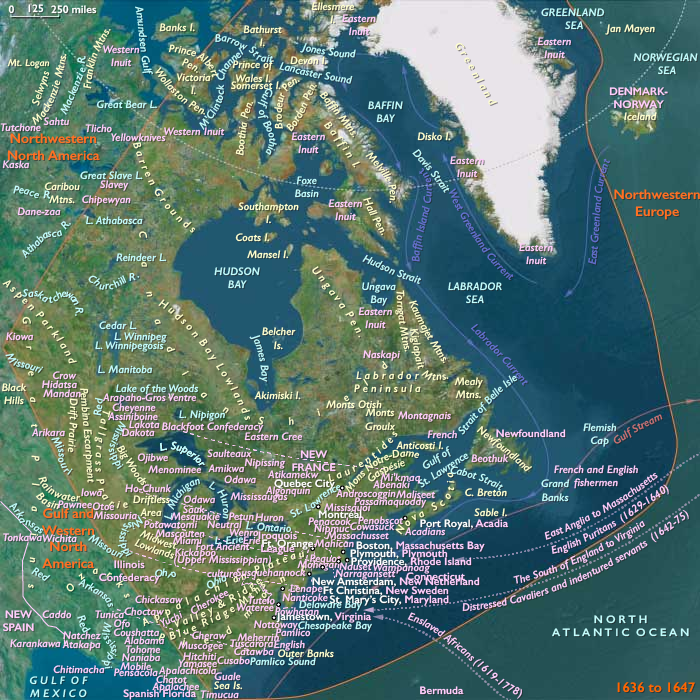
Branford, which joins the New Haven Colony in 1643, is the last the official "plantation" in the New Haven Confederation.
They base their government on that of Massachusetts but maintain stricter adherence to the Puritan discipline.
Locations
Groups
- Puritans
- England, (Stuart) Kingdom of
- Plymouth Colony (English Colony)
- Saybrook Colony (English)
- (Connecticut) River Colony (English)
- Providence Plantation
- New Haven Colony (English)
Subjects
Regions
Subregions
Related Events
Filter results
Showing 10 events out of 32065 total
Okhotsk, located at the mouth of the Okhota River on the Sea of Okhotsk, at the eastern end of the River Route from the Urals, is the first Russian settlement on the Pacific Coast, established as a wintering camp in 1643 by Cossacks under Semyon Shelkovnikov.
This is within the traditional lands of the Lamuts —a term meaning "ocean people" in Even, by which name they are known today.
The Evens, or Eveny, practice shamanism and support themselves by reindeer-breeding, hunting, fishing and trapping.
There is little land fit for agriculture east of the Yenisei River except for Dauria, the land between the Stanovoy Mountains and the Amur River, which is nominally controlled by China.
Vassili Poyarkov, sent to explore this land, had in 1640 been in Yakutsk as pismenyy golova (roughly, in charge of records and correspondence).
Poyarkov with one hundred and thirty-three men had started out in June of 1643 from Yakutsk, sent by the voevoda of Yakutsk, Peter Golovin.
Having no idea of the proper route, Poyarkov has traveled up the rivers Lena, Aldan, Uchur, Gonam.
Delayed by sixty-four portages, it is early winter before he reaches the Stanovoy watershed.
Leaving forty-nine men to overwinter, he pushes south over the mountains in December to reach the upper Zeya River in Daur country, where he finds a land of farmers with domestic animals, proper houses and Chinese trade goods who pay tribute to the Manchus, who are just starting their conquest of China.
He builds a winter fort near the mouth of the Umelkan river.
He employs excessive brutality to extract supplies from the natives, thereby provoking their hostility and making supplies harder to get.
His men survive on a diet of pine bark, stolen food, stray forest animals and native captives whom they cannibalize.
Evangelista Torricelli, born in Faenza, part of the Papal States, had been left fatherless at an early age and educated under the care of his uncle, a Camaldolese monk, who had first entered young Torricelli into a Jesuit College in 1624 to study mathematics and philosophy until 1626, when he had sent Torricelli to Rome in 1627 to study science under the Benedictine Benedetto Castelli, professor of mathematics at the Collegio della Sapienza in Pisa.
Shortly after the publication of Galileo's Dialogues of the New Science, Torricelli had written to Galileo in 1632 of reading it "with the delight [...] of one who, having already practiced all of geometry most diligently [...] and having studied Ptolemy and seen almost everything of Tycho Brahe, Kepler and Longomontanus, finally, forced by the many congruences, came to adhere to Copernicus, and was a Galileian in profession and sect".
(The Vatican had condemned Galileo in June of the following year, and this was the only known occasion on which Torricelli had openly declared himself to hold the Copernican view.)
Aside from several letters, little is known of Torricelli's activities in the years between 1632 and 1641, when Castelli sent Torricelli's monograph of the path of projectiles to Galileo, then a prisoner in his villa at Arcetri.
Although Galileo had promptly invited Torricelli to visit, he did not accept until just three months before Galileo's death on January 8, 1642; during his stay, he written out Galileo's Discourse of the Fifth day.
Succeeding Galileo, at the request of Grand Duke Ferdinando II de' Medici, as the grand-ducal mathematician and professor of mathematics in the University of Pisa, Toriceli solves some of the great mathematical problems of the day, such as finding a cycloid's area and center of gravity; he also designs and builds a number of telescopes and simple microscopes; several large lenses, engraved with his name, are still preserved at Florence.Torricelli’s accidental invention of the mercury barometer arose from solving a practical problem: The Grand Duke's pump makers, in attempting to raise water to a height of twelve meters or more, have found that ten meters is the limit with a suction pump.
Employing mercury, fourteen times heavier than water, Toricelli n 1643 creates a tube approximately one meter long and sealed at the top, fills it with mercury, and sets it vertically into a basin of mercury.
The column of mercury falls to about 76 cm, leaving a Torricellian vacuum above.
As we now know, the column's height fluctuates with changing atmospheric pressure; this is the first barometer.
This discovery perpetuates his fame, and the Torr, a unit used in vacuum measurements, is named for him.
Torricelli also discovers Torricelli's Law, regarding the speed of a fluid flowing out of an opening, which will later be shown to be a particular case of Bernoulli's principle.

Alonzo Cano, a painter, architect and sculptor native to Granada, has been made first royal architect, painter to Philip IV, and instructor to the prince, Balthasar Charles, Prince of Asturias.
Roger Williams is sent by his fellow citizens to England in 1643 to secure a charter for Providence colony.
The Puritans are at this time in power in England, and through the offices of Sir Henry Vane a democratic charter is obtained.
While in England, Williams also has his A Key Into the Language of America (1643) published about his time among the Native Americans in New England.
The Confederates negotiate a "cessation of arms" (or ceasefire) in 1643, with the royalists in Ireland and open negotiations with James Butler, 1st Duke of Ormonde, the King's representative in Ireland.
This means that hostilities cease between the Confederates and Ormonde's royalist army in Dublin.
However, the English garrison in Cork (which is commanded by Murrough O'Brien, 1st Earl of Inchiquin, a rare Gaelic Irish Protestant) objecting to the ceasefire, mutinies and declares allegiance to the English Parliament.
The Scottish Covenanters had also landed an army in Ulster in 1642, which remains hostile to the Confederates and to the king—as do the forces of the British settlers living in Ulster.
La Tour, finding allies in Massachusetts in the spring of 1643, leads a party of English mercenaries against the Acadian colony at Port Royal on August 6.
His two hundred and seventy Puritan and Huguenot troops kill three, burn a mill, slaughter cattle and seize eighteen thousand livres of furs, one third of the plunder going to La Tour and the rest to the Bostonians.
The Capuchins demand Paris send support for d'Aulnay.
English buccaneers begin using the tortuous coastline of the area of present Belize as a base from which to attack Spanish ships.
Some of the buccaneers may have been refugees expelled by the Spanish in 1641-42 from settlements on islands off the coasts of Nicaragua and Honduras.
Abel Tasman, on his way back to Batavia, comes upon the Tongan archipelago on January 20, 1643.
Two names that Abel Tasman bestows in January 1643 on New Zealand landmarks endure today: Cape Maria van Diemen, named after the wife of his patron, Anthony van Diemen, Governor General of Batavia (now Jakarta), and ...
Years: 1643 - 1643
Locations
Groups
- Puritans
- England, (Stuart) Kingdom of
- Plymouth Colony (English Colony)
- Saybrook Colony (English)
- (Connecticut) River Colony (English)
- Providence Plantation
- New Haven Colony (English)