Both the town of Zug and the …
Years: 1364 - 1364
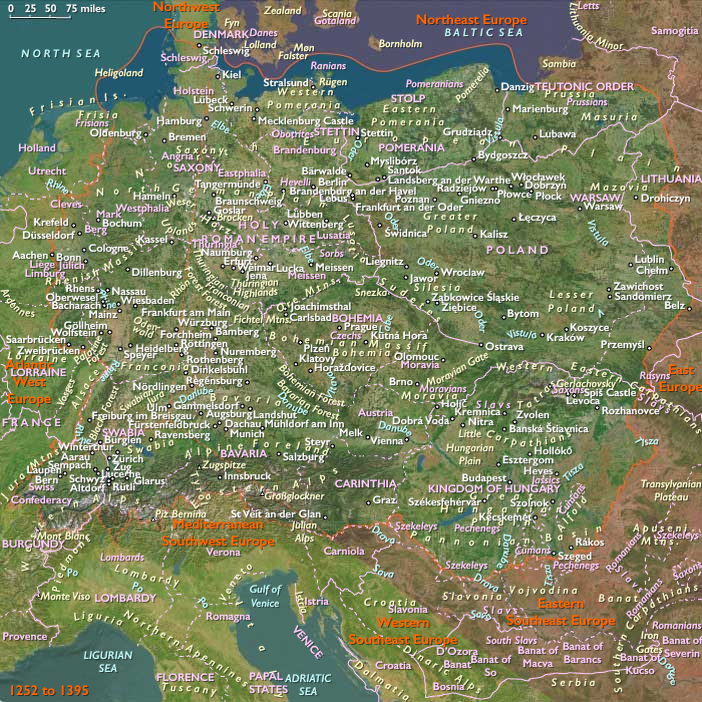
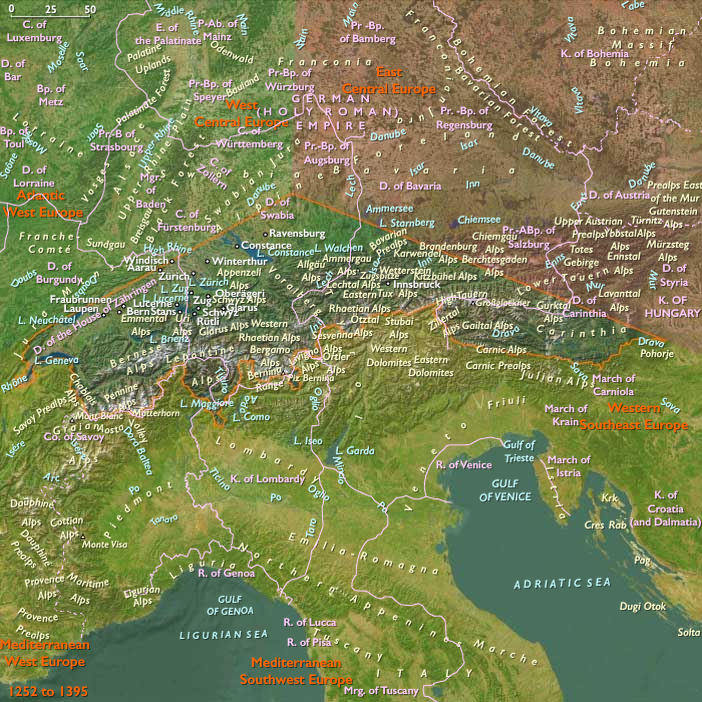
Both the town of Zug and the Aeusser Amt, or Outer District consisting of the surrounding villages and towns, had entered the Swiss Confederation on June 27, 1352, the latter being received on exactly the same terms as the town, and not, as was usual in the case of outer districts, as a subject land; but in September 1352, Zug had had to acknowledge its own lords again, and in 1355 had been obliged to break off its connection with the league.
The town and the Aeusser Amt are recovered for the league by the men of Schwyz in about 1364, and from this time Zug will take part as a full member in all the acts of the league.
Locations
Groups
Subjects
Regions
Subregions
Related Events
Filter results
Showing 10 events out of 43956 total
Members of the Swedish Council of Aristocracy, led by Bo Jonsson Grip, had arrived in the court of Mecklenburg in 1363, after having been banished from the country after a revolt against king Magnus Eriksson.
At the nobles' request, Albert of Mecklenburg launches an invasion of Sweden supported by several German dukes and counts.
Several Hanseatic cities and dukes in Northern Germany express support of the new king.
Stockholm and …
…Kalmar, with large Hanseatic populations, also welcome the intervention.
Albert is proclaimed King of Sweden and crowned on February 18, 1364.
Magnus finds refuge with his younger son in Norway, where he will retain his sovereignty over Iceland until he drowns in 1374 in a shipwreck in Bømlafjorden.
Rudolf concludes another contract of inheritance with his father-in-law Emperor Charles IV in 1364, providing for mutual inheritance between the Habsburg and Luxembourg dynasties.
King Casimir III of Poland realizes that the nation needs a class of educated people, especially lawyers, who can codify the country's laws and administer the courts and offices.
His efforts to found an institution of higher learning in Poland are rewarded when Pope Urban V grants him permission to set up a university in Kraków.
A royal charter of foundation is issued on May 12, 1364, and a simultaneous document is issued by the City Council granting privileges to the Studium Generale.
The King provided funding for one chair in liberal arts, two in Medicine, three in Canon Law and five in Roman Law, funded by a quarterly payment taken from the proceeds of the royal monopoly on the salt mines at Wieliczka.
Development of the University of Kraków stalls upon the death of King Casimir, and lectures are held in various places across the city, including, among others, in professors' houses, churches and in the cathedral school on the Wawel Hill.
It is believed that, in all likelihood, the construction of a building to house the Studium Generale began on Plac Wolnica in what is today the district of Kazimierz.
The regency for John V Palaiologos, paying the price for Ivan Alexander of Bulgaria's support in the civil war of 1341–47, had surrendered Phillipopolis and eight other cities in 1344 after holding them for twenty years.
The Ottoman Turks under Lala Shahin Pasha in 1364 move through the Maritsa River valleys and seize Philippopolis, calling the city Filibe, a corruption of "Philip".
It will be the capital of Rumelia until 1382, when the Ottomans capture Sofia, which is to become the main city of the province.
Plovdiv survives as one of the major cultural centers for Bulgarian culture and tradition.
Control of the main sources of Constantinople's grain and tax revenues enables Murad to force the emperor in Constantinople to accept Ottoman suzerainty.
The fall of Adrianople to Turkish troops has shocked the several Serbian factions into briefly uniting under Vukashin, the king of the southern Serbian lands, and a member of the powerful Macedonian family allied to that of Balshic, which rules in northern Albania and along the Adriatic, and …
… his brother John Ugljesha, the despot of Serres (modern Sérrai, Greece); the Slavic Christian states of the Balkans form an alliance to drive Murad back.
The death of Dushan in 1355 has left his successors too divided and weak to defeat the Ottomans, however, despite an alliance with King Louis of Hungary and Tsar Ivan Alexander Shishman of Bulgaria in what is to be the first European crusade against the Ottomans.
The kings of France and Cyprus, John II and Peter I, had taken crusading vows to go to the Holy Land on March 31, 1363, Good Friday, at Papal Avignon, and had received from Pope Urban V the sign of the cross (signum crucis) to sew on their garments as a sign of their vow.
This was the beginning of the Savoyard crusade, although John II will never fulfill his vow personally and Peter I will not ultimately cooperate with the count of Savoy in the venture.
The latter does not make his crusading vow, also before Urban V, until probably January 19, 1364, when a council of regional magnates is held at Avignon to form a league (colligatio) against the marauding free companies.
This is certainly the occasion when the pope bestows on Amadeus the Golden Rose, and the count founds the chivalric Order of the Collar to replace his earlier, and probably defunct, Order of the Black Swan.
The original members of the Order of the Collar are devoted followers, and often relatives, of Amadeus and all ware probably pledged to accompany him on crusade.
In the event, all but two who could not go for reasons of health, will travel east.
The Order, like the crusade, is dedicated to the Virgin Mary.
The deadline established for the departure of the crusade is March 1, 1365, although the pope expects both Peter of Cyprus and Amadeus of Savoy to depart earlier.
The deadline will be met by nobody, although the king of Cyprus will leave Venice on June 27 on the Alexandrian Crusade.
Urban V makes a serious effort to fund Amadeus's expedition with a series of seven bulls issued on April 1, 1364, granting him various new sources of income.
All confiscated "ill-gotten gains" (male acquisita) from theft, rapine or usury which cannot be restituted (to the victims) are to be used for the next six years for the crusade.
Further, "all the hitherto unspent legacies, gifts, confiscations, fines, and penances which had been bequeathed, given, assigned, or levied pro dicto passagio et Terre Sancte subsidio [for the passage to the Holy Land and its welfare] in the county of Savoy and its dependencies for the preceding twelve years and for the next six" are assigned to the count for his expedition.
Finally, the church is to pay a tithe (tenth) of its tithes to the count for the crusade, excepting those priests who receive permission to go on the journey themselves.

he Battle of Cocherel (May 6, 1364): Du Guesclin’s Victory Secures Burgundy for France
The Battle of Cocherel (May 6, 1364) was a pivotal battle in the Hundred Years' War, where Bertrand du Guesclin, leading the forces of the newly crowned Charles V of France, decisively defeated Charles II of Navarre’s army. This victory secured Burgundy for the French Crown, strengthened King Charles V's authority, and forced Navarre into a new peace agreement.
Background: The Struggle for Burgundy and Navarre’s Ambitions
- After the Battle of Poitiers (1356), France had been destabilized, and Charles II of Navarre sought to expand his influence, hoping to claim the Duchy of Burgundy.
- However, Dauphin Charles (the future Charles V) intended to grant Burgundy to his brother, Philip (later Philip the Bold).
- To neutralize the Navarrese threat, Charles V, shortly before his coronation in 1364, sent Bertrand du Guesclin to confront Navarre’s forces.
The Forces at Cocherel
French Army (Commanded by Bertrand du Guesclin)
- Supported by Jean, Count of Auxerre (the highest-ranking noble present).
- Reinforced by knights from Burgundy (e.g., Jean de Vienne), Picardy, Paris, Gascony, and Brittany.
Navarrese Army (Commanded by Jean de Grailly, Captal de Buch)
- Composed of 800–900 knights and 4,000–5,000 soldiers from:
- Normandy
- Gascony
- England (including 300 English archers)
- Many troops were routiers (mercenary free companies) that had previously operated in Brittany and western France.
Battle Tactics and Du Guesclin’s Strategy
- The Navarrese army took up a defensive position on a hill, using the standard English defensive formation:
- Archers were placed in wedges along the front, designed to decimate an advancing enemy before they reached the main force.
- Rather than engaging directly, du Guesclin used a feigned retreat, luring the Navarrese forces down from their defensive position.
- As the Navarrese pursued, du Guesclin’s reserve forces launched a devastating flank attack, crushing the enemy ranks.
- Jean de Grailly, Captal de Buch, was captured, further demoralizing the Navarrese forces.
Aftermath and Consequences
- Navarre’s forces were decisively defeated, forcing Charles II of Navarre into a new peace treaty with France.
- The victory secured Burgundy for Philip the Bold, ensuring it remained under the control of the French royal family.
- Du Guesclin’s success cemented his reputation as one of France’s greatest military leaders, setting the stage for his future role as Constable of France.
- The Battle of Cocherel marked an early success for Charles V, demonstrating the effectiveness of strategic military leadership over traditional chivalric tactics.
The French victory at Cocherel (1364) was a turning point in securing Valois authority, preventing Navarre from expanding its influence, and reaffirming Burgundy’s loyalty to the French Crown.