
Filters:
Philip II's Opportunistic Strategy in the Anglo-German-Papal …
Years: 1212 - 1212
January
Philip II's Opportunistic Strategy in the Anglo-German-Papal Conflicts (1212 CE)
By 1212, John of England and Otto IV of Germany were both embroiled in power struggles with Pope Innocent III, providing Philip II of France with an opportunity to advance Capetian interests in both Germany and England.
- John’s conflict with the papacy arose from his refusal to accept Pope Innocent III’s nominee for the Archbishop of Canterbury, leading to his excommunication in 1209.
- Otto IV’s struggle with Innocent III stemmed from his attempt to seize Sicily from the Pope’s favored candidate, Frederick II, violating previous agreements.
Philip sought to exploit these disputes:
- In Germany, he supported the rebellion of the German princes in favor of young Frederick II, undermining Otto’s rule.
- In England, he saw an opportunity for invasion, hoping to topple John and expand Capetian influence across the Channel.
The Marriage of Ferdinand of Portugal and Jeanne of Flanders (January 1212)
- On January 1212, Prince Fernando of Portugal, Count of Flanders, married Jeanne, the eldest daughter of Baldwin IX of Flanders (who had briefly reigned as Latin Emperor of Constantinople).
- Fernando (now known as Ferdinand, Count of Flanders) became entangled in a territorial dispute over Jeanne’s paternal inheritance, particularly Artois.
Philip’s Intervention in Flanders: The Capture of the Newlyweds
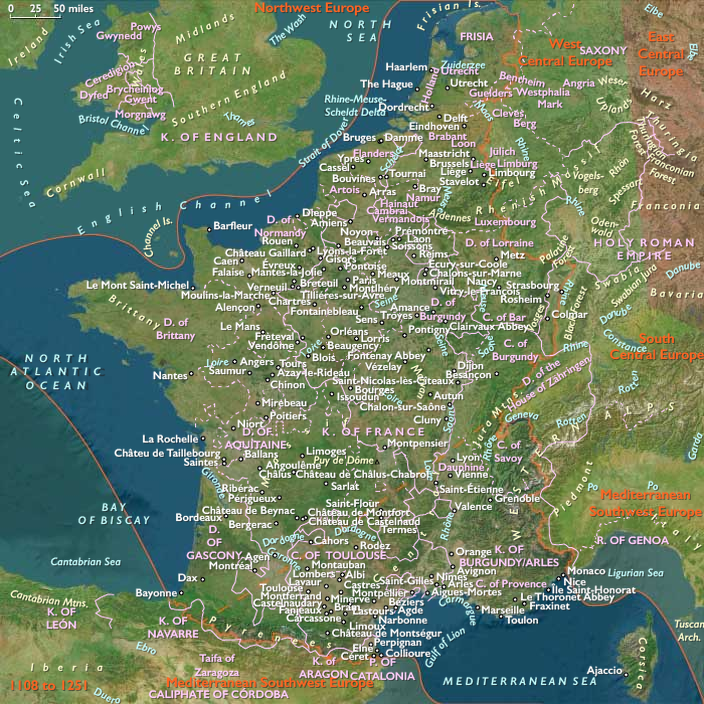
- As Jeanne and Ferdinand traveled to Flanders, they were ambushed and captured by Prince Louis (future Louis VIII of France), the eldest son of Philip II.
- Louis aimed to force Jeanne to surrender her claim to Artois, which had been taken back by force by her father after the death of her aunt, Elizabeth of Flanders.
- To secure their release, Jeanne was compelled to cede these Flemish lands to Philip, expanding Capetian control over Flanders.
Jeanne and Ferdinand Join the Anti-French Alliance
- After their release, Jeanne and Ferdinand aligned themselves with Philip’s enemies, reviving an anti-French coalition consisting of:
- John of England.
- Otto IV of Germany.
- The discontented Flemish nobility.
- This new alliance set the stage for a renewed war between France and its rivals, culminating in the Battle of Bouvines in 1214, where Philip II would secure his greatest military triumph.
Philip’s manipulation of the Anglo-German conflicts and his intervention in Flanders allowed him to consolidate power in northern France, though it also provoked new enemies who would challenge him militarily in the coming years.
Locations
People
- Frederick II
- John of England
- Louis VIII of France
- Otto IV of Brunswick
- Philip II of France
- Pope Innocent III
- Sancho I of Portugal
Groups
- Papal States (Republic of St. Peter)
- Flanders, County of
- Holy Roman Empire
- France, (Capetian) Kingdom of
- Christians, Roman Catholic
- Portugal, Burgundian (Alfonsine) Kingdom of
- England, (Plantagenet, Angevin) Kingdom of
Topics
Commodoties
Subjects
Regions
Subregions
Years: 1212 - 1212
January
Locations
People
- Frederick II
- John of England
- Louis VIII of France
- Otto IV of Brunswick
- Philip II of France
- Pope Innocent III
- Sancho I of Portugal
Groups
- Papal States (Republic of St. Peter)
- Flanders, County of
- Holy Roman Empire
- France, (Capetian) Kingdom of
- Christians, Roman Catholic
- Portugal, Burgundian (Alfonsine) Kingdom of
- England, (Plantagenet, Angevin) Kingdom of
Topics
Commodoties
Subjects
Regions
Subregions