
Both Brandenburg and Sweden had claimed succession …
Years: 1655 - 1655
July
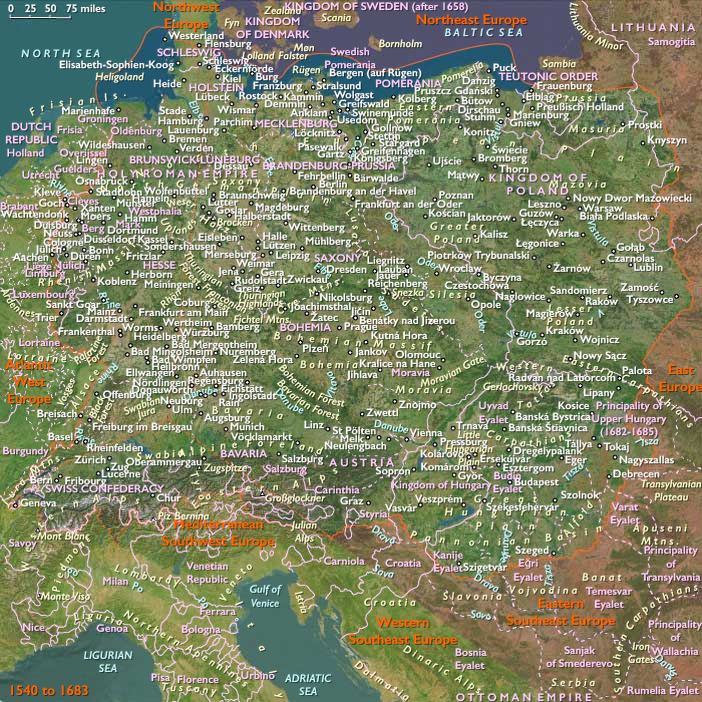
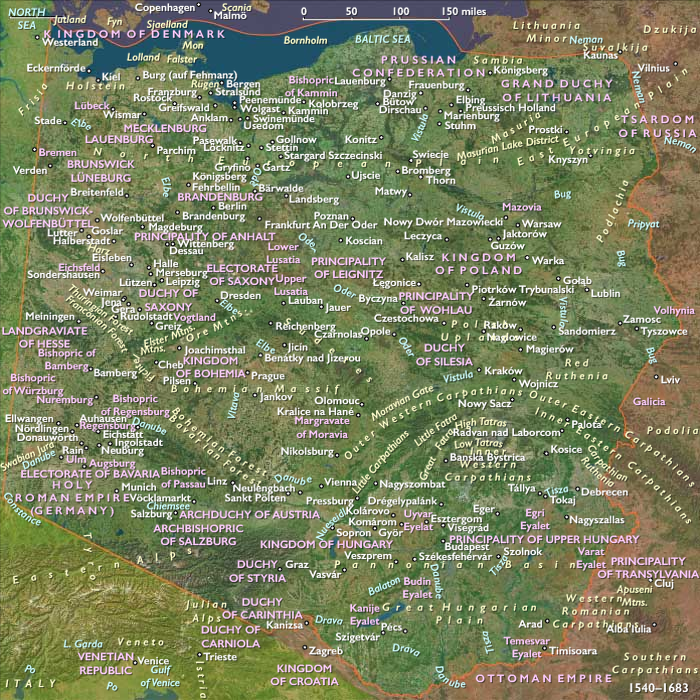
Both Brandenburg and Sweden had claimed succession in the Duchy of Pomerania after the extinction of the local House of Pomerania during the Thirty Years' War.
During the war, Sweden had occupied the Duchy of Pomerania in 1630. her possession secured by the Treaty of Stettin (1630).
After the death of the last Griffin duke, Bogislaw XIV, in 1637, his duchy was supposed to be inherited by Brandenburg, who based her claims on in the Treaty of Grimnitz (1529).
This however had been hindered by the Swedish presence.
Under the terms of the 1648 Peace of Westphalia that had ended the war, Pomerania was to be partitioned between Brandenburg and Sweden.
The 1650 Treaty of Nuremberg had roughly defined the areas that should be under control of Sweden and Brandenburg, respectively.
The Treaty of Stettin, signed on July 19, 1653, determines the actual border, partitioning the Duchy of Pomerania along a line running east of the Oder river.
The areas west of this line (Vorpommern, including Stettin) stay with Sweden and hence are referred to as Swedish Pomerania.
The areas east of the line (Farther Pomerania) are to be transferred to Brandenburg.
Half of the customs revenues of the Farther Pomeranian towns are the prerogative of Sweden even after her withdrawal.
The treaty consolidates Sweden's control of the Oder estuary, adding to Sweden's gain of control at the lower Weser and Elbe rivers from the Peace of Westphalia.
Thus, the treaty consolidates Sweden's control over the mouths of all major German rivers, except for the Rhine.
Swedish Pomerania becomes the largest territorial foothold of Pomerania in Germany.
Locations
People
Groups
- Crimean Khanate
- Cossacks, Zaporozhian
- Sweden, (second) Kingdom of
- Denmark-Norway, Kingdom of
- Russia, Tsardom of
- Polish-Lithuanian Commonwealth (Commonwealth of the Two Nations)
Topics
Commodoties
Subjects
Regions
Subregions
Years: 1655 - 1655
July
Locations
People
Groups
- Crimean Khanate
- Cossacks, Zaporozhian
- Sweden, (second) Kingdom of
- Denmark-Norway, Kingdom of
- Russia, Tsardom of
- Polish-Lithuanian Commonwealth (Commonwealth of the Two Nations)
Topics
Commodoties
Subjects
Regions
Subregions