
Boniface was born probably around 1270, as …
Years: 1296 - 1296
Boniface was born probably around 1270, as the son of Francesco of Verona, and grandson of Giberto I of Verona, one of the three original Lombard barons (the "triarchs") who divided the island of Negroponte (Euboea) in central Greece between them.
Boniface's father, as a younger son, did not inherit his father's triarchy.
The identity of Boniface's mother is unknown.
Boniface, himself the youngest of three brothers, had inherited a single castle from his father, which he sold in 1287 in order to arm and equip himself and ten attendants, and went to the court of the Duchy of Athens.
There he became a friend and close companion of the underage Duke, Guy II de la Roche.
Guy has been under the tutorship and regency of his mother, Helena Angelina Komnene, who had been forced to make submission to Isabella of Villehardouin in December 1289.
She had in 1291 married her second husband, Hugh of Brienne, and he had become bailiff of the duchy.
Guy reaches his majority in 1296 and does homage to Isabella and her husband, Florent of Hainaut.
The ceremony for the coming of age of Guy had been celebrated in June 1294 with great splendor at the co-capital of Thebes, and Guy had chosen Boniface to be the one to knight him.
Boniface, as described in the chronicle of Ramon Muntaner, stood out by his splendid attire even among the assembled nobility of Frankish Greece, dressed in its finery.
As a reward for the knighting, Guy had given Boniface an annuity of fifty thousand sols, conferred on him thirteen castles on the mainland, including the lordship of Gardiki in southern Thessaly, which Guy had inherited from his mother, and the island of Salamis.
Boniface had also been given the hand of a lady, identified as "Agnes de Cicon" by earlier scholars, the lady of Aegina and of Karystos on the southern tip of Euboea.
In addition, the Duke had stipulated that in the event of his own premature death, Boniface is to become regent of the duchy.
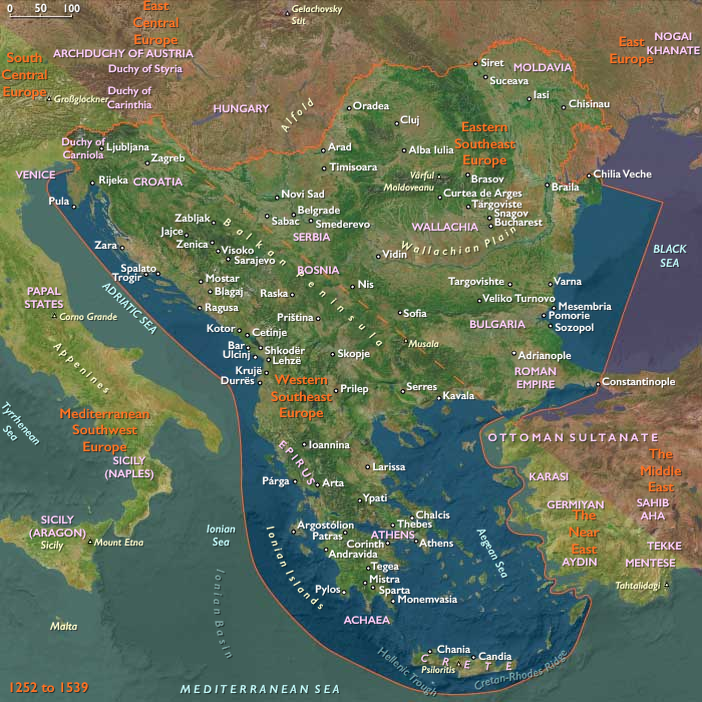
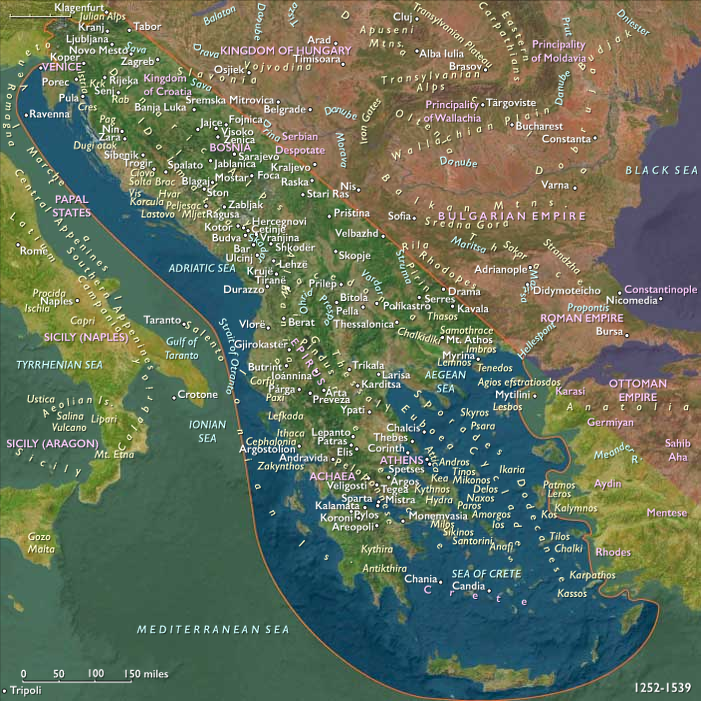
Boniface now turns his attention to his home island of Euboea.
Most of Euboea had been captured from the Lombards for Constantinople in the 1270s by a renegade named Licario, but after Licario's departure from the island in around 1280, the Lombards began recovering the forts they had lost.
Boniface in 1296 decides to campaign against the remaining imperial strongholds on the island, which include his wife's inheritance, Karystos.
He is swiftly successful, and by the end of the year he has managed not only to recover Karystos, but to expel the Byzantines altogether from the island.
This campaign makes him the most powerful figure of the island, for in addition to Karystos, which is his by right of his wife, he holds on to the other forts he has captured as well, aided by the fact that most of the surviving claimants of the Lombard triarchies are women.
At the same time, however, the Republic of Venice increasingly makes its presence felt on the island through its colony at Chalkis, and through the rising influence of the local Venetian representative, the bailo.
Locations
People
Groups
- Greeks, Medieval (Byzantines)
- Pisa, (first) Republic of
- Genoa, (Most Serene) Republic of
- Italians (Latins)
- Venice, (Most Serene) Republic of
- Athens, Duchy of
- Negroponte, Triarchy of
- Roman Empire, Eastern: Palaiologan dynasty
- Achaea, Principality of
Topics
Commodoties
Subjects
Regions
Subregions
Related Events
Showing 10 events out of 45219 total
Years: 1296 - 1296
Locations
People
Groups
- Greeks, Medieval (Byzantines)
- Pisa, (first) Republic of
- Genoa, (Most Serene) Republic of
- Italians (Latins)
- Venice, (Most Serene) Republic of
- Athens, Duchy of
- Negroponte, Triarchy of
- Roman Empire, Eastern: Palaiologan dynasty
- Achaea, Principality of
Topics
Commodoties
Subjects
Regions
Subregions