
Boleslaw V, son of the assassinated Leszek …
Years: 1257 - 1257
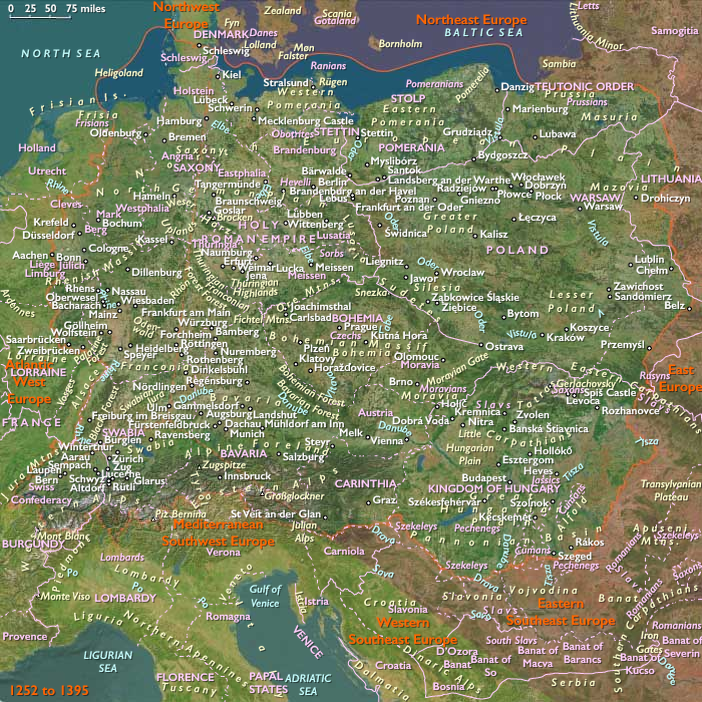
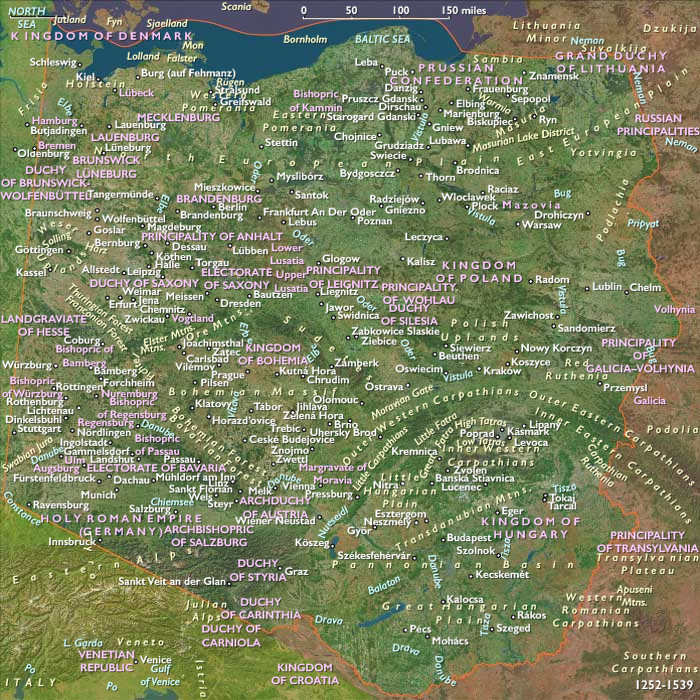
Boleslaw V, son of the assassinated Leszek the White, Prince of Sandomierz, succeeds his brother Przemyzl in 1257 to become prince in Kraków, and thus the predominant prince in fragmented Poland, though the authority of the Duke of Kraków is not adequately defined by law and is ignored in actual practice.
Bolesaw had earlier married Cunegunda (Kinga), daughter of King Béla IV of Hungary. (According to medieval chronicles, the marriage, entered into with reluctance on the bride’s part, was never consummated. Kinga, being extremely pious, was averse to fulfilling her marital duties. At first Boleslaw tried to change her mind, but she demurred and he reluctantly accepted the situation. His religious convictions forbade him to take a mistress. Hence the epithet, "the Chaste" or "the Shy. Kinga’s reign as queen is marked by such charitable works as visiting the poor and helping the lepers.)
Kraków, almost entirely destroyed during the Tatar invasions of 1241, has been rebuilt by Boleslaw on a regular grid pattern and is incorporated in 1257, based on the Magdeburg law, with tax benefits and trade privileges for its citizens, who are mainly German immigrants.
Concurrent with the metamorphosis in the structure of the Polish state and sovereignty had been an economic and social impoverishment of the country.
Harassed by civil strife and foreign invasions, like that of the Mongols in 1241, the small principalities had become enfeebled and depopulated.
The attendant decrease in the incomes of the princes led them to encourage immigration from foreign countries.
A great number of German peasants, who, during the interregnum following the death of Frederick II, had suffered great oppression at the hands of their lords, are induced to settle in Poland under highly favorable conditions.
Thus, alongside the Polish "grody" have come into existence a large number of towns, with German laws, customs and institutions.
The ancient towns of Kraków, Lwów, Poznań, Plock and others having received a large influx of Germans, the resettled cities come to be regarded by the metropolitan towns in Germany as their branches and as outposts of German trade and civilization in Poland.
The common law of the country is supplanted by the Magdeburg and Halle law, German silver coins become the money of the country, and all municipal records begin to be kept in the German language.
But for the Mongol invasion, Polish towns would have developed without foreign interference and the cities' populations would have remained mainly Polish.
Locations
People
Groups
- Germans
- Tatars
- Poles (West Slavs)
- Magdeburg, Archbishopric of
- Mongols
- Poland, Greater
- Poland during the period of fragmentation, Kingdom of
- Mongol Empire
- Holy Roman Empire
Topics
- Ostsiedlung (German: Settlement in the East), a.k.a. German eastward expansion
- Poland, Fragmentation of
- Mongol Conquests
- Mongol Invasions of Europe
Commodoties
Subjects
Regions
Subregions
Years: 1257 - 1257
Locations
People
Groups
- Germans
- Tatars
- Poles (West Slavs)
- Magdeburg, Archbishopric of
- Mongols
- Poland, Greater
- Poland during the period of fragmentation, Kingdom of
- Mongol Empire
- Holy Roman Empire
Topics
- Ostsiedlung (German: Settlement in the East), a.k.a. German eastward expansion
- Poland, Fragmentation of
- Mongol Conquests
- Mongol Invasions of Europe
Commodoties
Subjects
Regions
Subregions