
Boleslaw begins annexing slices of Slovakia in …
Years: 1001 - 1001
Boleslaw begins annexing slices of Slovakia in 1001.
Locations
People
Groups
- Hungarian people
- Slavs, West
- Wends, or Sorbs (West Slavs)
- Bohemia, Duchy of
- German, or Ottonian (Roman) Empire
- Poland, Principality of
- Austria, Margravate of
- Czechs [formerly Bohemians] (West Slavs)
Commodoties
Subjects
Regions
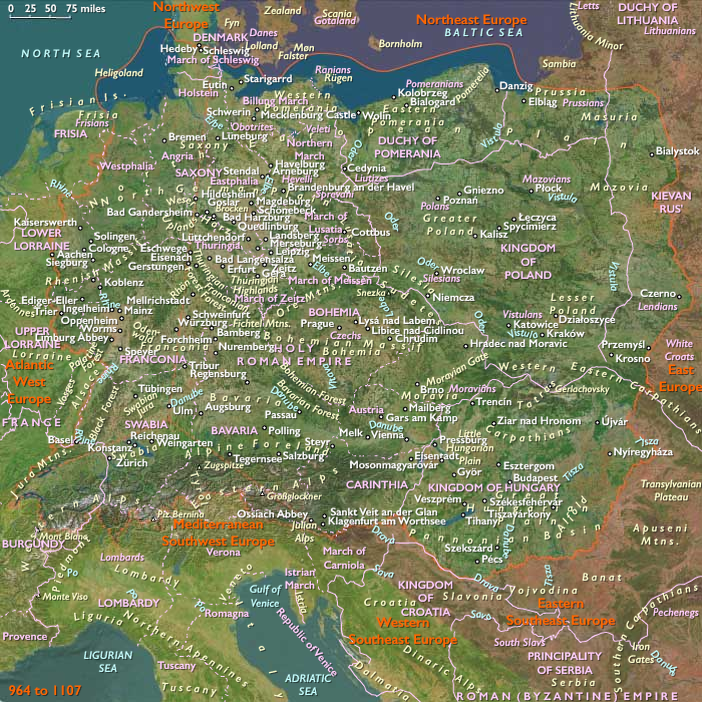
Subregions
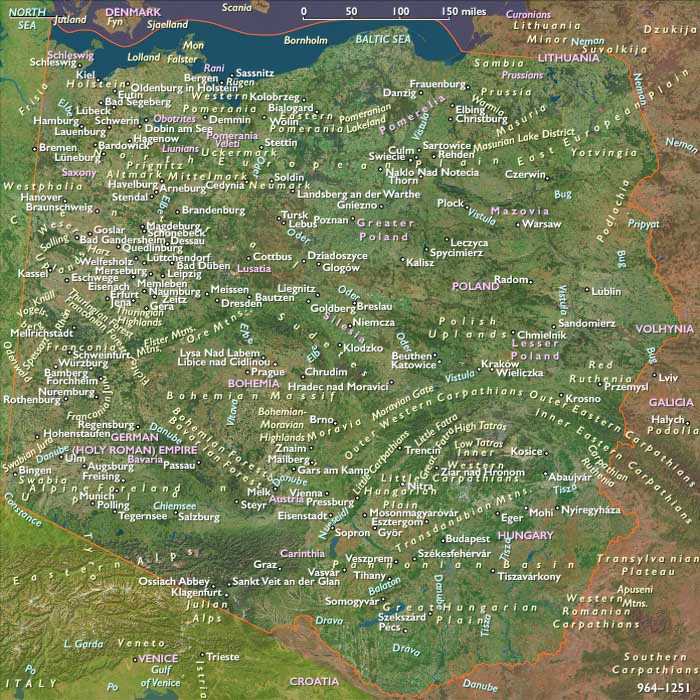
Related Events
Filter results
Showing 10 events out of 51980 total
Mahmud of Ghazni, an ethnic Turk and a Muslim, had taken over his father's kingdom in 998.
He had then set out west from Ghazni to take the Kandahar region followed by Bost (Lashkar Gah), which he has turned it into a militarized city.
Beginning in 1001, Mahmud leads mounted armies in an invasion of the Punjab region of northern India, employing tactics of massacre, pillage, and destruction to secure for the Muslims a gateway into the Indian subcontinent.
At Peshawar on November 28, 1001, Mahmud’s fifteen-thousand-man light cavalry, superior in skill and training to the Indian defenders, defeats an army nearly three times its size, commanded by Raja Jayapala of the Kabul Shahi dynasty, killing the Indian leader.
The Marital Affairs of Robert II of France: Dynastic Strategy and Papal Opposition (989–1001)
As the Capetian dynasty sought to establish its legitimacy and secure powerful alliances, Robert II of France was repeatedly entangled in politically driven marriages, often encountering papal resistance. His early marriages reflect the complex diplomatic maneuvering of the period, as well as the growing influence of the papacy over royal unions.
First Marriage: Rozala-Susanna of Italy (989–996)
- Around 989, Hugh Capet, having failed to secure an imperial bride from Constantinople for his son, arranged for Robert to marry Rozala (Susanna), the daughter of Berengar II of Italy.
- Rozala, already a widow of Arnulf II of Flanders, was many years older than Robert and brought with her substantial Flemish territories, strengthening Capetian control in the north.
- However, this union was short-lived. After Hugh Capet’s death in 996, Robert divorced Rozala, discarding the Flemish alliance in favor of a Burgundian connection.
Second Marriage: Bertha of Burgundy and Papal Excommunication (996–1000)
- Robert then pursued Bertha of Burgundy, daughter of Conrad of Burgundy and widow of Odo I of Blois.
- This match was politically advantageous, reinforcing Capetian claims in Burgundy and countering the power of the House of Blois.
- However, Bertha was Robert’s cousin, and Pope Gregory V refused to sanction the marriage on grounds of consanguinity.
- Despite this, Robert persisted in the union, leading to his excommunication by the pope.
- The excommunication weakened his position, forcing him into lengthy negotiations with Gregory’s successor, Sylvester II, who eventually annulled the marriage.
Final and Lasting Marriage: Constance of Arles (1001)
- In 1001, Robert entered into his final and longest-lasting marriage with Constance of Arles, the daughter of William I of Provence.
- This union cemented Capetian ties with southern France, an increasingly wealthy and influential region.
- Constance proved to be a strong-willed and politically assertive queen, often at odds with Robert’s courtiers but ultimately securing her family’s influence at court.
Impact and Legacy
- Robert’s turbulent marital history highlights the Capetians’ struggle to consolidate power while navigating the growing influence of the papacy.
- His excommunication and forced annulment demonstrated the Church’s increasing authority over royal marriages, a conflict that would later resurface in French history.
- Ultimately, his union with Constance of Arles produced several heirs, securing the Capetian dynasty’s future stability.
Robert’s marital missteps illustrate the fragile balance of dynastic ambition, papal authority, and feudal politics in the early Capetian era, as France slowly transformed into a more centralized medieval monarchy.
Danish attacks on England escalate between 991 and 1005 from small isolated raids to massed attacks by larger forces.
The Danes ravage the countryside, demanding huge tributes (Danegeld) from Æthelred, the Anglo-Saxon king.
The attacks continue, however, and their plunder and pillage tactics, combined with a rapid march strategy, bring them as far as Æthelingadene.
The attack begins with the arrival of the Viking fleet off the Sussex coast, which then proceeds to "Æthelingadene" where the men of Hampshire unite to fight against them.
An indication of the severity of the English casualty list is given by the Anglo-Saxon Chronicle, which cites the total English losses as eighty-one, including two high-reeves and three thegns, of the bishop of Winchester; this is compared, to 'a much greater number' lost by the Danes.
The Danes manage to win the field and advance further west, however, while the Anglo-Saxons retreat to Winchester.
The First Battle of Alton had failed to stop the Danish army.
They attack Devon, burning many towns such as Teignton, until the area surrenders.
The advance continues towards Exmouth, until …
…they reach Pinhoe, a village on the northeastern outskirts of Exeter, where the high-steward of the king, Cole, and Edsy, the reeve of the king, once again raises an army against them at the Battle of Pinhoe.
The Vikings have laid siege to Exeter, but due to the strong fortification of Athelstan they start pillaging nearby villages.
Men from Devon and Somerset fight the Danes to stop their invasion.
The battle is hard fought and the defenders nearly use up all their ammunition.
A priest of Pinhoe, wanting to supply the Saxon troops with ammunition, sneaks through the Danish lines and runs to Exeter to obtain arrows and arms.
He successfully returns to the defending Saxons and supplies them with the weapons, but these prove insufficient for the Saxons to defeat the Vikings, who infiltrate Pinhoe and burn it to the ground as a warning for the citizens of Exeter.
The priest will later be awarded for his outstanding bravery an annual payment of sixteen shillings, equivalent to the annual salary of the Vicar of Pinhoe.
Again, the Danes prevail and burn 'many goodly towns that we cannot name'.
Here, they turn eastwards and reach …
…the Isle of Wight, until the people here make peace with them.
The Emperor had spent the remainder of 1000 in Italy without any notable activities.
Otto III had earlier declared himself king of Lombardy and is preparing to establish a Rome-based ”ecclesiastical empire.” When, in January 1001, Tibur, Italy, rebels against Otto, he lays siege to the town, quickly forces its surrender, and then pardons its inhabitants.
In a change of policy towards the papacy, Otto III bestows the governance of the city upon Pope Sylvester II as part of the Papal States but under the overlordship of the Holy Roman Empire.
Previously, Otto III had revoked the Pope's rights as secular ruler by denying the Donation of Constantine and by amending the Diploma Ottonianum.
Angered by Otto’s action, …
…the Romans, who had wanted the rival town destroyed, rebel against the Emperor in February and besiege his palace.
Accompanied by Bishop Bernward of Hildesheim and the German chronicler Thangmar, Otto III returns to the city to conduct peace negotiations with the rebellious Romans.
Though both sides agree to a peaceful settlement, with the Romans respecting Otto III's rule over the city, feelings of mistrust characterize the city.
Otto III's advisors urge the Emperor to wait outside the city until military reinforcements can arrive to ensure his safety.
After placating the rebels momentarily, …
…Otto withdraws to the monastery of St. Apollinaris, near Ravenna, to do penance.
Unable to regain control of the imperial city, he requests military support from his third cousin Henry of Bavaria.
While in Ravenna, Otto III receives ambassadors from Duke Boleslaw I of Poland and approves the plans of King Stephen of Hungary to establish the Archdiocese of Esztergom in order to convert Hungary to Christianity.
Otto III also strengthens relations with the Venetian Doge, Pietro II Orseolo.
Since 996, the Emperor had been godfather to Pietro II's son, Otto Orseolo, and in 1001 the Emperor arranges for Pietro II's daughter to be baptized.
Ulric Manfred, born in Turin, was the son of Manfred I, from whom he has inherited a vast march centered on Turin (1000), which had been created from the lands of Arduin Glaber.
By a charter dated July 31, 1001, the Emperor Otto III confirms his possessions and grants him several privileges.
This grant is requested by Hugonis marchionis, probably Hugh the Great, margrave of Tuscany.
Years: 1001 - 1001
Locations
People
Groups
- Hungarian people
- Slavs, West
- Wends, or Sorbs (West Slavs)
- Bohemia, Duchy of
- German, or Ottonian (Roman) Empire
- Poland, Principality of
- Austria, Margravate of
- Czechs [formerly Bohemians] (West Slavs)
