
The most powerful of Madagascar's kingdoms—the one …
Years: 1684 - 1827
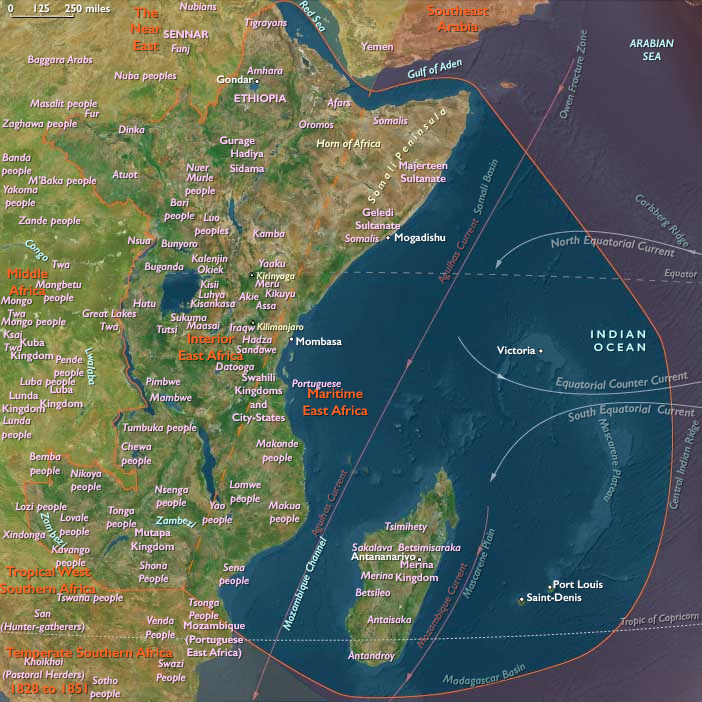
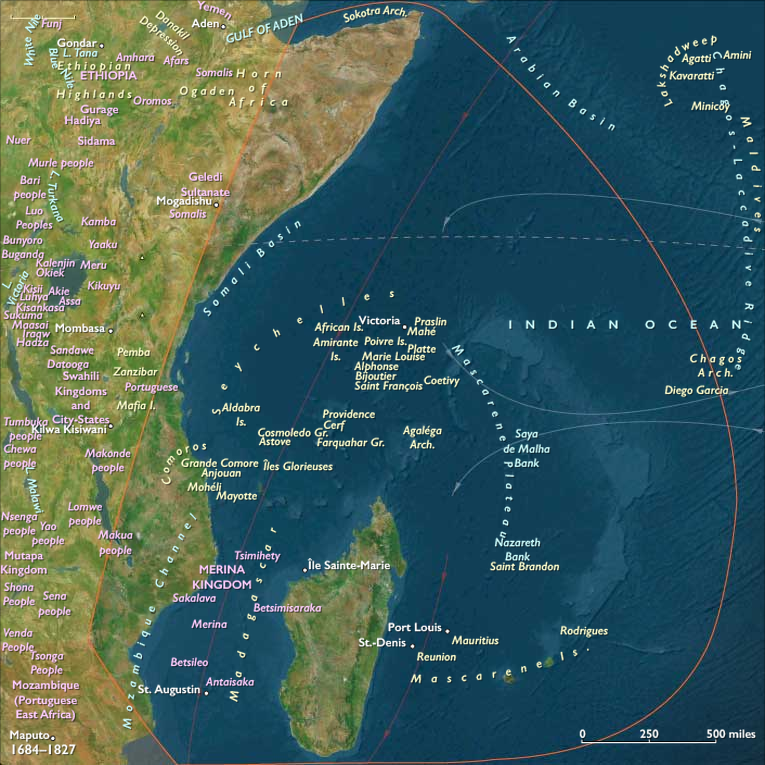
The most powerful of Madagascar's kingdoms—the one that eventually establishes hegemony over a great portion of the island—is that developed by the Merina ethnic group.
Before the Merina emergevas the dominant political power on the island in the nineteenth century, they alternate between periods of political unity and periods in which the kingdom separates into smaller political units.
The location of the Merina in the central highlands affords them some protection from the ravages of warfare that recur among the coastal kingdoms.
The distinction, recognized both locally and internationally, between the central highlanders (the Merina) and the cotiers (inhabitants of the coastal areas) will soon exert a major impact on Madagascar's political system.
Organized like the coastal kingdoms in a hierarchy of nobles, commoners, and slaves, the Merina develop a unique political institution known as the fokonolona (village council).
Through the fokonolona, village elders and other local notables are able to enact regulations and exert a measure of local control in such matters as public works and security.
Two monarchs play key roles in establishing Merina political dominance over Madagascar.
The first, who rules under the name of Andrianampoinimerina (r. 1797-1810), seizes the throne of one of the Merina kingdoms in 1787.
By 1806 he has conquered the remaining three kingdoms and united them within the former boundaries of Imerina, the capital established at the fortified city of Antananarivo.
Radama I (r. 1810- 28), an able and forward-looking monarch, succeeds to the throne in 1810 upon the death of his father.
By adroitly playing off competing British and French interests in the island, he is able to extend Merina authority over nearly the entire island of Madagascar.
Radama I first conquers the Betsileo ethnic group in the southern part of the central highlands and subsequently overpowers the Sakalava, an ethnic group that also seeks at times to assert its hegemony over other groups.
With the help of the British, who want a strong kingdom to offset French influence, Radama I modernizes the armed forces.
In 1817 the peoples of the east coast, facing an army of thirty-five thousand soldiers, submit with little or no protest; Radama then conquers the entire southeast as far as Tolanaro.
Particularly barren or impenetrable parts of the island escape conquest, especially in the extreme south, but before his death Radama I succeeds in bringing the major and more hospitable portions of the country under Merina rule.
Locations
People
Groups
- Sakalava people
- Antanosy people
- Mahafaly
- Merina, Kingdom of
- Madagascar, feudal
- Antandroy
- Betsileo people
- Menabé, Sakalava Kindom of
- Boina, Sakalava Kingdom of
- Betsimisaraka confederation
Topics
- Interaction with Subsaharan Africa, Early European
- Colonization of Asia, Portuguese
- Colonization of Asia, French
- Sub-Saharan Africa, Modern
- Piracy, Golden Age of
Commodoties
Subjects
Regions
Subregions
Years: 1684 - 1827
Locations
People
Groups
- Sakalava people
- Antanosy people
- Mahafaly
- Merina, Kingdom of
- Madagascar, feudal
- Antandroy
- Betsileo people
- Menabé, Sakalava Kindom of
- Boina, Sakalava Kingdom of
- Betsimisaraka confederation
Topics
- Interaction with Subsaharan Africa, Early European
- Colonization of Asia, Portuguese
- Colonization of Asia, French
- Sub-Saharan Africa, Modern
- Piracy, Golden Age of
Commodoties
Subjects
Regions
Subregions