
Filters:
The initial attempt to develop a Slovak …
Years: 1828 - 1839
The initial attempt to develop a Slovak literary language had been made by a Jesuit priest, Anton Bernolak.
The language he developed in the 1780s, subsequently called bernoldkovcina, is based primarily on western Slovak dialects.
The language has been adopted by the Catholic clergy and disseminated in religious literature.
Bernolak and his followers, however, had remained loyal to the Kingdom of Hungary, and their movement never developed nationalist political implications.
The Protestant revival was more limited in scope, confined largely to the Slovak minority settled in urban centers.
Slovak Protestantism is characterized by an attachment to Czech culture.
The artificial and archaic language of the Czech Bible, known as biblictina, had served as the literary vehicle of the Protestant clergy since the sixteenth century.
In the early nineteenth century, two German-educated Protestant theologians, the poet Jan Kollar and Pavol Safarik, had endeavored to create a literary language that would combine Czech with elements of the central Slovak dialect.
They published a reader, Citanka, in 1825, and beginning in the 1830s they gain a following among the younger generation of students at Protestant secondary schools.
At this time, the Slovak national awakening splits into two factions
Kollar and Safarik are adherents of pan-Slavic concepts that stress the unity of all Slavic peoples.
They continue to view Czechs and Slovaks as members of a single nation, and they attempt to draw the languages closer together.
Other Slovaks break with the Czechs and proclaim the separate identity of the Slovak nation.
The language he developed in the 1780s, subsequently called bernoldkovcina, is based primarily on western Slovak dialects.
The language has been adopted by the Catholic clergy and disseminated in religious literature.
Bernolak and his followers, however, had remained loyal to the Kingdom of Hungary, and their movement never developed nationalist political implications.
The Protestant revival was more limited in scope, confined largely to the Slovak minority settled in urban centers.
Slovak Protestantism is characterized by an attachment to Czech culture.
The artificial and archaic language of the Czech Bible, known as biblictina, had served as the literary vehicle of the Protestant clergy since the sixteenth century.
In the early nineteenth century, two German-educated Protestant theologians, the poet Jan Kollar and Pavol Safarik, had endeavored to create a literary language that would combine Czech with elements of the central Slovak dialect.
They published a reader, Citanka, in 1825, and beginning in the 1830s they gain a following among the younger generation of students at Protestant secondary schools.
At this time, the Slovak national awakening splits into two factions
Kollar and Safarik are adherents of pan-Slavic concepts that stress the unity of all Slavic peoples.
They continue to view Czechs and Slovaks as members of a single nation, and they attempt to draw the languages closer together.
Other Slovaks break with the Czechs and proclaim the separate identity of the Slovak nation.
Locations
Groups
- Czechs [formerly Bohemians] (West Slavs)
- Slovaks (West Slavs)
- Christians, Roman Catholic
- Moravian Margravate
- Bohemia, Kingdom of
- Holy Roman Empire
- Protestantism
- Jesuits, or Order of the Society of Jesus
- Austrian Empire
Subjects
Regions

Subregions
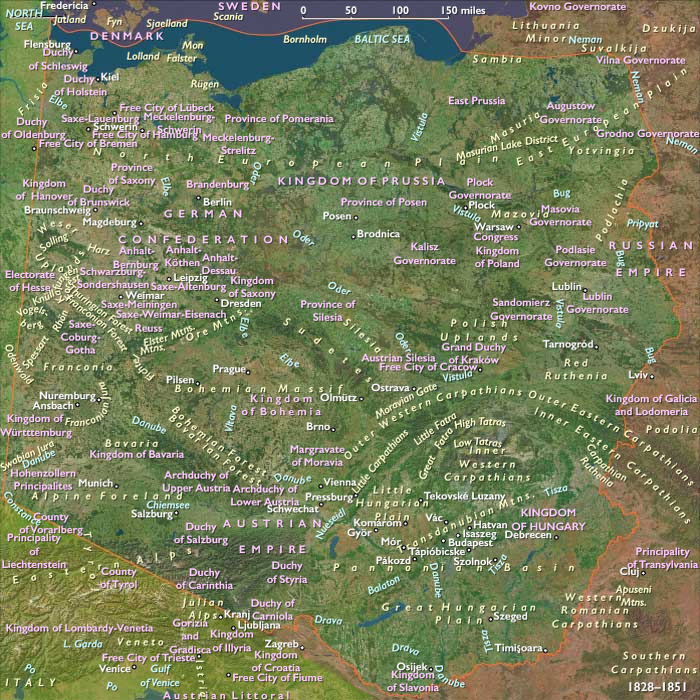
Years: 1828 - 1839
Locations
Groups
- Czechs [formerly Bohemians] (West Slavs)
- Slovaks (West Slavs)
- Christians, Roman Catholic
- Moravian Margravate
- Bohemia, Kingdom of
- Holy Roman Empire
- Protestantism
- Jesuits, or Order of the Society of Jesus
- Austrian Empire
Subjects
Regions
Subregions