
Bezprym is the only child of Boleslaw …
Years: 1030 - 1030
Bezprym is the only child of Boleslaw I the Brave born from his second marriage with an unknown Hungarian princess, who, in older literature, was identified as Judith, daughter of Géza, Grand Duke of Hungary.
Though opinions vary about the identity of Boleslaw’s second wife, there is a number of researchers still support the hypothesis of her being the daughter of Géza.
The marriage of Bezprym’s parents had ended soon after his birth, probably because of the deterioration in political relations between Poland and Hungary.
Bezprym's mother had been repudiated and sent away, although probably she remained in Poland and died soon afterwards.
Shortly after Boleslaw’s divorce, he had remarried with Emnilda, who has borne him five children.
The eldest son of this union, the future Mieszko II Lambert, was born in 990.
Almost nothing is known about Bezprym's first years of life in contrast with his half-brother Mieszko II, whose youth is fully described in several contemporary sources.
This probably shows that his father disliked him and considered Mieszko II as his successor since his birth, which was already confirmed by Boleslaw’s later political activity.
Bezprym was destined to a Church career, a fact demonstrated in the Vita of St. Saint Romuald, a hermit from Ravenna.
There it is stated that in one of the hermitages resided a son of a Polish Duke, who in 1001 gave him a horse.
According to modern historians, this Polish prince could only be Bezprym.
In earlier historiography, it was theorized that the Polish prince who lived in the hermitage of Ravenna was Lambert, son of Mieszko I or an unknown son of Boleslaw from his first marriage with the daughter of Rikdag, Margrave of Meissen.
It is possible that he was in Hungary and there he was appointed head of Veszprém and Zala county.
In this case the name "Veszprém" originated from his name.
This hypothesis proposed by a Hungarian researcher, is not accepted by Polish historians.
It is also probable that Bezprym was present at the coronation of his father as King of Poland in Gniezno Cathedral on April 25, 1025.
Probably after Mieszko II took control over the government of Poland, both Bezprym and his youngest half-brother Otto resided in Poland for a short time.
However, Mieszko had soon expelled Bezprym from the country.
He probably does the same with Otto in 1030, when he discovers that they are conspiring against him with the help of Emperor Conrad II.
Locations
People
Groups
- Saxony, Duchy of
- German, or Ottonian (Roman) Empire
- Poles (West Slavs)
- Austria, Margravate of
- Hungary, Kingdom of
- Poland of the first Piasts, Kingdom of
Commodoties
Subjects
Regions
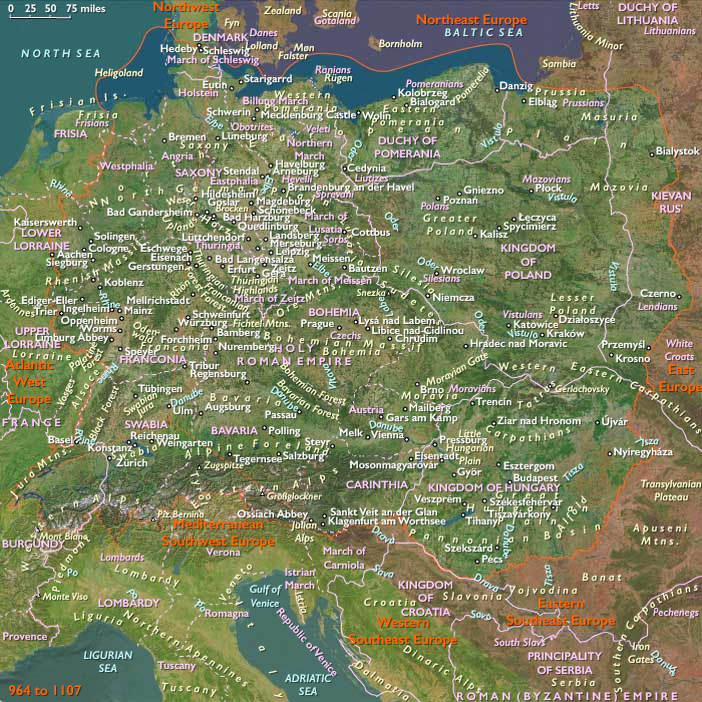
Subregions
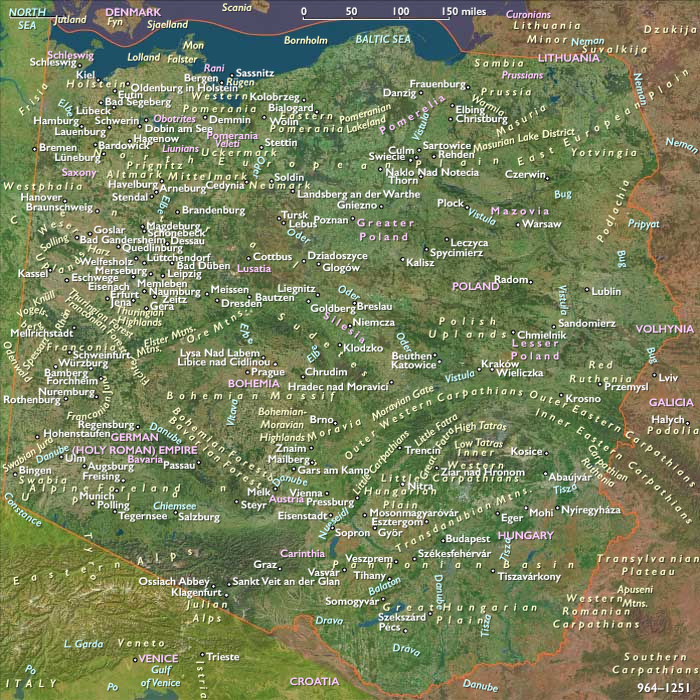
Years: 1030 - 1030
Locations
People
Groups
- Saxony, Duchy of
- German, or Ottonian (Roman) Empire
- Poles (West Slavs)
- Austria, Margravate of
- Hungary, Kingdom of
- Poland of the first Piasts, Kingdom of
Commodoties
Subjects
Regions
Subregions