
Bethencourt is defeated by the aboriginals of …
Years: 1422 - 1422
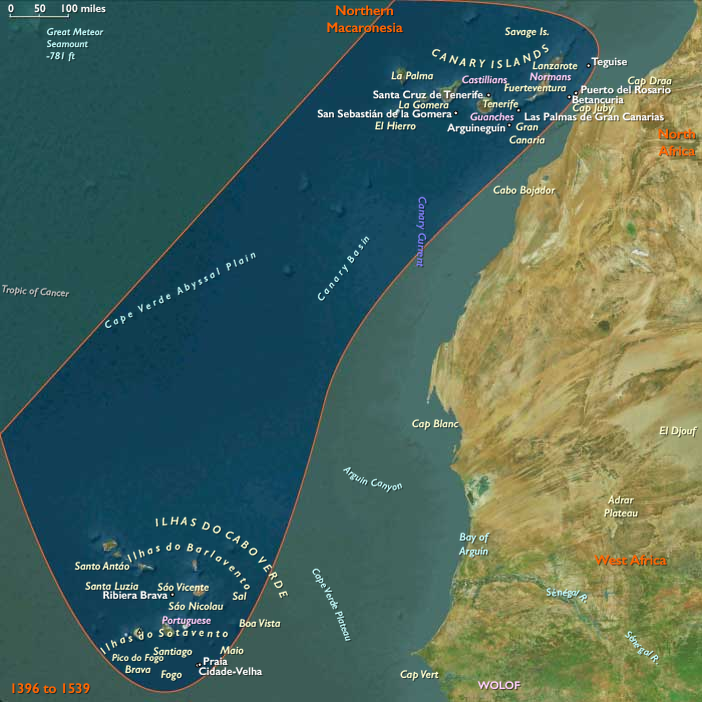
Bethencourt is defeated by the aboriginals of the island of Gran Canaria (Canarios) in the battle of Arguineguin at the south of the island, acquiring the title of “Great.
He dies in 1422, and is buried in the church of Grainville-la-Teinturiere in Normandy.
Locations
People
Groups
Topics
Commodoties
Subjects
- Origins
- Commerce
- Labor and Service
- Conflict
- Mayhem
- Exploration
- Faith
- Government
- Technology
- Movements
Regions
Subregions
Related Events
Filter results
Showing 10 events out of 42162 total
Philippa is effectively Regent during King Eric's periods of absence abroad.
In Sweden, where she spends a lot of her time, she appears to have been de facto ruler even when the King was in residence.
Eric evidently has great trust in Philippa.
Both medieval and modern authors give a favorable account of her rule.
It is even said that in certain matters she was more efficient than her husband; scholars have largely accepted this judgment of the Queen without going into detail.
Philippa in 1422 presides over the Swedish council in order to solve a dispute between Swedish noble factions.
The days of Constantinople and of Hellenism are numbered with Murad as sultan.
After restoring order in the Ottoman empire, Murad revokes all the privileges accorded in 1399 to Constantinople by his father and …
…lays siege to Constantinople in June 1422.
The combination of stiff resistance by the defenders and the city's nearly impregnable walls force the attackers to retire, but only after the Greeks provide Murad with huge amounts of tribute.
(Another factor prompting the Turkish withdrawal may have been Murad's necessary return to the Ottoman capital to prevent another pretender, also possibly encouraged by Constantinople, from usurping power.)
Relations between the Timurid state and the Ming China of the Yongle Emperor have normalized during Shah Rukh's rule, as compared to the era of Timur and the Hongwu Emperor, who had nearly started a war (which had been averted only due to the death of Timur).
Chinese embassies, led by Chen Cheng, had visited Samarkand and Herat several times in 1414-1420, while a large embassy sent by Shah Rukh (and immortalized by its diarist, Ghiyāth al-dīn Naqqāsh) travels to China in 1419-1422.
Lorenzo Monaco produces the monumental frescoes of the “Life of the Virgin” for the Bartolini Chapel of the Church of Santa Trinita in Florence in 1420-22, and, in 1422, the “Adoration of the Magi.”
Jacopo della Quercia, in 1422, completes the marble reliefs in the Trenta Chapel at San Frediano in Lucca, an unusual blend of elegant Gothic rhythms and massive classical form.
France in Crisis (1422): The Dual Monarchy, Civil War, and the Work of Alain Chartier
By 1422, France was in a state of devastation, still reeling from the disaster at Agincourt (1415) and the subsequent English conquest of Normandy. The civil war between the Armagnacs and the Burgundians showed no sign of resolution, further weakening French resistance.
Following the deaths of both Henry V of England and Charles VI of France within two months of each other in 1422, an infant, Henry VI of England, became the nominal king of both England and France, in accordance with the 1420 Treaty of Troyes. Meanwhile, the Dauphin Charles was recognized in southern France as Charles VII but remained uncrowned and politically weak.
I. The Political Situation in France and England (1422)
- King Charles VI of France died on October 21, 1422, at age fifty-three, leaving his kingdom divided.
- The Treaty of Troyes (1420) had disinherited the Dauphin Charles, granting the French throne to Henry V of England and his heirs.
- However, Henry V had died unexpectedly on August 31, 1422, just two months before Charles VI, leaving his infant son, Henry VI, as the nominal ruler of both England and France.
- John of Lancaster, Duke of Bedford, was declared Regent of France, focused on consolidating English control and ensuring Henry VI's claim to the French throne.
- Meanwhile, Humphrey, Duke of Gloucester, acted as Lord Protector of England, creating a power struggle within the English court.
II. France’s Internal Struggles and the Uncrowned Charles VII
- The Armagnac-Burgundian Civil War continued, preventing a unified French resistance against England.
- The Dauphin Charles VII, though recognized in the south, remained uncrowned, lacking the political and military strength to assert his rule.
- France was in a desperate situation, with large portions of the country occupied by the English and their Burgundian allies.
III. Alain Chartier: A Voice for French Unity and Reform
- Alain Chartier (b. c. 1385 in Bayeux) was a poet, diplomat, and political writer, born into a distinguished family.
- He studied at the University of Paris, as did his elder brother Guillaume Chartier, who later became Bishop of Paris (1447).
- Chartier became a loyal supporter of Charles VII, serving as clerk, notary, and financial secretary.
His Key Works and Their Significance
- Livre des quatre dames (1416) – A poetic lament on the aftermath of Agincourt, told through the voices of four noblewomen affected by the war.
- Débat du reveille-matin (1422–1426?) – A dialogue-based political commentary on France’s struggles.
- La Belle Dame sans Mercy (1424) – A celebrated lyrical poem, influencing later French and English courtly literature.
Le Quadrilogue Invectif (1422): A Call for National Unity
- In 1422, Chartier wrote Le Quadrilogue Invectif, a highly original prose work analyzing France’s political plight during the Anglo-French conflict.
- The dialogue features four interlocutors:
- France herself, personified as a suffering mother.
- The Nobility, accused of selfish ambition and failing to defend the kingdom.
- The Clergy, criticized for corruption and neglect of spiritual duty.
- The Common People, portrayed as the primary victims of war and civil strife.
- Key Themes:
- The abuses of the feudal military system and the suffering of the peasantry.
- The need for unity between warring factions to fight the English invaders.
- The argument that France’s cause, while desperate, was not yet lost—if internal divisions could be resolved.
IV. The Impact of Chartier’s Work
- Chartier’s writings helped shape early French nationalism, calling for an end to factionalism in favor of a united resistance against England.
- His vision of reform influenced the court of Charles VII, especially during the later campaigns of Joan of Arc (1429–1431).
- Le Quadrilogue Invectif remains one of the most important political treatises of the Hundred Years' War, reflecting the despair and hope of early 15th-century France.
V. Conclusion: A Nation in Crisis but Not Yet Defeated
- France’s situation in 1422 seemed dire, with:
- An uncrowned Dauphin, Charles VII.
- English occupation of most of the north.
- Continued civil war between the Armagnacs and Burgundians.
- However, Chartier’s writings argued that France could still be saved, provided its leaders set aside their rivalries and worked toward a common cause.
The Treaty of Troyes and the succession of Henry VI in 1422 marked the height of English ambitions in France, but French resistance, inspired by figures like Chartier, was far from over.
The Founding of the University of Franche-Comté in Dole (1423)
In 1423, the University of Franche-Comté was established in Dole, then part of the Duchy of Burgundy. This marked a significant moment in the expansion of higher education in medieval France, reinforcing Burgundy’s status as a center of learning and intellectual life.
I. The Strategic Importance of Dole
- Dole, the capital of the Free County of Burgundy (Franche-Comté), was a thriving administrative and judicial center under Burgundian rule.
- The decision to establish a university in Dole was part of Burgundy’s broader ambition to consolidate its influence by fostering education, law, and governance.
II. The Role of the Duchy of Burgundy in Education
- Under the Valois Dukes of Burgundy, particularly Philip the Good, patronage of learning and culture flourished.
- The establishment of a university in Dole aligned with the Duchy’s goal of strengthening regional autonomy and legal administration.
- The university was modeled after the great centers of medieval learning, such as Paris and Bologna, focusing on law, theology, and the liberal arts.
III. Legacy and Later Development
- The University of Franche-Comté remained in Dole until 1678, when Louis XIV relocated it to Besançon after annexing the region to France.
- Despite its relocation, the university continued to serve as a key institution of higher learning, producing prominent scholars, theologians, and jurists.
- Today, the University of Franche-Comté remains one of France’s oldest academic institutions, with a legacy that dates back to its founding in 1423.
The establishment of the University of Franche-Comté in 1423 was a testament to the Burgundian commitment to education and governance, playing a crucial role in the intellectual history of the region.
Erik VII, ruler of the Kalmar Union, issues his edict of 1422, which permits only Danes to pursue trades and crafts, a blatant move against the power of the Hanseatic League.
The league, fearing loss of trade to Norway (the dominant trading member of the three Kalmar states) and exorbitant trade tariffs, allies with the county of Holstein (still warring with Kalmar over Erik’s 1409 seizure of the duchy of Schleswig), and declares war on Kalmar with the objective of breaking Erik’s monopoly on shipping traffic through the Oresund.
Erik’s forces conquer and successfully hold the western Baltic Sea port of Flensburg in Schleswig; his Danish navy defeats the league’s fleet in the Oresund, and Erik takes control of the entrance to the sound.
Jacqueline of Hainaut is an honored guest at the court of England, and when the future Henry VI was born, Jacqueline had been made one of his godparents.
It is only after the unexpected death of Henry V in 1422 that Jacqueline obtains a dubious divorce from John IV of Brabant, valid only in England, that allows her third marriage with Humphrey, Duke of Gloucester, Henry V's brother and Regent of the Kingdom on behalf of his infant nephew Henry VI.
However, as not all rules are observed, the marriage is arranged in haste and in secret sometime between February and March 7, 1422, in the town of Hadleigh, Essex.
The news of this marriage shocks everyone.
It is announced on October 15, 1422, that Jacqueline not only is married with one of the most powerful princes of Europe, but also she is rumored to be pregnant with his child.
To secure her position, Jacqueline has to obtain the formal annulment of her marriage with John IV of Brabant, but when she asks Pope Martin V in Rome and Antipope Benedict XIII in Avignon to resolve her irregular marital status, her uncle John III intervenes against it.
Unexpectedly, Philip the Good, who wants to prevent an English invasion, supports the annulment of her cousin's marriage with the Duke of Brabant.
Years: 1422 - 1422
Locations
People
Groups
Topics
Commodoties
Subjects
- Origins
- Commerce
- Labor and Service
- Conflict
- Mayhem
- Exploration
- Faith
- Government
- Technology
- Movements
