
Filters:
Bertrand du Guesclin and the Renewed Breton …
Years: 1363 - 1363
Bertrand du Guesclin and the Renewed Breton Conflict (1363–1364)
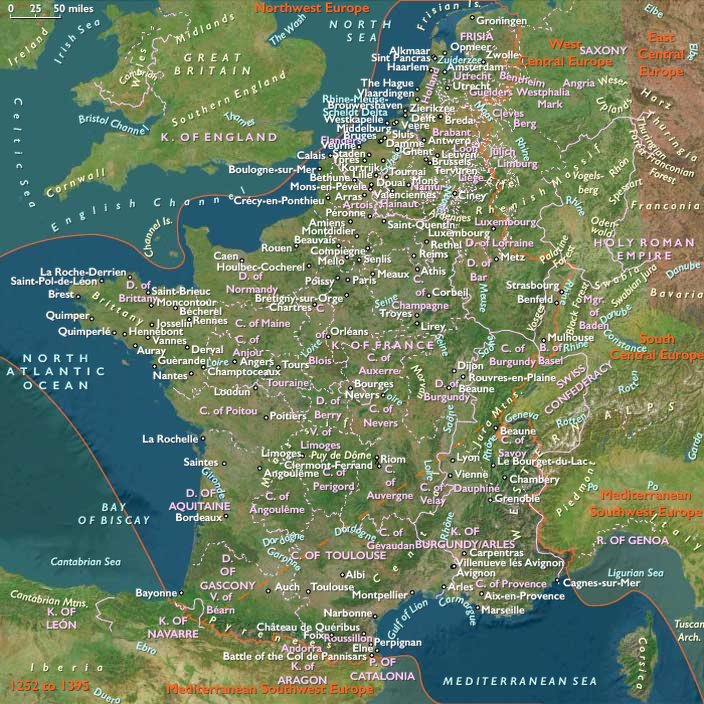
As the War of the Breton Succession resumed in 1363, Bertrand du Guesclin, a formidable Breton knight known for his guerrilla warfare tactics, once again played a key role in supporting the French-backed claimant, Charles of Blois, against Jean de Montfort and his English allies. However, despite some early successes, Charles' campaign faltered when du Guesclin was drawn away to other fronts, leading to a stalemate in Brittany.
Bertrand du Guesclin: A Ruthless Breton Commander
- Born into the petty nobility of Brittany (the seigneurs of Broons), du Guesclin gained a reputation as a rough and brutal warrior.
- Serving Charles of Blois, he became a key figure in the war, fighting against Jean de Montfort’s English-backed forces.
- He was knighted in 1354 after successfully countering an English raid led by Hugh Calveley on the Castle of Montmuran, while serving Arnoul d'Audrehem.
Du Guesclin’s Earlier Victories: The Siege of Rennes (1356–1357)
- He successfully defended Rennes against an English siege, commanded by Henry of Grosmont, 1st Duke of Lancaster.
- Using guerrilla tactics, he harassed and exhausted the besieging English forces.
- During the siege, he fought and killed English knight William Bamborough in single combat.
The 1363 Campaign: Initial Success, Then Stalemate
- With war resuming in 1363, Charles of Blois launched a new offensive, supported by du Guesclin.
- Du Guesclin, also known as the Black Dog of Brocéliande, helped secure key victories, advancing the Bloisist cause.
- However, when du Guesclin left Brittany to take control of strongholds in Navarre and Normandy, Charles of Blois’ momentum stalled.
- His advance halted at the siege of Bécherel, where Jean de Montfort’s forces successfully resisted.
Failed Negotiations and Joan’s Opposition
- As the siege dragged on, the warring parties agreed to meet near Évran to resolve their differences.
- The bishops intervened, proposing a partition of Brittany between Jean de Montfort and Charles of Blois.
- However, another opportunity for peace was rejected, as Joan of Penthièvre (Charles’ wife) refused to negotiate, insisting on continuing the fight to completely eliminate the Montfortist claim.
The Stage is Set for the Final Battle
- The failure of diplomacy meant that the conflict would continue, culminating in the Battle of Auray (1364)—the decisive engagement of the Breton War of Succession.
- With Charles of Blois refusing to compromise, Brittany remained a divided and war-torn region, further entrenching English and French influence in the duchy.
Despite his skills as a military commander, du Guesclin’s absence from Brittany in 1363 left Charles of Blois vulnerable, and Joan of Penthièvre’s refusal to negotiate peace ensured that the war would continue toward its decisive conclusion at Auray.
Locations
People
Groups
Topics
Commodoties
Subjects
Regions
Subregions

Years: 1363 - 1363
Locations
People
Groups
Topics
Commodoties
Subjects
Regions
Subregions