
Bernardino of Siena was born in 1380 …
Years: 1425 - 1425
Bernardino of Siena was born in 1380 to the noble Albizeschi family in Massa Marittima (Tuscany), a Sienese town of which his father, Tollo, was then governor.
Left orphaned at six, he was raised by a pious aunt.
In 1397, after a course of civil and canon law, he joined the Confraternity of Our Lady attached to the hospital of Santa Maria della Scala church.
Three years later, when the plague visited Siena, he ministered to the plague-stricken, and, assisted by ten companions, took upon himself for four months entire charge of this hospital.
He escaped the plague but was so exhausted that a fever confined him for several months.
In 1403 he joined the Observant branch of the Order of Friars Minor (the Franciscan Order), with a strict observance of St. Francis' Rule.
Bernardino was ordained a priest in 1404 and was commissioned as a preacher the next year.
About 1406 St. Vincent Ferrer, a Dominican friar and missionary, while preaching at Alessandria in the Piedmont region of Italy, allegedly foretold that his mantle should descend upon one who was then listening to him, and said that he would return to France and Spain, leaving to Bernardino the task of evangelizing the remaining peoples of Italy.
The period of Bernardino's public engagement coincided with a time when the Catholic Church was responding actively (through civil and armed means) to pressures that it regarded as heretical, and which were gaining popularity in southern France and northern Italy, as well as to pressures of some reformed monastic orders.
Instead of remaining cloistered and preaching only during the liturgy, Bernardino preached directly to the public.
Bernardino preaches all over Italy and plays a great part in the religious revival of the early fifteenth century.
Although he has a weak and hoarse voice, he is said to have been one of the greatest preachers of his time.
His style is simple, familiar, and abounding in imagery.
Cynthia Polecritti, in her biography of Bernardino, notes that the texts of his sermons “are acknowledged masterpieces of colloquial Italian.”
He is an elegant and captivating preacher, and his use of popular imagery and creative language draws large crowds to hear his reflections; and, as Polecritti also notes, the subject matter of his sermons reveals much about the contemporary context of fifteenth-century Italy.
He travels from place to place, remaining nowhere more than a few weeks.
These journeys are all made on foot.
In the towns, the crowds assembles to hear him are at times so great that it becomes necessary to erect a pulpit on the marketplace.
Like Vincent Ferrer, he usually preaches at dawn.
His hearers, so as to ensure themselves standing room, arrive beforehand, many coming from far-distant villages.
The sermons often last three or four hours.
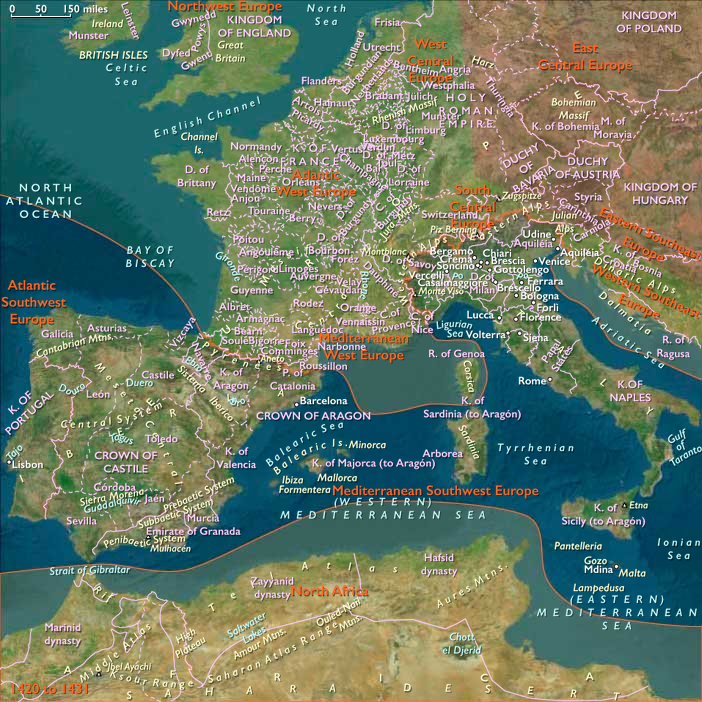
He had been invited to Ferrara in 1424, where he preached against the excess of luxury and immodest apparel.
In Bologna, he had spoken out against gambling, much to the dissatisfaction of the card manufacturers and sellers.
Returning to Siena in April 1425, he preaches here for fifty consecutive days.
His success is claimed to be remarkable.
"Bonfires of the Vanities" are held at his sermon sites, where people throw mirrors, high-heeled shoes, perfumes, locks of false hair, cards, dice, chessmen, and other frivolities to be burned.
Bernardino enjoins his listeners to abstain from blasphemy, indecent conversation, and games of hazard, and to observe feast days.
Locations
People
Groups
Subjects
Regions
Subregions
Years: 1425 - 1425
Locations
People
Groups
Subjects
Regions
Subregions