Bernard of Clairvaux has proved himself an …
Years: 1151 - 1151
Bernard of Clairvaux has proved himself an effective spokesman for the Cistercian reform movement throughout Europe: by 1151 over three hundred monasteries stand, with more than eleven thousand Cistercian monks and nuns.
Construction begins on the Cistercian’s Kirkstall Abbey on the outskirts of Leeds, Yorkshire; it will take seventy-five years to complete.
Locations
People
Groups
Topics
Subjects
Regions
Subregions
Related Events
Filter results
Showing 10 events out of 48700 total
Jaya Harivarman’s forces, having suppressed Vamasaraja’s rebellion, pacify the rebellious Cham regions (or competing Cham principality) of Amaravati (North Champa) in 1151.
Construction of the Anping Bridge had started in 1138 during the Southern Song Dynasty and lasts until 1151.
It is originally eight hundred and eleven zhang (two thousand two hundred and twenty-three meters [1.381 miles])long and 1.6 zhang (4.4 meters [fourteen feet]) wide, consisting of three hundred and thirty-one spans of granite beams resting on top of stone piers, the largest beam weighing twenty-five tons.
The width of the bridge varies from three to 3.8 meters (9.8 to 12.5 feet).
Upon completion, it is the longest bridge in China, and will remain so until 1905.
Its total length will not be exceeded until 1846.
The bridge lies in the prefecture-level city of Quanzhou, crossing what originally was a tidal estuary of the Shijing River that separates the town of Anhai (in the county-level city of Jinjiang) east of the river, from the town of Shuitou (in the county-level city of Nan'an) west of the river.
The bridge is named after Anhai, which was formerly known as Anping.
It originally has five pavilions where travelers can rest; however, only one pavilion (Shuixin Pavilion) still exists today.
Li Renxiao, the eldest son of Tangut Emperor Chongzong, had succeeded him in 1139 at the age of sixteen.
Immediately following his coronation as Emperor Renzong, many natural disasters had occurred and he has worked to stabilize the economy, making friendly overtures to the Jin Dynasty.
In domestic politics, Renzong has created many schools and used examinations to choose his officials.
He respects Confucianism, and has built many temples worshipping Confucius.
Eventually, Renzong hires a Tibetan lama as a religious advisor and prints many copies of Buddhist teachings.
Yuri had captured Kiev in 1149, but in 1151 he is driven from the capital of Rus by his nephew Iziaslav.
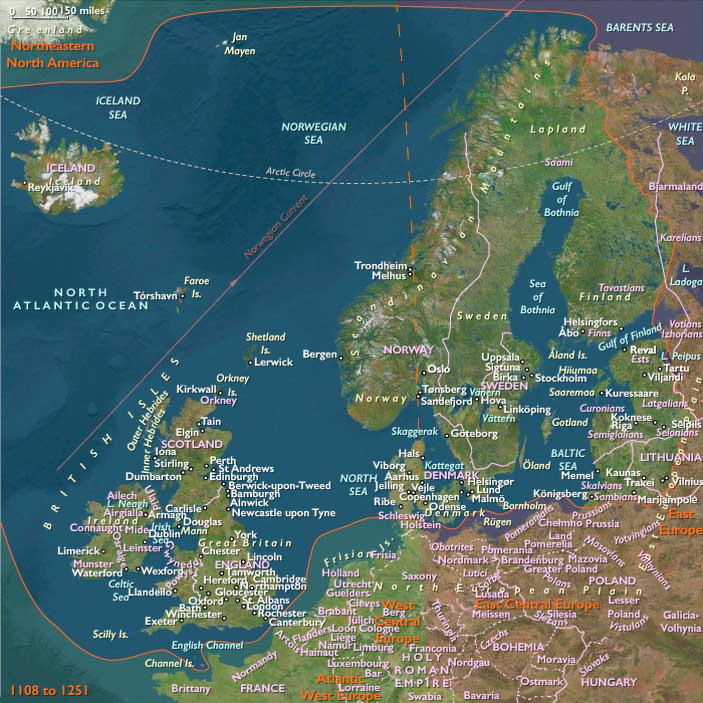
Sweyn Grathe has had to fight for the past few years against his rival, the son of King Niels' son Magnus the Strong, who the magnates of Jutland have declared king Canute V. Sweyn expels Canute from Denmark in 1151; the latter’s request for help from Emperor Frederick only results in a compromise which pleases no one.
Frederick offers to grant Sweyn the kingship as “first king” with Canute to rule Zealand under the crown, making him the inferior co-ruler of Sweyn.
Sweyn’s ally Valdemar, the son of the Duke of South Jutland, persuades the rival claimants to accept lands in Jutland and Skane (extreme southern Sweden) in lieu of Zealand; the aspirants agree.
Seljuq weakness after 1150 enables various Turkmen leaders to establish their own principalities along the fringes of the empire of Rum, where they act as ghazis, or warriors for the faith of Islam, against the infidels.
Ghazni, founded sometime in antiquity as a small market-town and mentioned by Ptolemy, had been a thriving Buddhist center before and during the seventh century CE.
In 683, Arab armies had brought Islam to the nearby regions.
Yaqub Saffari from Zaranj had reigned over the vast region.
After the city was rebuilt by Yaqub’s brother, it had become the dazzling capital of the Ghaznavid Empire from 994, encompassing much of northern India, Persia and Central Asia.
Many iconoclastic campaigns have been launched from Ghazni into India, resulting in large scale destruction of ancient temples, libraries and palaces.
The Ghaznavids had taken Islam to India and returned with fabulous riches taken from both Indian princes and temples.
Contemporary visitors and residents at Ghazni write with wonder of the ornateness of the buildings, the great libraries, the sumptuousness of the court ceremonies and of the wealth of precious objects owned by Ghazni’s citizens.
In order to avenge the death of his brothers, Ala al-Din Husayn, king of the Ghurid dynasty had launched a campaign against sultan Bahram-Shah of Ghazna in 1150 he Ghaznavid and Ghurid armies had met at Tiginabad and through the heroic efforts of Kharmil Sam-i Husain and Kharmil Sam-i Banji the Ghaznavid army was routed.
Bahram had rallied elements of his army at the hot springs, Jush-i Ab-i Garm, but was again routed and fled back to Ghazn.
Bahram had rallied the remaining elements of his army with the addition of the city's garrison, but again his army is routed and the city burned by the Ghurids.
Following this defeat, Bahram flees to the Ghaznavid territories in India.
Ghazna is now subjected to seven days of pillage and rapine, in which sixty thousand residents of the city are killed.
All the tombs of the Ghaznavid rulers, with the exception of Mahmud, Mas'ud and Ibrahim, are broken open and the remains burned.
Ala al-Din also destroys the city of Bust.
From these events, he gains the nickname, Jahānsūz (meaning the World Burner).

The commune of Bologna, confronted with internal strife, is the first Italian republic to turn to the rule of a podestà, one Guido di Ranieri da Sasso.
The name given to certain high officials in many Italian cities beginning in the later Middle Ages, podestà mainly means the chief magistrate of a city state, the counterpart to similar positions in other cities that go by other names, e.g.
rettori ("rectors"), but it can also mean the local administrator, who is the representative of the Holy Roman Emperor.
‘Abd al-Mu’min gives the Jews and Christians of Ifriqiya (Tunisia) the option of conversion to Islam or death after he conquers the region in 1151.
The Emergence of the University of Paris (c. 1150 CE)
Like the University of Bologna and the University of Oxford, the University of Paris did not arise through a single founding act, such as a royal charter or papal bull. Instead, it gradually evolved from the cathedral schools of Notre-Dame on the Left Bank of the Seine, near the Île de la Cité, around 1150 CE.
Origins: From Cathedral Schools to a Universitas
- The schools of Notre-Dame, Sainte-Geneviève, and Saint-Victor had long been centers of theological and philosophical study.
- By the mid-12th century, the number of masters and students had dramatically increased, forming a distinct intellectual community.
- This group of scholars began to self-organize, leading to the development of a structured institution of learning.
The Meaning of "Universitas"
- In medieval Latin, universitas had a general meaning, referring to a corporation or guild, rather than specifically to a university as understood today.
- The University of Paris functioned similarly to other medieval corporations, such as guilds of merchants and artisans.
- It became known as a universitas magistrorum et scholarium, meaning “a guild of masters and scholars”, emphasizing its communal and self-regulating nature.
Paris as a Center of Learning
- The University of Paris quickly became a leading institution of medieval scholarship, attracting students from all over Europe.
- It gained particular renown for its faculty of theology, producing some of the greatest scholastic thinkers, including Peter Abelard, Albertus Magnus, and Thomas Aquinas.
- By the late 12th and early 13th centuries, it was formally recognized by both the Papacy and the French crown, securing its autonomy and privileges.
Legacy
- The University of Paris played a crucial role in shaping European intellectual history, laying the groundwork for modern universities.
- Its structure—organized around faculties and granting degrees—became the model for later medieval and Renaissance institutions of higher learning.
- It helped formalize scholastic education, solidifying Paris as one of the intellectual capitals of Europe.
Though it emerged organically rather than being officially founded, the University of Paris became one of the most influential institutions of the medieval world, shaping the development of Western education for centuries to come.