
Bernard, Count of Armagnac and the Rise …
Years: 1407 - 1407
Bernard, Count of Armagnac and the Rise of the Armagnac Faction (1407–1418)
Bernard VII, Count of Armagnac (1360–1418), a Gascon magnate, first gained influence at the French courtthrough his family’s ties to the House of Visconti in Milan. His sister, Béatrice d'Armagnac, married Carlo Visconti, while Louis, Duke of Orléans, married Valentina Visconti, creating a strong political alliance between the Armagnacs and the Orléanists.
After Louis of Orléans was assassinated in 1407 on the orders of John the Fearless, Duke of Burgundy, Bernard became the leader of the anti-Burgundian faction, which soon became known as the Armagnacs.
I. The Assassination of Louis of Orléans and the Formation of the Armagnac Party
- In 1407, John the Fearless had Louis of Orléans murdered, triggering open conflict between Burgundians and Orléanists.
- As a key Orléanist supporter, Bernard assumed leadership of the faction, which began rallying opposition against the Burgundians.
- Over time, the anti-Burgundian coalition became known as the "Armagnacs," named after Bernard’s dominant role in leading the movement.
II. The Armagnacs vs. the Burgundians: Civil War in France
- The rivalry escalated into a full-scale civil war (1407–1435) between:
- The Armagnacs, led by Bernard VII and later by Charles d'Orléans and the Dauphin (future Charles VII).
- The Burgundians, led by John the Fearless and later Philip the Good, supported by Parisian merchants and later allied with the English.
- In 1410, Bernard married his daughter Bonne d'Armagnac to Charles, Duke of Orléans, further strengthening his ties to the Orléanist cause.
III. Bernard’s Leadership and Influence in France
- By 1413, Bernard had secured control of the French government as Constable of France, effectively ruling in the name of the Dauphin (future Charles VII).
- His rule was marked by brutal repression of Burgundian supporters, particularly after the Cabochien Revolt in Paris (1413).
- His leadership ended tragically in 1418, when the Burgundians stormed Paris, massacred Armagnac supporters, and executed Bernard.
IV. Long-Term Impact and Legacy
- Bernard’s leadership cemented the lasting division between the Armagnacs and Burgundians, a rift that destabilized France for decades.
- His violent feud with the Burgundians allowed England to exploit France’s internal chaos, culminating in the Treaty of Troyes (1420), which nearly disinherited the Valois dynasty.
- Even after Bernard’s death, the Armagnac faction remained a powerful force, ultimately leading the resistance against English rule under Charles VII and Joan of Arc.
The rise of Bernard, Count of Armagnac, as leader of the anti-Burgundian faction (1407–1418) was a defining moment in French history, as his conflict with Burgundy fueled civil war and weakened France during the Hundred Years' War.
Locations
People
- Bernard VII
- Charles VI of France
- Charles VII of France
- Charles of Orléans
- John the Fearless
- Louis I, Duke of Orléans
- Philip the Good
Groups
Topics
Commodoties
Subjects
Regions
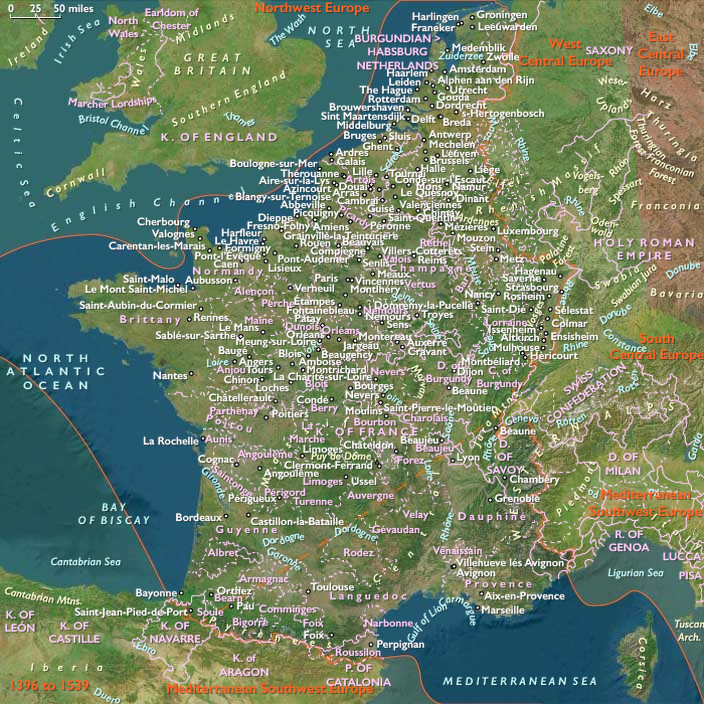
Subregions
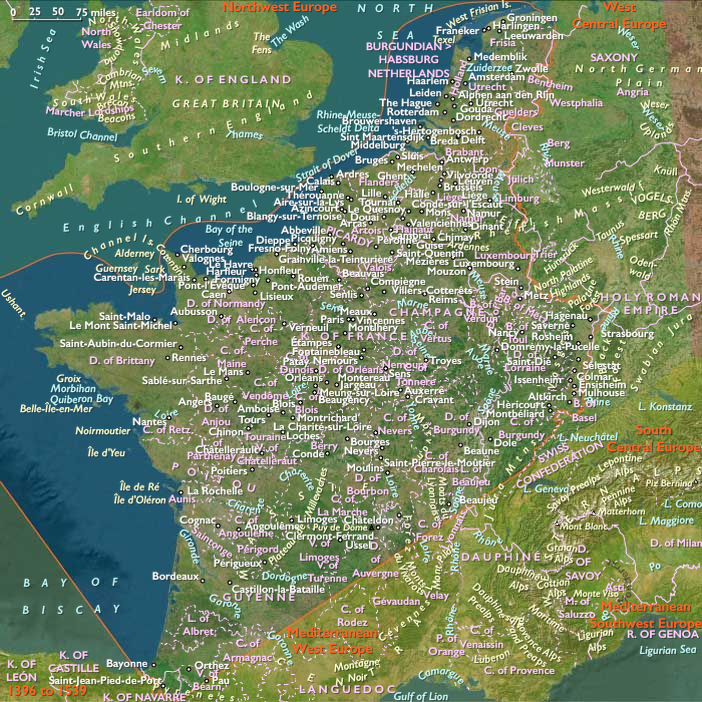
Years: 1407 - 1407
Locations
People
- Bernard VII
- Charles VI of France
- Charles VII of France
- Charles of Orléans
- John the Fearless
- Louis I, Duke of Orléans
- Philip the Good
Groups
Topics
Commodoties
Subjects
Regions
Subregions