
Benedetto Antelami, the most forward-looking of the …
Years: 1190 - 1190
Benedetto Antelami, the most forward-looking of the trinity of Lombard sculptors including Wiligelmo da Modena and Nicolo of Verona, creates, in about 1190, his masterpieces in the noble, monumental figures of David and Ezekiel.
Set into niches on the facade of the cathedral of Fidenza, formerly Borgo San Donnino, dedicated to Saint Domninus of Fidenza.
The ponderous figures are actually carved in relief, although they give the impression of being freestanding statues.
Antelami's works are characteristic for their realism, and strong emotion, within the formalist context of their time.
Locations
People
Groups
Topics
Subjects
Regions
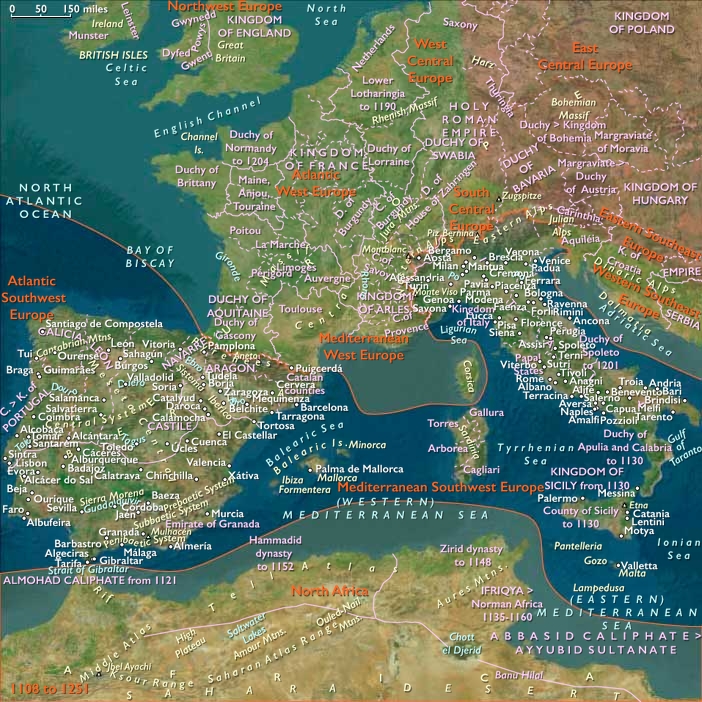
Subregions
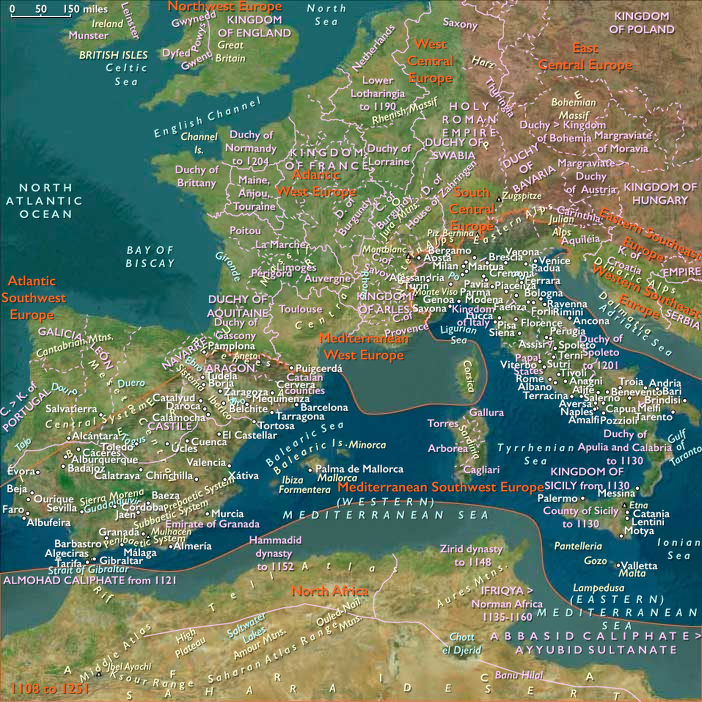
Related Events
Filter results
Showing 10 events out of 47929 total
Jayavarman launches another invasion of Champa in 1190, laying waste its territory and sacking its capital of Vijaya (Binh Dinh).
The Khmer conquerors divide Champa into two vassal states with puppet rulers.
The Chams rebel the following year, ousting one of two puppet rulers, Prince In, and replacing him with a Cham prince.
The prince conquers the Khmer puppet monarch of the other Champa state and reunites the two polities as a kingdom, taking the throne as king Jaya Indravarman V.
The Burmese kingdom of Pagan experiences anarchy until 1190, when Anawrahta's lineage regains control with the assistance of the Sri Lankan kingdom of Polonnaruwa.
The new regime reforms Burmese Buddhism on Sri Lankan Theravada models.
Henry had stayed with his father-in-law, in Normandy before being allowed back into Germany in 1185.
He had been exiled again in 1188.
His wife Matilda dies in 1189.
After Frederick Barbarossa goes on the Crusade of 1189, Henry returns to Saxony, mobilizes an army of his faithful, and conquers the rich city of Bardowick as punishment for her disloyalty.
Only the churches are left standing.
The Jews of Montpelier are prohibited from holding any “high” office in France by a decree in 1190.
The Wall of Philip Augustus: Paris Fortified Against the Plantagenets (Begun 1190)
During the ongoing struggles between Philip II of France and the Anglo-Norman House of Plantagenet, Philip ordered the construction of a massive stone wall to fortify Paris, later known as the Wall of Philip Augustus. The decision to fortify the capital was made in 1190, just before Philip departed for the Third Crusade, as he feared an attack from the northwest, where Normandy was controlled by the Plantagenets.
Strategic Reasons for the Wall
-
Protecting Paris During the Third Crusade
- Philip anticipated that, in his absence on crusade, the Angevin kings of England—especially Richard I—could seize the opportunity to strike at France.
- Paris, as the royal capital, needed defenses to prevent invasion from Anglo-Norman forces.
-
Fortifying Against Plantagenet Normandy
- At the time, Normandy was still in Plantagenet hands, and any attack on Paris would likely come from the northwest.
- To prepare for this, Philip prioritized fortifying the Right Bank first, as it was the most vulnerable to an invasion from Normandy.
Construction and Design of the Wall
- The Right Bank defenses were built first, given its greater risk of attack from the Plantagenet-controlled territories.
- The wall was made of stone and featured:
- Large fortified gates at key entry points.
- Defensive towers spaced along the length of the wall.
- A moat in some sections to further strengthen the city's defenses.
- Upon Philip’s return from the Crusade, construction continued on the Left Bank, ensuring the entire city was enclosed.
Impact of the Wall of Philip Augustus
- First major fortification of Paris – The wall transformed Paris into a true medieval stronghold, providing defensive security for the expanding Capetian capital.
- A symbol of Philip’s kingship – Strengthening the capital reinforced Philip’s authority, demonstrating his foresight and strategic planning.
- A legacy of urban defense – The wall remained in use for centuries, with portions still visible today, marking Philip’s lasting influence on the development of Paris.
The Wall of Philip Augustus, begun in 1190, was a direct response to the ongoing Capetian-Plantagenet rivalry and was a key part of Philip’s strategy to secure France while embarking on the Third Crusade.
The Holy Grail and Chrétien de Troyes' Perceval, ou le Conte du Graal (1180–1190 CE)
The Holy Grail, originally a symbolic talisman likely rooted in Celtic pagan tradition, evolved in the late 12th century into a Christian relic associated with the cup used at the Last Supper. According to later legend, Joseph of Arimathea used this cup to collect the blood of Christ at the Crucifixion.
The Grail became a central object of medieval quest literature, sought after by King Arthur's knights, most notably in Perceval, ou le Conte du Graal by Chrétien de Troyes, the first known literary work to feature the Holy Grail.
Chrétien de Troyes and Perceval (1180–1190)
- French poet Chrétien de Troyes wrote Perceval, ou le Conte du Graal (Perceval, or the Story of the Grail) around 1180.
- The romance tells the story of Perceval, a young knight who witnesses a mysterious procession featuring the Grail at the castle of the Fisher King.
- However, Perceval fails to ask the right questions about the Grail, missing his chance to heal the wounded king and restore the land.
Chrétien died before completing the romance, and other poets later attempted to finish it between 1180 and 1190, adding Christian mystical interpretations to the legend.
The Holy Grail’s Evolution in Medieval Literature
- In Chrétien’s original Arthurian context, the Grail is a mysterious object with unclear religious significance.
- Later versions, such as Robert de Boron’s Joseph d’Arimathie (late 12th century), explicitly link the Grail to Christ and the Last Supper, transforming it into a sacred Christian relic.
- The Grail quest becomes central to Arthurian legend, inspiring later romances, including:
- Wolfram von Eschenbach’s Parzival (early 13th century).
- The Vulgate Cycle (13th century), which introduced Galahad as the purest Grail knight.
- Thomas Malory’s Le Morte d'Arthur (15th century), cementing the Grail as a key element of Arthurian mythology.
Legacy of Perceval and the Grail Legend
- Chrétien’s Perceval marked the first recorded literary appearance of the Holy Grail, setting the foundation for centuries of Grail literature.
- The legend blended Celtic, Christian, and chivalric themes, shaping medieval spiritual and heroic ideals.
- The Grail’s transformation from a mystical object to a Christian relic reflected broader religious and cultural changes in medieval Europe.
Though unfinished at his death in 1180, Chrétien de Troyes' Perceval gave birth to one of the most enduring and influential legends of Western literature.
The Jews in England, who number approximately twenty-five hundred in 1190, have thus far enjoyed relative freedom of movement, education, and the right to own real estate, in contrast to the Jews on the continent.
Serbia’s proposed alliance with the German Crusaders is not concluded, because Frederick concludes the Treaty of Adrianople with Isaac in February 1190.
Matters are complicated by a secret alliance between the Emperor of Constantinople and Saladin, warning of which is supplied by a note from Sibylla, ex-Queen of Jerusalem, but Isaac is soon forced to assist Frederick, whose avowed intention, at least at one time, was to conquer Constantinople.
William II of Sicily had died in November 1189, leaving his father's half sister Constance heiress to the Sicilian kingdom, consisting of the island of Sicily and the southern part of the Italian peninsula.
To prevent Constance's husband, the German king—soon to be emperor—Henry VI from ruling their country, the barons of southern Italy had elected the native Tancred of Lecce, who is an illegitimate son of Constance's brother Roger III, Duke of Apulia, and who had imprisoned the late king's wife, Joan of England (sister of Richard I), and denied her possession of her dower.
He is crowned King Tancred I of Sicily early in 1190.
His coup is backed by the chancellor Matthew d'Ajello and the official class, while most of the nobles support the rival claims of Constance and Henry.
The Welfs and the Rhenish princes also oppose Henry’s attempted takeover.
Frederick's immense army now crosses from Iconium into Armenian territory in southeastern Anatolia.
On June 10, Frederick, who had ridden ahead with his bodyguard, is thrown from his horse while crossing the Saleph River in Cilicia and the shock of the cold water causes him to have a heart attack.
Weighed down by his armor, he drowns in water that is barely hip-deep, according to the chronicler Ibn al-Athir.
The death of the sixty-nine-year-old emperor breaks the morale of the German army, and only a small remnant, under dukes Leopold V of Austria and Frederick VI of Swabia, the emperor's son, will finally reach Tyre.
To Saladin and the Muslims, who had been seriously alarmed by Frederick's approach, the German emperor's death seems an act of God.
