
Belisarius, after securing the loyalty of the …
Years: 533 - 533
December
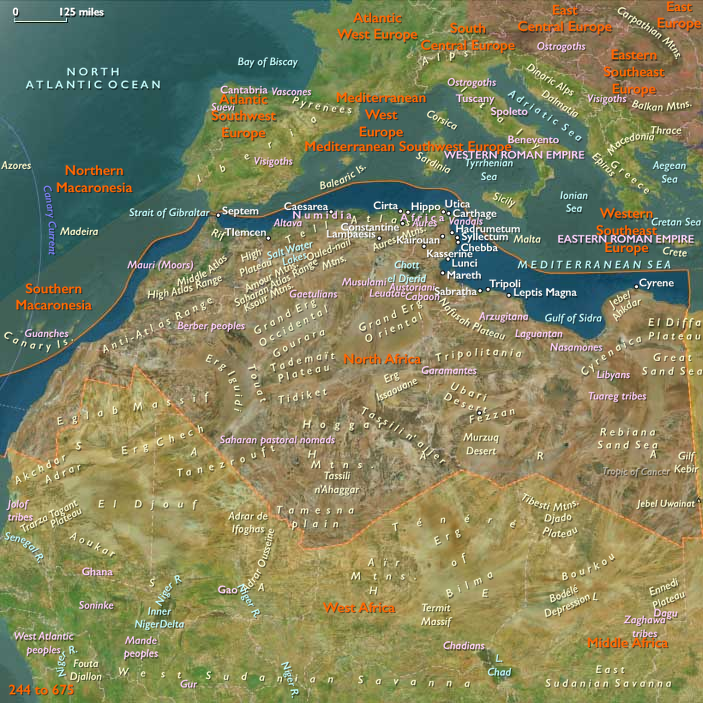
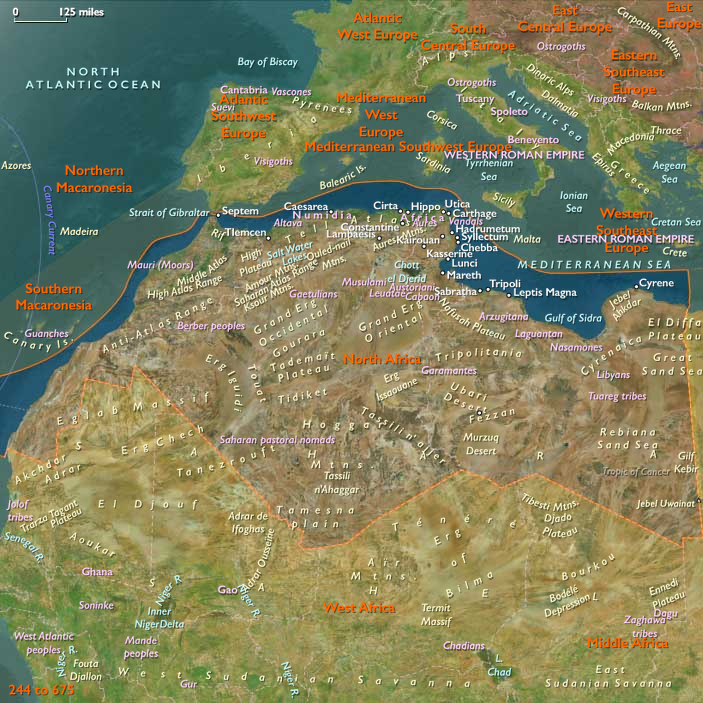
Belisarius, after securing the loyalty of the populace and the army, and completing the repairs to the walls, resolves to meet Gelimer in battle, and in mid-December marches out of Carthage in the direction of the fortified Vandal camp at Tricamarum, some twenty-eight kilometers from Carthage.
As at Ad Decimum, the Roman cavalry proceeds in advance of the infantry, and the ensuing Battle of Tricamarum is a purely cavalry affair, with Belisarius' army considerably outnumbered.
Both armies keep their most untrustworthy elements—the Moors and Huns—in reserve.
John the Armenian plays the most important role on the Roman side, and Tzazon on the Vandal.
John leads repeated charges at the Vandal center, culminating in the death of Tzazon.
This is followed by a general Roman attack across the front and the collapse of the Vandal army, which retreats to its camp.
Gelimer, seeing that all is lost, flees with a few attendants into the wilds of Numidia, whereupon the remaining Vandals give up all thoughts of resistance and abandon their camp to be plundered by the Romans.
Like the previous battle at Ad Decimum, it is again notable that Belisarius failed to keep his forces together, and was forced to fight with a considerable numerical disadvantage.
The dispersal of his army after the battle, looting heedlessly and leaving themselves vulnerable to a potential Vandal counterattack, is also an indication of the poor discipline in the Roman army and the command difficulties Belisarius faced.
As Bury comments, the expedition's fate might have been quite different "if Belisarius had been opposed to a commander of some ability and experience in warfare", and points out that Procopius himself "expresses amazement at the issue of the war, and does not hesitate to regard it not as a feat of superior strategy but as a paradox of fortune".
(Bury, John Bagnell (1923).
History of the Later Roman Empire: From the Death of Theodosius I to the Death of Justinian.
London: MacMillan & Co. Vol.
II, p. 137)
Locations
People
Groups
- Goths (East Germanic tribe)
- Huns
- Christianity, Arian
- East, or Oriens, Praetorian prefecture of
- Moors
- Vandals and the Alans, Kingdom of the
- Christianity, Chalcedonian
- Ostrogoths, Italian Kingdom of the
- Roman Empire, Eastern: Justinian dynasty
Topics
Commodoties
Subjects
- Commerce
- Engineering
- Environment
- Labor and Service
- Conflict
- Mayhem
- Faith
- Government
- Technology
- Movements
Regions
Subregions
Years: 533 - 533
December
Locations
People
Groups
- Goths (East Germanic tribe)
- Huns
- Christianity, Arian
- East, or Oriens, Praetorian prefecture of
- Moors
- Vandals and the Alans, Kingdom of the
- Christianity, Chalcedonian
- Ostrogoths, Italian Kingdom of the
- Roman Empire, Eastern: Justinian dynasty
Topics
Commodoties
Subjects
- Commerce
- Engineering
- Environment
- Labor and Service
- Conflict
- Mayhem
- Faith
- Government
- Technology
- Movements
Regions
Subregions