Jules Bastien-Lepage, whose health had begun to …
Years: 1884 - 1884
December
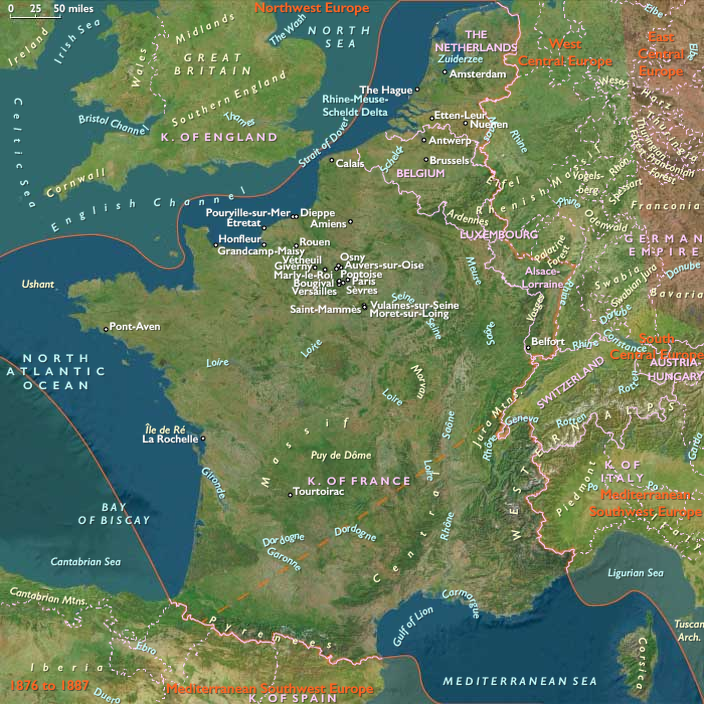
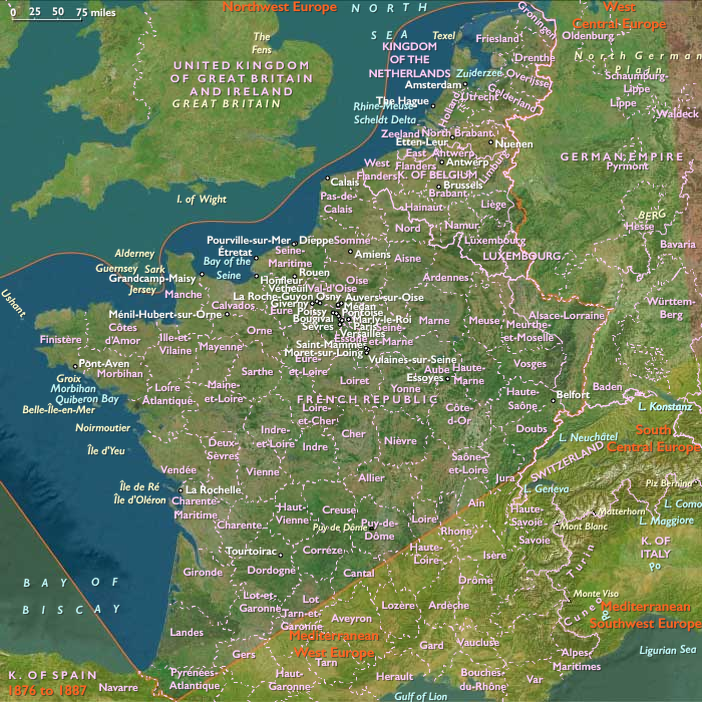
Jules Bastien-Lepage, whose health had begun to fail the previous year, dies in Paris on December 10, 1884 at age thirty-six.
Locations
People
Groups
Topics
Subjects
Regions
Subregions
Related Events
Filter results
Showing 10 events out of 11131 total
Michigan Tech had been founded in Houghton, Michigan, 1885 as the Michigan Mining School.
After much agitation by Jay Abel Hubbell, the state legislature had established the school to train mining engineers.
Hubbell had donated land for the school's first buildings.
The school starts with four faculty members and twenty-three students.
It will be housed in the Houghton Fire Hall from 1886 through 1889.
Weather patterns will continue to be chaotic for years, and temperatures will not return to normal until 1888.
The eruption had injected an unusually large amount of sulfur dioxide (SO2) gas high into the stratosphere that was subsequently transported by high-level winds all over the planet.
This had led to a global increase in sulfurous acid (H2SO3) concentration in high-level cirrus clouds.
The resulting increase in cloud reflectivity (or albedo) reflects more incoming light from the sun than usual, and cools the entire planet until the suspended sulfur falls to the ground as acid precipitation.
The eruption will darken the sky worldwide for years afterwards, and produces spectacular sunsets throughout the world for many months.
British artist William Ashcroft will make thousands of color sketches of the red sunsets halfway around the world from Krakatoa in the years after the eruption.
The Alaskan region is organized in 1884 and the name is changed from the Department of Alaska to the District of Alaska.
Legislators in Washington, D.C., are occupied with post-Civil War reconstruction issues at this time, and have little time to dedicate to Alaska.
Henrietta Dugdale's campaign for ‘equal justice for women’, which had begun with a letter to Melbourne’s Argus newspaper in April 1869, peaks during the 1880s in radical public debate as a member of Melbourne’s Eclectic Society and the Australasian Secular Association, through her utopian allegory A Few Hours in a Far-Off Age and in the formation in May 1884 of the Victorian Women’s Suffrage Society, the first of its kind in Australasia.
Born at St. Pancras London on 14 May 1827, the second surviving daughter of John Worrell and Henrietta Ann (née Austin), her claim of a first marriage at fourteen does not fit with her official marriage in 1848 to a merchant navy officer J. A. Davies, with whom she had come to Australia in 1852.
After Davies’ death, she married ship’s captain William Dugdale in Melbourne in March 1853 and settled at Queenscliff where her sons Einnim, Carl and Austin were born.
She had moved to the Melbourne suburb of Camberwell after separating from William Dugdale in the late 1860s.
The "Australian compact", based around centralized industrial arbitration, a degree of government assistance particularly for primary industries, and White Australia, is to continue for many years before gradually dissolving in the second half of the twentieth century.
The discovery of gold in Australia in 1851 had led to an influx of immigrants from all around the world.
The rapid economic expansion that had followed the gold rushes has produced a period of prosperity which has lasted forty years, culminating in the great Land Boom of the 1880s.
Melbourne in particular has grown rapidly, becoming Australia's largest city and for a while the second-largest city in the British Empire: its grand Victorian buildings are a lasting reminder of the period.
During the 1880s, trade unions develop among shearers, miners, and stevedores (wharf workers), but soon spread to cover almost all blue-collar jobs.
Shortages of labor lead to high wages for a prosperous skilled working class, whose unions demand and get an eight-hour day and other benefits unheard of in Europe.
Australia gains a reputation as "the working man's paradise."
Some employers try to undercut the unions by importing Chinese labor, producing a reaction which leads to all the colonies restricting Chinese and other Asian immigration.
This is the foundation of the White Australia Policy.
The German flag is flown over Kaiser-Wilhelmsland, the Bismarck Archipelago and the German Solomon Islands on November 23, 1884, under the auspices of the Deutsche Neuguinea-Compagnie (New Guinea Company).
The first Germans in the South Pacific were probably sailors on the crew of ships of the Dutch East India Company: during Abel Tasman's first voyage, the captain of the Heemskerck was one Holleman (or Holman), born in Jever in northwest Germany.
Hanseatic League merchant houses were the first to establish footholds: Johann Cesar Godeffroy & Sohn of Hamburg, headquartered at Samoa from 1857, operated a South Seas network of trading stations especially dominating the copra trade and carrying German immigrants to various South Pacific settlements; in 1877 another Hamburg firm, Hernsheim and Robertson, establishes a German community on Matupi Island, in Blanche Bay (the northeast coast of New Britain) from which it trades in New Britain, the Caroline and Marshall Islands.
By the end of 1875, one German trader reports: "German trade and German ships are encountered everywhere, almost at the exclusion of any other nation". (Hans-Jürgen Ohff (2008) Empires of enterprise: German and English commercial interests in East New Guinea 1884 to 1914 Thesis (Ph.D.) University of Adelaide, School of History and Politics; p. 26 quoting Schleinitz to Admiralty, 28 Dec. 1875, Drucksache zu den Verhandlungen des Bundesrath, 1879, vol. 1, Denkschrift, xxiv–xxvii, p. 3.)
In the late 1870s and early 1880s, an active minority, stemming mainly from a right-wing National Liberal and Free Conservative background, has organized various colonial societies all over Germany in order to persuade Chancellor Bismarck to embark on a colonial policy.
The most important ones are the "Kolonialverein of 1882" and the Gesellschaft für Deutsche Kolonisation, founded in 1884.
Bismarck's initial response may be summed up by a marginal note he wrote in 1881: "Colonies demand a fatherland in which the national feeling is stronger than the hatred of the parties [for each other]".
(Hartmut Pogge von Strandmann, "Domestic Origins of Germany's Colonial Expansion under Bismarck" (1969) Past & Present 42 pp 140–159 at p 144 citing Deutsches Zentralarchiv Potsdam, Reichskanzlei 7158.)
On April 24, 1884, Bismarck had signals a change in policy by placing German trading interests in southwestern Africa under the protection of the German Empire.
Bismarck tells the Reichstag on June 23, 1884 of the change of German colonial policy: annexations will now proceed but by grants of charters to private companies.
On his return to Germany from his 1879–1882 Pacific expedition, German ethnographer, naturalist and colonial explorer Otto Finsch had joined a small, informal group interested in German colonial expansion into the South Seas led by the banker, Adolph von Hansemann.
Finsch had encouraged them to pursue the founding of a colony on the northeast coast of New Guinea and the New Britain Archipelago, even providing them with an estimate of the costs of such a venture.

The territory of southeastern New Guinea becomes a British protectorate on November 6, 1884, after the Australian colonies had promised financial support.
Qing China renames the conquered region of Kashgaria, establishing Xinjiang ("new frontier") as a province in 1884 and formally applying onto it the political system of China proper.
For the first time, the name "Xinjiang" replaces old historical names such as "Western Regions", "Chinese Turkestan", "Eastern Turkestan", "Uyghuristan", "Kashgaria", "Uyghuria", "Alter Sheher" and "Yetti Sheher".
The openly anti-Jewish policies pursued by the new tsar and the popularity of these policies among large segments of the non-Jewish population pose serious political, economic, and spiritual dilemmas for Russian Jewry.
On the economic level, the tsar's policies severely limit Jewish economic opportunities and undermine the livelihood of the Jewish masses.
Many impoverished East European Jews, therefore, emigrate from the Russian Empire.
Leon Pinsker convenes the Kattowitz Conference (Katowice, Poland) of the Hovevei Zion society, which establishes a permanent committee with headquarters in Odessa in 1884.
One of the visions of the Zionist movement is the establishment of a Jewish university in the Land of Israel; this is first proposed at the Kattowitz Conference.