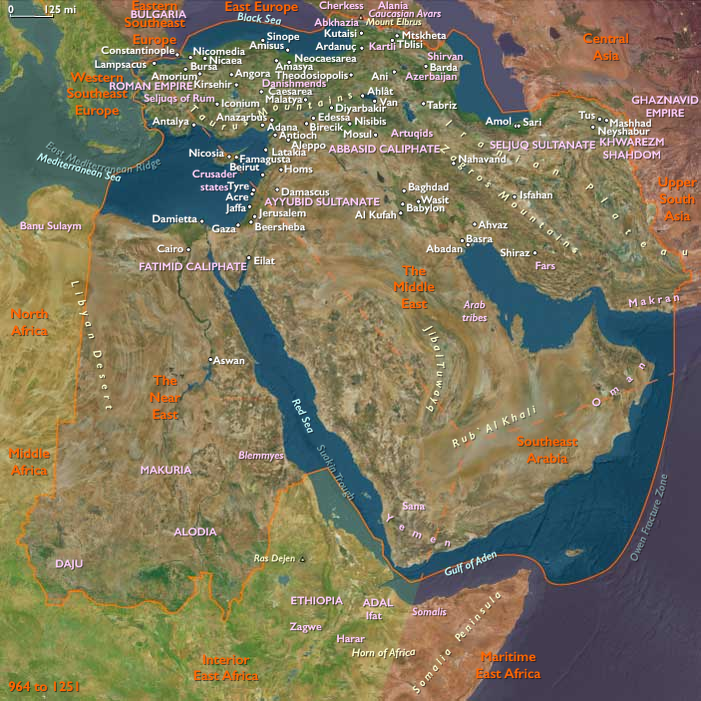
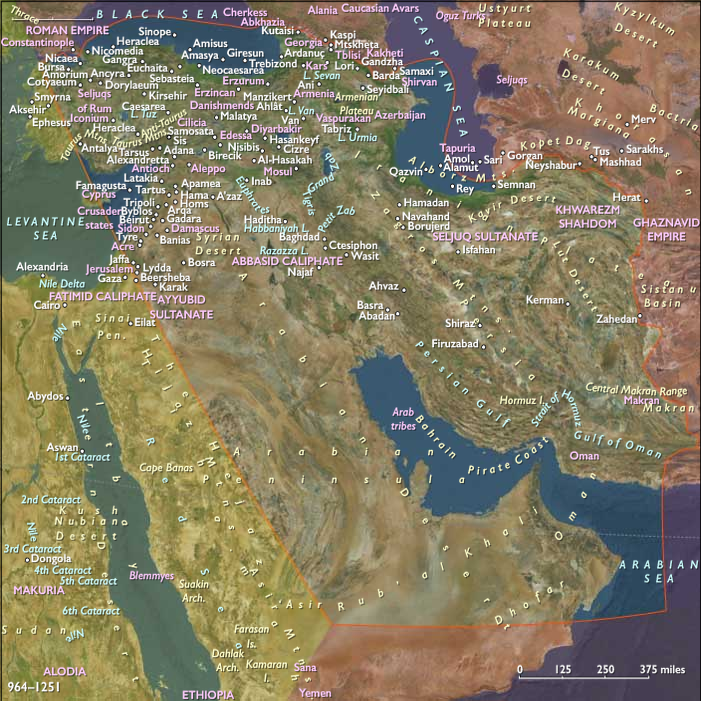
…Beirut and Akka.
Years: 1057 - 1057
…Beirut and Akka.
Locations
People
Groups
- Arab people
- Berber people (also called Amazigh people or Imazighen, "free men", singular Amazigh)
- Islam
- Roman Empire, Eastern: Macedonian dynasty
- Fatimid Caliphate
- Mirdasid dynasty
- Aleppo, Mirdasid Emirate of
- Christians, Eastern Orthodox
Subjects
Regions
Subregions
Related Events
Filter results
Showing 10 events out of 34 total
The Portuguese Crown has between 1534 and 1536 created in Brazil a number of hereditary fiefs, called “captaincies,” some larger than Portugal itself.
According to the charter grant passed by King John III on March 10, 1534, the doneé of the Captaincy of Pernambuco was Duarte Coelho Pereira, who has served with distinction in the Portuguese campaigns in India.
The captaincy, sixty leagues wide, stretches between the Igaraçu River (a tributary of Canal de Santa Cruz southern portion) and the São Francisco River.
Pereira calls it New Lusitania.
The boundary to the north is the parallel marking the southern boundary of the Captaincy of Itamaracá; to the south, the Rio São Francisco far shore; to the west the Tordesillas meridian; to the east, the Canal de Santa Cruz and Atlantic ocean.
The captaincy initially includes what is today the state of Alagoras.
Upon receiving the donation, Duarte Coelho Pereira had gone to Brazil with his wife, children and many relatives.
They had landed on the shores of Santa Cruz canal, where there is a nucleus of settlement in the Porto dos Marcos.
He advances to the mouth of the Igaraçu River, Pernambuco, where he founds the village of the same name.
He builds the Church of Santos Cosme e Damião, the first in Brazil, giving the administration of the village to Afonso Gonçalves, and heads south.
On a hill, he builds a fort (Castelo Duarte Pereira), a chapel and houses for themselves and for the settlers, which become the settlement of Olinda, constituted a village by the Charter Act passed on March 12, 1537.
The sugar mills of Duarte Coelho and his wife, and that of his brother-in-law Jerónimo de Albuquerque on the Beberibe River near Olinda, are the first in the captaincy.
The small port of Olinda is negligible, with no depth to receive large vessels crossing the Atlantic Ocean.
In turn, Recife, a town named by the first donee for its arrecife dos navios (reef or causeway ships—Recife is shielded by a long barrier reef) becomes the main port of the captaincy.

Enslaved Africans begin to brought to Brazil beginning in 1538.
Although the two governments on the Iberian Peninsula and in the Americas are kept separate, trade and travel controls becomes lax.
An active contraband trade develops between Brazilian settlements and Buenos Aires, and Portuguese moving overland appear in Asunción, Potosí, Lima, and even Quito.
Expansion along the Atlantic coast has been gradual.
Using the model of the Atlantic islands, the crown in 1536 had divided the Brazilian coast into fifteen donatory captaincies (donatários).
To induce settlement, the crown offers ten leagues of coastline as personal property, a percentage of the dyewood trade, control over trade of enslaved natives, as well as the exclusive right to build mills.
With Spanish assistance hereafter, the Portuguese expand north to Paraíba, then west through Ceara and Maranhão against the natives and the French, until they find Belem in 1616.
Beginning in 1621, these possessions are divided into the state of Maranhão (embracing the crown captaincies of Ceara, Maranhão, and Para) and the state of Brazil, centering on Salvador, Bahía.
In the Amazon and Rio de la Plata river basins, the Spanish rather than the Portuguese had been first on the scene.
The Spaniards include Álvar Núñez Cabeza de Vaca, who journeys from the coast of Santa Catarina to Asunción in 1540, and Francisco de Orellana, who descends the Amazon in 1542.
Two areas of particular importance lie adjacent to the river systems that delimit Brazil in the south and in the north: the Parana-Paraguay Basin in the south and the Mamore-Guapore Basin in the north.
The Jesuits found eight missions among the Guaraní peoples between the Parana and Paraguai rivers in what is now southern Paraguay from 1609 to 1628.
They press deep into what is today the state of Parana, between the Ivai and Paranapanema rivers, to establish fifteen more in what is called Guaíra Province.
The Guaíra missions are attacked from 1629 to 1631 by slave hunters, known as bandeirantes, from the Portuguese town of São Paulo.
According to the governor of Buenos Aires, these attacks result in the enslavement of more than seventy-thousand Guaraní.
Consequently, the Jesuits decide to evacuate some ten thousand survivors downriver and overland to sites between the Rio Uruguai and the Atlantic, in what becomes the state of Rio Grande do Sul.
Only twenty-two of forty-eight missions remain in the whole region by 1650.
The Jesuits stop the slave hunters in the south by arming and training the Guaraní, who deal a significant blow to their oppressors in the Battle of Mborore in 1641.
This victory ensure the continued existence of the southern Spanish missions for another century, although they will become a focal point of Portuguese-Spanish conflict in the 1750s.
Broadly speaking, the Battle of Mborore stabilizes the general boundary lines between the Portuguese and the Spanish in the south.
The Spanish had established the town of Santa Cruz de la Sierra in the north of the territory claimed by Portugal in 1561, and from here plant missions in the Mamore-Guapore Basin in about 1682.
Called the Mojos and Chiquitos, these mission provinces are in what is now low-land Bolivia fronting on the states of Mato Grosso and Rondonia.
By 1746 there are twenty-four mission towns in the Mojos and ten in Chiquitos.
The bandeirantes again carry the flag of Portugal into the region, first attacking the Chiquitos missions for slaves and then discovering gold in Mato Grosso (1718-36).
Unsure where these gold discoveries are in relation to the Spanish territories, the members of the Lisbon-based Overseas Council, which administers the colonies, order a comprehensive reconnaissance and the drawing of accurate maps.
Francisco de Melo Palheta leads an expedition from Belem to the Guapore in 1723, reporting to Lisbon the startling news about the numerous prosperous Jesuit missions.
The Portuguese empire at the outset is a commercial rather than a colonial one.
Portugal lacks sufficient population to establish colonies of settlers throughout its maritime empire.
The Portuguese practice is to conquer enough space for a trading fort and a surrounding enclave from which to draw on the wealth and resources of the adjacent country.
A map of this maritime commercial domain would show a series of dots connected by sealanes rather than continuous stretches of territory.
French competition forces the Portuguese shift to colonialism in Brazil.
This shift involves the gradual move from trading for brazilwood to cultivating sugarcane, which requires control of great expanses of land and increasing numbers of slaves.
The first to burst past the Tordesillas Line are the slave hunters.
Portuguese nobleman and explorer Brás Cubas, who had arrived in 1531 with Martim Afonso de Sousa, the founder of the Captaincy of São Vicente, establishes the Brazilian port of Santos in 1546.
The region of Santos is already populated, but Brás Cubas officially founds the first Holy House of Mercy, which he calls All Saints, a name that is to pass to the village, the port of which is better located than the one in São Vicente.
Santos today, as the main city in the metropolitan region of Baixada Santista, has the biggest seaport in Latin America, which traded over seventy-two million tons in 2006.
A significant tourist center, it has large industrial complexes and shipping centers, which handle a large portion of the world's coffee exports; as well as a number of other Brazilian exports including steel, oil, cars, oranges, bananas and cotton.
Years: 1057 - 1057
Locations
People
Groups
- Arab people
- Berber people (also called Amazigh people or Imazighen, "free men", singular Amazigh)
- Islam
- Roman Empire, Eastern: Macedonian dynasty
- Fatimid Caliphate
- Mirdasid dynasty
- Aleppo, Mirdasid Emirate of
- Christians, Eastern Orthodox