
Gauguin achieves the consummate expression of his …
Years: 1897 - 1897
Gauguin achieves the consummate expression of his developing vision in 1897 in his chief Tahitian work, Where Do We Come From? What Are We? Where Are We Going? (1897, Museum of Fine Arts, Boston, Tompkins Collection).
An enormous contemplation of life and death told through a series of figures, beginning with a baby and ending with a shriveled old woman, the work is surrounded by a dreamlike, poetic aura that is extraordinarily powerful.
Gauguin had flattened his imagery with sometimes unsuccessful results before the 1890s, but his "primitivism" has become less forced throughout this decade.
The influences of Jean-Auguste-Dominique Ingres and Pierre Puvis de Chavannes have led him to create increasingly rounded and modeled forms and a more sinuous line; as a result, Gauguin's images become more luxuriant and more naturally poetic as he develops marvelously orchestrated tonal harmonies.
An enormous contemplation of life and death told through a series of figures, beginning with a baby and ending with a shriveled old woman, the work is surrounded by a dreamlike, poetic aura that is extraordinarily powerful.
Gauguin had flattened his imagery with sometimes unsuccessful results before the 1890s, but his "primitivism" has become less forced throughout this decade.
The influences of Jean-Auguste-Dominique Ingres and Pierre Puvis de Chavannes have led him to create increasingly rounded and modeled forms and a more sinuous line; as a result, Gauguin's images become more luxuriant and more naturally poetic as he develops marvelously orchestrated tonal harmonies.
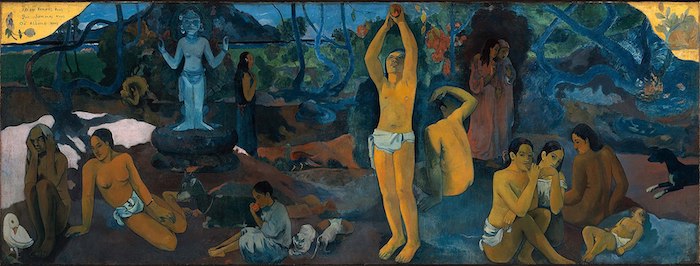
Paul Gauguin: Where Do We Come From? What Are We? Where Are We Going? (1897); oil on canvas 139.1 cm (54.7 ″); Width: 374.6 cm (12.2 ft); Museum of Fine Arts, Boston
Locations
People
Groups
Topics
Subjects
Regions
Subregions
Related Events
Showing 10 events out of 9270 total
Years: 1897 - 1897
Paul Gauguin: Where Do We Come From? What Are We? Where Are We Going? (1897); oil on canvas 139.1 cm (54.7 ″); Width: 374.6 cm (12.2 ft); Museum of Fine Arts, Boston
Locations
People
Groups
Topics
Subjects
Regions
Subregions