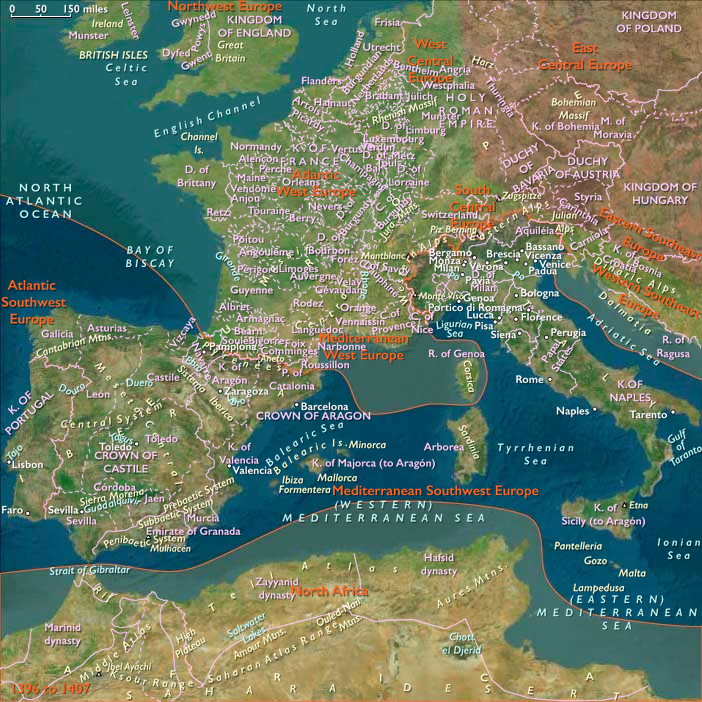
The difficulties in electing the King of the Germans, or Holy Roman Emperor, had eventually led to the emergence of a fixed college of electors, the Kurfürsten, whose composition and procedures had been set forth in the Golden Bull of 1356.
This development probably best symbolizes the emerging duality between Kaiser und Reich, emperor and realm, which were no longer considered identical.
This is also revealed in the way the post-Hohenstaufen kings attempted to sustain their power.
Earlier, the Empire's strength (and finances) greatly relied on the Empire's own lands, the so-called Reichsgut, which always belonged to the respective king (and included many Imperial Cities).
Its relevance had faded after the thirteenth century (even though some parts of it would remain until the Empire's end in 1806).
Instead, the Reichsgut has been increasingly pawned to local dukes, sometimes to raise money for the Empire but, more frequently, to reward faithful duty or as an attempt to civilize stubborn dukes.
The direct governance of the Reichsgut no longer matches the needs of either the king or the dukes.
Instead, the kings, beginning with Rudolph I of Habsburg, increasingly have relied on the lands of their respective dynasties to support their power.
In contrast with the Reichsgut, which is mostly scattered and difficult to administer, these territories are comparably compact and thus easier to control.
Rudolph I had thus lent Austria and Styria to his own sons in 1282.
The first Holy Roman Emperor since Frederick II had been crowned in 1312 as Henry VII of the House of Luxembourg.
From Henry, all kings and emperors will rely on the lands of their own family (Hausmacht): Louis IV of Wittelsbach (king 1314, emperor 1328–1347) had relied on his lands in Bavaria; Charles IV of Luxembourg, the grandson of Henry VII, had drawn strength from his own lands in Bohemia.
Interestingly, it has thus become increasingly in the king's own interest to strengthen the power of the territories, since the king profits from such a benefit in his own lands as well.
The thirteenth century also had seen a general structural change in how land was administered.
Instead of personal duties, money increasingly had become the common means to represent economic value in agriculture.
Peasants have been increasingly required to pay tribute for their lands.
The concept of "property" has more and more replaced more ancient forms of jurisdiction, although they remain very much tied together.
In the territories (not at the level of the Empire), power has become increasingly bundled: Whoever owns the land has jurisdiction, from which other powers derive.
It is important to note, however, that jurisdiction at this time does not include legislation, which will not exist until well into the fifteenth century.
Court practice heavily relies on traditional customs or rules described as customary.
The territories now begin to transform themselves into predecessors of modern states.
The process varies greatly among the various lands and is most advanced in those territories that are most identical to the lands of the old Germanic tribes, e.g., Bavaria.
It is slower in those scattered territories that have been founded through imperial privileges.
The "constitution" of the Empire is still largely unsettled at the beginning of the fifteenth century.
Although some procedures and institutions have been fixed, for example by the Golden Bull of 1356, the rules of how the king, the electors, and the other dukes should cooperate in the Empire much depends on the personality of the respective king.
At the beginning of this age, the German King (formally King of the Romans), by election in 1376, is Wenceslaus, called the Drunkard.
By inheritance King of Bohemia (as Wenceslaus IV) from 1378, he is the third Bohemian and second German monarch of the House of Luxembourg.
Two days after his election, a quarrel between the duke of Bavaria and the archbishop of Salzburg had given the signal for a general war in Swabia, in which the cities, weakened by their isolation, mutual jealousies and internal conflicts, had organized against the new king.
Defeated by Count Eberhard II at Doffingen (August 24, 1388), the cities had been severally taken and devastated.
Most of them had quietly acquiesced when King Wenceslaus proclaimed an arrangement at Eger in 1389 which prohibited all leagues between cities, whilst confirming the political autonomy of the cities.
This arrangement is to provide a modicum of stability for the next several decades.