
Beatrice, the youngest daughter of Raymond Berenguer …
Years: 1247 - 1247
Beatrice, the youngest daughter of Raymond Berenguer IV of Provence and Beatrice of Savoy, had been married on January 31, 1246, to Charles of France, Count of Anjou and Maine, the youngest brother of King Louis IX of France.
Charles was born in 1226, shortly before the death of his father, King Louis VIII.
The affection of his mother Blanche seems largely to have been bestowed upon his brother Louis; and Louis tends to favor his other younger brothers, Robert of Artois and Alphonse of Toulouse.
The self-reliance this has engendered in Charles may account for the drive and ambition he will show in his later life.
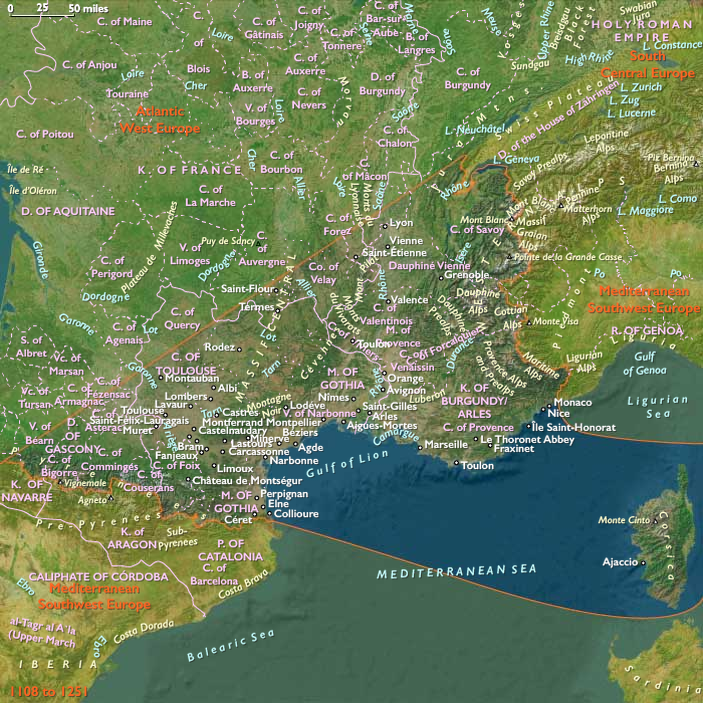
Upon his accession as Count of Provence and Forcalquier in 1246, Charles had rapidly found himself in difficulties.
His sisters-in-law felt cheated by their father's will, and his mother-in-law, the Dowager Countess Beatrice of Savoy, claims the entire County of Forcalquier and the usufruct of Provence as her jointure.
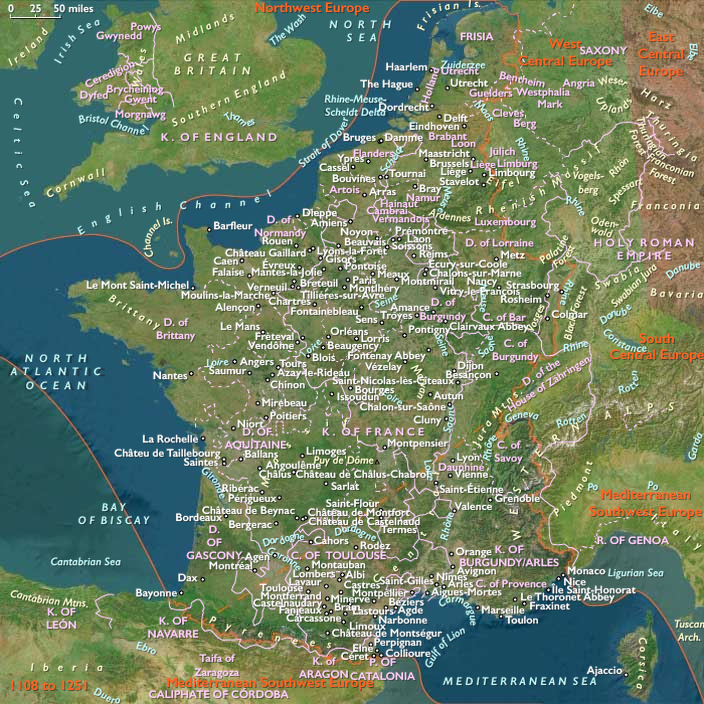
Furthermore, while Provence is technically a part of the Kingdom of Burgundy and hence of the Holy Roman Empire, in practice it is free of central authority.
The recent counts had governed with a light hand, and the nobles and cities (three of which, Marseille, Arles, and Avignon are Imperial cities technically separate from the county) have enjoyed great liberties. (Charles, in contrast, is disposed towards a rigid administration; he will order inquests in 1252 and again in 1278 to ascertain his rights.)
Charles breaks the traditional powers of the great towns (Nice, Grasse, Marseille, Arles, Avignon) and arouses considerable hostility by his punctilious insistence on enjoying his full rights and fees.
In 1247, while Charles has gone to France to receive the Counties of Anjou and Maine, the local nobility (represented by Barral of Baux and Boniface of Castellane) join with Beatrice and the three Imperial cities to form a defensive league against him.
Unfortunately for Charles, he has promised to join his brother on the Seventh Crusade.
For the time being, Charles' only recourse is to compromise with Beatrice, allowing her to have Forcalquier and a third of the Provençal usufruct.
Wealthy Provence provides the funds that support his wider career.
His rights as landlord are, on the whole, of recent establishment, but his rights as sovereign entitles him to revenues on the gabelles (mainly salt), from alberga (commutation of gîte) and cavalcata (commutation of the duties of military service) and quista ("aids").
From the Church, unlike his brothers in the north, he receives virtually nothing.
Charles' agents are efficient, the towns are prosperous, the peasants are buying up the duties of corvée and establishing self-governing consultates in the villages: Provence flourishes.
Locations
People
Groups
Topics
Commodoties
Subjects
Regions
Subregions
Years: 1247 - 1247
Locations
People
Groups
Topics
Commodoties
Subjects
Regions
Subregions