
Bavarian-born Albert of Cologne, educated principally at …
Years: 1263 - 1263
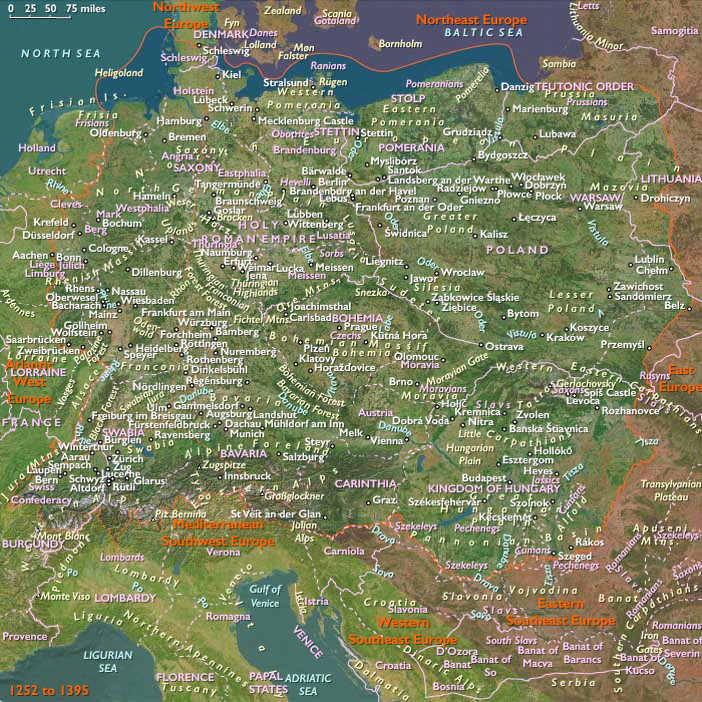
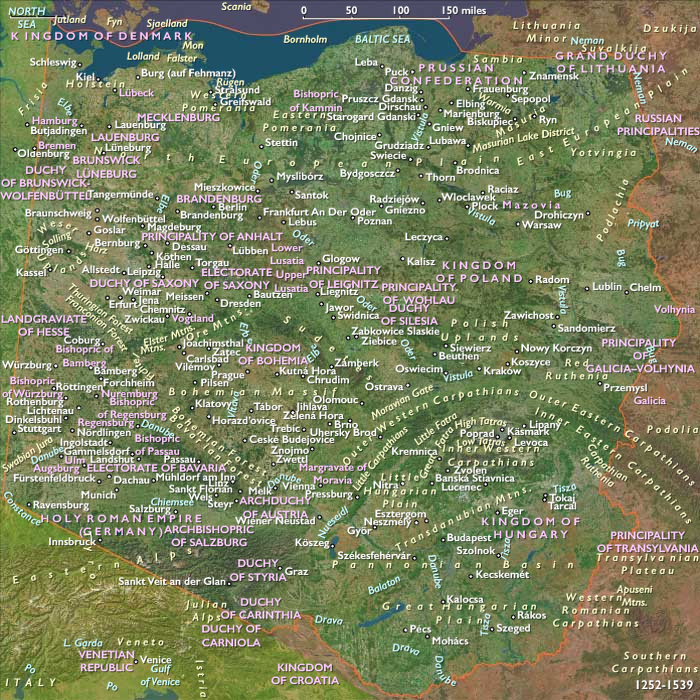
Bavarian-born Albert of Cologne, educated principally at Padua, where he received instruction in Aristotle's writings, had in 1223 (or 1221) become a member of the Dominican Order, against the wishes of his family, and studied theology at Bologna and elsewhere.
Selected to fill the position of lecturer at Cologne, Germany, where the Dominicans had a house, he taught for several years there, at Regensburg, Freiburg, Strasbourg and Hildesheim.
In 1245 he had gone to Paris, received his doctorate and taught for some time as a master of theology with great success.
During this time Thomas Aquinas began to study under Albertus.
Serving as provincial of the Dominicans from 1254 to 1257; he publicly defended the Dominicans against attacks by the secular and regular faculty of the University of Paris, commented on the Gospel of John, and answered the errors of the Arabian philosopher Averroes.
Made bishop of Regensburg from 1260 by Pope Alexander IV, he resigns after three years and becomes a preacher of the Crusades.
His main work, however, has been paraphrasing and commenting on Aristotle's philosophy; in so doing, he adds new areas of investigation.
As the first medieval scholar to apply Aristotle's philosophy to Christian thought, he has achieved fame for his comprehensive knowledge of and advocacy for the peaceful coexistence of science and religion.
Contemporaries such as Roger Bacon apply the term "Magnus" to Albertus during his own lifetime, referring to his immense reputation as a scholar and philosopher.
Regarded as the greatest German philosopher and theologian of the Middle Ages, beatified in 1622 and canonized in 1931, Albertus Magnus is honored by Catholicism as a Doctor of the Church, one of only thirty-three men and women with this honor.
Locations
People
Groups
Subjects
Regions
Subregions
Years: 1263 - 1263
Locations
People
Groups
Subjects
Regions
Subregions