
Bathhouses in India now exist in palaces, …
Years: 185BCE - 185BCE
Bathhouses in India now exist in palaces, monasteries, and the houses of the wealthy.
Each bathhouse features a dressing room, a steam room with stone benches arranged around a fireplace, a cool basement room for relaxing, and a swimming pool for finishing the bath.
Mauryan territories, centered around the capital of Pataliputra, had shrunk considerably from the time of the great Emperor Ashoka when Brihadratha came to the throne in 192 BCE.
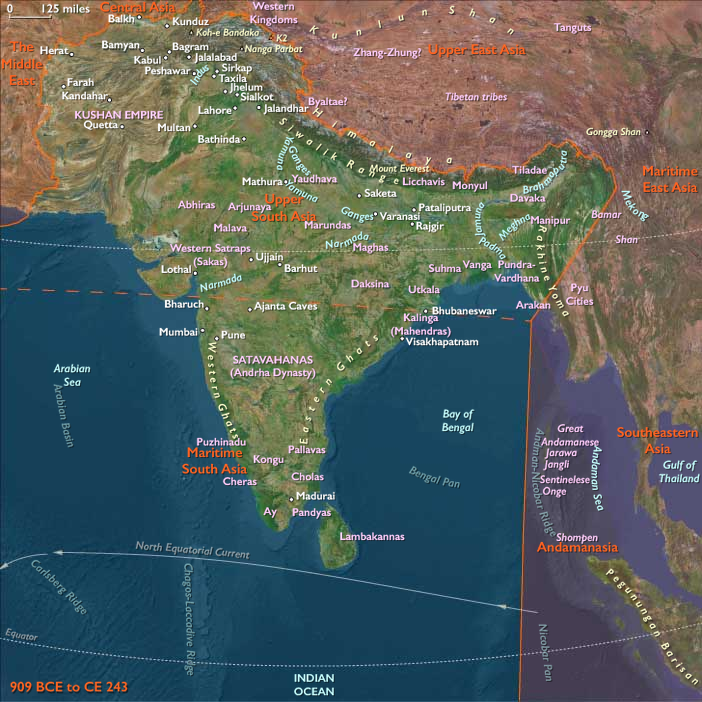
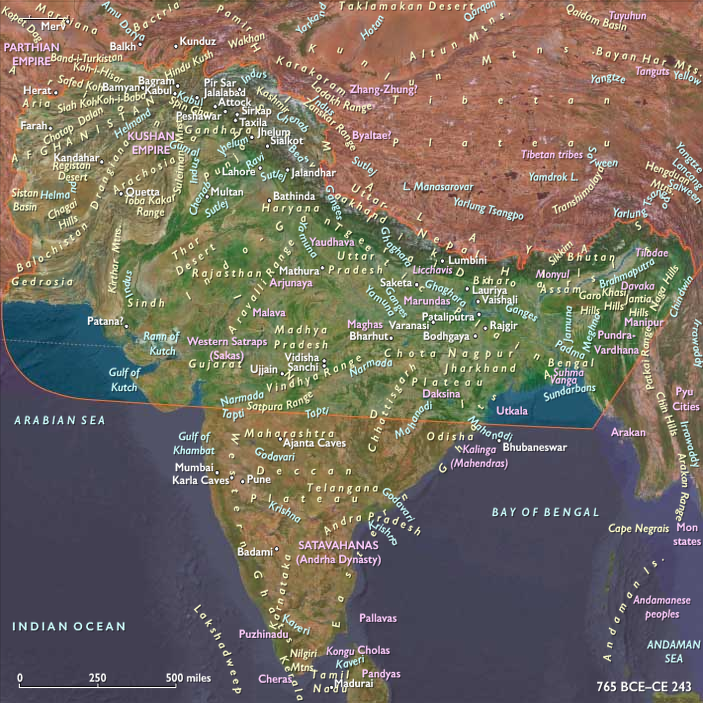
The Yuga Purana section of the Gargi Samhita says that the Yavana (Greco-Bactrian) army led by King Dhamamita (Demetrius) invaded the Mauryan territories during Brihadratha's reign and after occupying Panchala region and the cities of Saketa and Mathura, they finally captured Pataliputra.
But soon they had to leave to Bactria to fight a fierce battle (probably between Eucratides and Demetrius).
The seventh century CE historian Banabhatta relates in his Harshacharita that the king’s principlal senapati (general), Pusyamitra Sunga, while parading the entire Mauryan army before Brihadratha on the pretext of showing him the strength of the army, crushed his master because he was too weak to keep his promise (probably to repulse the Yavanas).
Pusyamitra now ascends the throne, becoming the ruler of Magadha and neighboring territories.
The kingdom of Pushyamitra is extended up to Narmada in the south, and controls Jalandhar and Sialkot in the Punjab in the northwestern regions, and the city of Ujjain in central India.
With the demise of the Mauryas, the Kabul Valley and much of the Punjab soon passes into the hands of the Indo-Greeks and the Deccan to the Satavahanas.
Locations
People
Groups
- Hinduism
- Buddhism
- Greeks, Hellenistic
- Maurya Empire
- Greco-Bactrian Kingdom
- Sunga Empire
- Indo-Greeks, Kingdom of the
Topics
Commodoties
Subjects
Regions
Subregions
Related Events
Showing 3 events out of 3 total
Years: 185BCE - 185BCE
Locations
People
Groups
- Hinduism
- Buddhism
- Greeks, Hellenistic
- Maurya Empire
- Greco-Bactrian Kingdom
- Sunga Empire
- Indo-Greeks, Kingdom of the
Topics
Commodoties
Subjects
Regions
Subregions