Basil, born in an eminent family to …
Years: 363 - 363
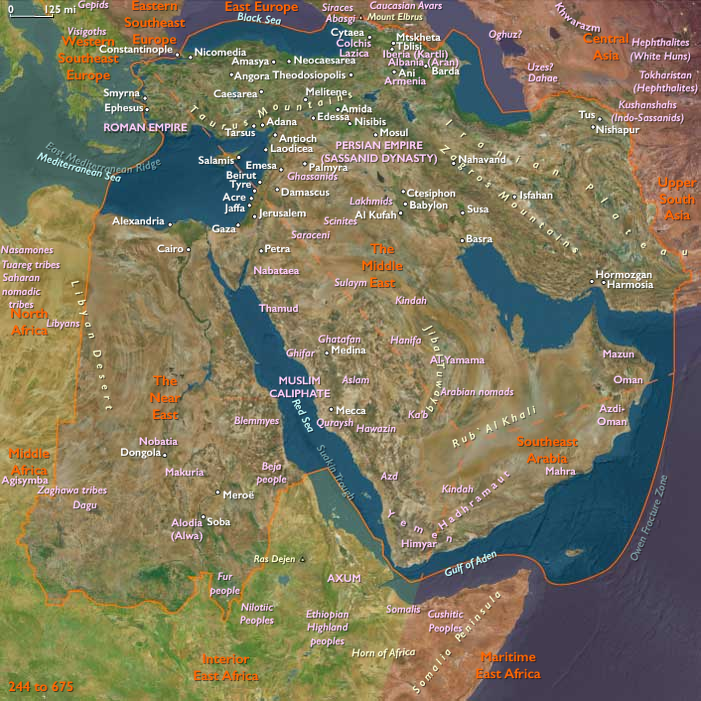
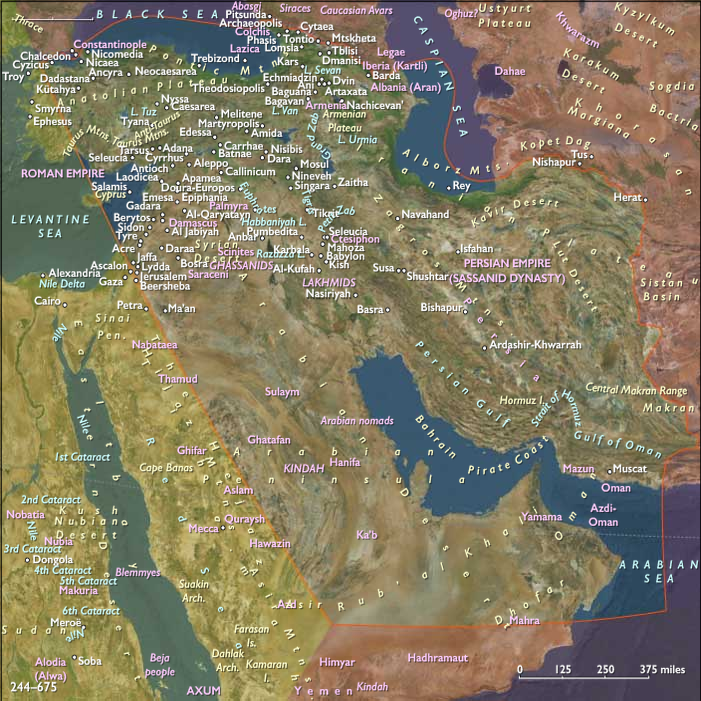
Basil, born in an eminent family to devout orthodox Christian parents at Caesarea in Cappadocia (present Kayseri, Turkey), received his higher education in Constantinople and Athens but, impressed by the ascetic life, had renounced a promising career to become a monk.
Settling as a hermit near Neocaesarea by the Iris River in Pontus, he has founded a monastic community here, where Gregory of Nazianzus, the son of the bishop in that Cappadocian town, joins him.
Gregory had been reluctant to a assume a position of responsibility in the church; he will later explain this stance in his Defense of the Flight to Pontus.
Basil’s younger brother, also named Gregory and known as Gregory of Nyssa, joins him as well.
Basil begins his anti-Arianist trilogy, Against Encomius, in 363.
Locations
People
Groups
Topics
Subjects
Regions
Subregions
Related Events
Filter results
Showing 10 events out of 59709 total
The invasion of Persian territory, always a lure in antiquity, is one to which Julian is not immune.
Motivated by a desire for military glory and a decision to reassert Rome's preeminence in the East, he assembles, despite counsels of prudence from Rome and the Levant, the largest Roman army (sixty-five thousand strong and backed by a river fleet) ever to head a campaign against Persia.
Despite counsels of prudence from Rome and the Levant, Julian leads his huge force into Sassanian territory in 363, wreaking havoc and approaching the very gates of Ctesiphon on the Tigris (below modern Baghdad), a major Sassanian city.
The Persians, aided by the desert, famine, treachery, and the incompetence of the Roman army—corrupted perhaps by large numbers of hostile Christians—once again prove themselves superior.
On June 25, during a disastrous retreat from the walls of Ctesiphon, below modern Baghdad, Julian is wounded by a spear, thrown “no one knew whence,” which pierces his liver.
He dies the next night at age thirty-one, having been emperor for twenty months.
Julian's successor, Jovian, chosen by the army's general staff, is a Christian, but not a fanatic.
To extricate his army from Persia, the new ruler immediately concludes an ignominious peace with Shapur, ceding to the Persians a good part of Galerian's conquests of 298, including all Roman territory east of the Tigris River, …
…together with the cities of Singara (modern Sinjar, Iraq) and …
…Nisibis (modern Nusaybin, Turkey), which had not surrendered; …
…Rome also abandons Christian Armenia.
Some of Jovian's contemporaries, believing that the army could have fought its way out, consider this treaty to be dishonorable.
Shapur, turning his attention to Armenia, defeats its pro-Roman ruler and attempts to force Zoroastrianism on the country.
The Romans, however, will eventually regain their influence here.
Meletius, a moderate Christian born at Melitene in Lesser Armenia of wealthy and noble parents, had first appeared around 357 as a supporter of Acacius, bishop of Caesarea, the leader of that party in the episcopate which supported the Homoean formula by which the Arianist emperor Constantius II sought for a compromise between the Homoiousian and the Homoousian.
Appointed bishop of Antioch in 360, had immediately offended the emperor, resulting in his exile.
The supporters of Eustathius, a former bishop of Antioch, had created a schism here by consecrating the presbyter Paulinus, a stricter adherent of the Homousian formula, as bishop in the absence of Meletius.
The synod of Alexandria had sent deputies to attempt an arrangement between the two anti-Arian Churches; but before they arrived, Paulinus had been consecrated bishop by Lucifer of Calaris.
When Meletius returns in consequence of the emperor Julian’s accession, he finds himself as one of three rival bishops.
Ephrem, known as Ephrem the Syrian, a Christian theologian and poet, had found himself among a large group of refugees from Nisibis that fled west after the Persian victory of 363, first to Amida (Diyarbakir), then to Edessa, home to a noted theological school; here, he writes most of his known works.
Intensely devoted to the saints, especially Mary, whom he views as the New Eve, he applies his florid style to voluminous writings on scriptural, dogmatic, and ascetical topics.
He is celebrated for his metrical homilies and hymns, (still used in the liturgy of the Nestorian church).
Cyril, the anti-Arianist bishop of Jerusalem, has written twenty-four treatises on Christian doctrine called Catecheses.
Acacius, the Arian bishop of Caesarea, had had exiled Cyril from his see in 358, forcing his retirement to Tarsus; the Council of Seleukeia, held two years later, results in his reinstatement and the deposition of Acacius.
The process in 360 had been reversed through the metropolitan's court influence, and Cyril had suffered another year's exile from Jerusalem, until the accession of Julian the Apostate allows him to return in 363.
The Official Division of the Roman Empire (364 CE) and the Growing Vulnerability of the West
The division of the Roman Empire became official in 364 CE, when Emperor Valentinian I took control of the Western Roman Empire, while his brother Valens ruled the Eastern Roman Empire. This division, though initially intended as an administrative strategy, further weakened the empire’s ability to defend itself, especially in the West, where economic struggles and political instability left it increasingly vulnerable to barbarian incursions.
1. The Official Division of the Empire (364 CE)
- In 364 CE, after the brief rule of Jovian, the empire was officially divided:
- Valentinian I ruled the West, governing from Mediolanum (Milan) and Rome.
- Valens ruled the East, initially based in Constantinople, which would become the permanent capital of the Eastern Empire.
- The division reflected growing administrative challenges, as a single emperor could no longer effectively manage the vast empire.
2. Economic and Administrative Disruptions
- The Western Roman Empire faced severe financial problems, including:
- Declining tax revenues due to depopulation and economic decline.
- Increased military expenses to defend its borders.
- Corrupt administration and political infighting, which weakened the government.
- In contrast, the Eastern Roman Empire remained wealthier and more stable, with stronger trade connections to the Mediterranean and Asia.
3. Increased Barbarian Invasions
- As the West struggled, barbarian groups began launching more frequent and destructive raids.
- The most significant threats included:
- The Goths, who had been pressured by the advancing Huns and were seeking refuge within Roman borders.
- The Vandals and Alans, who began probing the empire’s western frontiers.
- The Franks and Alemanni, who continued to raid Gaul.
- These invasions further destabilized Roman control, as the Western Empire lacked the resources and manpower to defend its borders effectively.
4. Consequences of the Division
- While the Eastern Empire managed to reinforce its defenses, the West became increasingly vulnerable.
- The weakening of the Western military led to a reliance on barbarian mercenaries (foederati), who would later turn against Rome.
- The empire’s fragmentation made it easier for external enemies to exploit divisions between East and West.
5. Conclusion: A Precursor to the Fall of the West
The division of the Roman Empire in 364 CE was meant to strengthen imperial administration, but it ultimately led to a growing imbalance between East and West.
- While the Eastern Empire survived and thrived, the Western Empire spiraled into decline, ultimately collapsing in 476 CE.
- This period marked the beginning of the end for Rome in the West, as economic troubles, political instability, and barbarian invasions pushed it toward fragmentation and collapse.
Though the empire still endured, the events of 364 CE set the stage for the Western Roman Empire’s fall and the rise of medieval Europe.
East Central Europe (364–375 CE): Valentinian’s Frontier Consolidation and Persistent Gothic Pressure
Between 364 and 375 CE, East Central Europe—including Poland, Czechia, Slovakia, Hungary, and those portions of Germany and Austria lying east of 10°E and north of a line stretching from roughly 48.2°N at 10°E southeastward to the Austro-Slovenian border near 46.7°N, 15.4°E—experienced renewed Roman frontier consolidation under Emperor Valentinian I (364–375 CE), amid persistent external pressures from Gothic tribes. Valentinian strengthened frontier defenses along the Danube, reinforcing Roman provincial security in Pannonia and Noricum. Meanwhile, the Rugii remained stable in their settlements around the upper Tisza, and the proto-Slavic communities continued their resilience and adaptation within the Gothic sphere of influence.
Political and Military Developments
Valentinian’s Robust Frontier Policies
-
Emperor Valentinian I prioritized strengthening frontier defenses along the Danube, significantly reinforcing fortifications, increasing troop deployments, and improving defensive infrastructure.
-
Valentinian’s assertive military strategies provided a stronger barrier against repeated Gothic incursions, reducing their frequency and severity but not fully eliminating threats.
Continued Gothic Pressure
-
Gothic groups, while somewhat restrained by Valentinian’s fortified frontier, remained persistent threats, launching intermittent raids and maintaining diplomatic tensions, especially along vulnerable points in the Roman defenses.
Rugian Stability in Roman Pannonia
-
The Rugii maintained their established presence near the upper Tisza River, contributing positively to frontier stability. Their communities served as reliable diplomatic and economic partners for Roman authorities.
Economic and Technological Developments
Moderate Economic Recovery and Trade
-
Strengthened defenses under Valentinian allowed modest economic recovery along the frontier. Although cautious, cross-border trade between Romans, Rugii, and other neighboring tribes improved, increasing regional economic stability.
Frontier Infrastructure Strengthening
-
Infrastructure investment expanded, particularly regarding defensive fortifications, roads, and logistical networks, enhancing regional security and facilitating trade and communication.
Cultural and Artistic Developments
Artistic Adaptation and Integration
-
Cultural production along the frontier continued to reflect security concerns, though renewed stability allowed for more elaborate craftsmanship in metalwork, ceramics, and decorative artifacts.
-
Interaction among Romans, Rugii, and surrounding tribes fostered distinctive hybrid artistic styles, blending Germanic traditions and Roman techniques.
Proto-Slavic Cultural Continuity
-
Proto-Slavic communities remained culturally resilient, preserving traditional customs and practices despite ongoing external pressures from Gothic groups.
Settlement and Urban Development
Enhanced Frontier Towns
-
Frontier towns, including Carnuntum, Vindobona, and Aquincum, saw increased investment in fortifications and defensive infrastructure, becoming well-protected military and administrative centers.
Continued Stability of Rugian Settlements
-
Rugian communities consolidated their positions, becoming well-integrated, stable components of the regional landscape, benefiting from improved economic interactions and frontier defenses.
Social and Religious Developments
Stable Rugian Leadership
-
The Rugii maintained effective leadership structures, balancing diplomatic cooperation with Roman authorities and preserving tribal autonomy, contributing to regional stability.
Proto-Slavic Social Resilience
-
Proto-Slavic populations preserved strong social and religious traditions, maintaining internal cohesion and adapting successfully to the shifting regional environment under Gothic influence.
Long-Term Consequences and Historical Significance
The era 364–375 CE marked an important phase of frontier consolidation under Valentinian I. Roman defensive enhancements significantly improved regional stability, though Gothic pressures persisted. The enduring stability of Rugian and proto-Slavic communities provided valuable resilience, shaping East Central Europe’s political, cultural, and social landscape. These developments laid essential foundations for subsequent historical changes and transformations across the region in the late fourth century and beyond.
Eastern Southeast Europe (364–375 CE): Barbarian Invasions and Cultural Transitions
Settlement and Migration Patterns
Onset of Barbarian Invasions
Between 364 and 375 CE, Eastern Southeast Europe experienced intensified invasions by Germanic and Central Asian tribes, dramatically reshaping the region's demographic and cultural landscape. The first major incursions included those by the Visigoths, Ostrogoths, Gepids, and later the nomadic pastoralist Huns, who arrived around 370 from Central Asia. These groups swept across the Danube frontier, overwhelming Roman defenses and precipitating a wave of instability and population displacement.
Decline of Dacian Settlements
As Rome's power receded from the region, Dacia became increasingly vulnerable, transforming into a thoroughfare for invading tribes aiming for wealthier lands further west and south. Roman-built towns and settlements were progressively abandoned, infrastructure deteriorated, and rural life declined precipitously, leaving local populations exposed to frequent plundering and disruptions.
Economic and Technological Developments
Economic Collapse and Insecurity
The relentless incursions severely undermined economic stability, trade, and agriculture. Crumbling Roman roads became unsafe due to highwaymen and banditry, severely impacting trade and travel. While some fortified urban centers struggled to maintain economic activity, rural commerce and agricultural productivity dramatically decreased under continuous threat.
Infrastructure Decay
Roman infrastructure, once the backbone of regional connectivity and prosperity, fell into disrepair. Roads, aqueducts, and urban defenses deteriorated due to lack of maintenance, resources, and security, symbolizing the broader regional decline.
Cultural and Artistic Developments
Emergence of Dacian Ethnic Identity
Despite political and economic turmoil, this era marked the consolidation of a distinct Dacian ethnic identity, emerging from the fusion of Roman colonists, indigenous Getae, and coastal Greek populations. This cultural synthesis fostered new forms of linguistic expression and religious practices, laying foundations for later Romanian cultural heritage.
Linguistic Transition and Literacy
The Vulgar Latin language increasingly replaced the native Thracian tongue in commerce, administration, and daily life, significantly advancing literacy among local populations, especially those involved with the Roman military and administrative systems. This linguistic shift laid the groundwork for the evolution of the modern Romanian language.
Social and Religious Developments
Religious Syncretism and Continuity
A notable religious fusion occurred during this period, reflecting both Roman and indigenous influences. The local populace, having embraced deities from the Greco-Roman pantheon such as Jupiter, Diana, and Venus, also retained indigenous religious traditions, such as cremation rites originally practiced by the Getae, often incorporating Roman customs such as placing coins with cremated remains for Charon, the mythological ferryman of the dead.
Mithraic and Indigenous Beliefs
Some inhabitants continued the worship of Mithras, the Persian god of light popular among Roman legionnaires. These religious practices exemplified the diverse and syncretic spiritual landscape that persisted even amidst regional upheaval.
Long-Term Consequences and Historical Significance
The period from 364 to 375 CE represented a critical turning point for Eastern Southeast Europe, characterized by severe barbarian invasions, economic disintegration, infrastructure collapse, and profound cultural transformation. Despite these disruptions, significant cultural and linguistic developments took root, ultimately shaping the region's enduring ethnic, linguistic, and religious herita