
Bartolomeu Dias is a Knight of the …
Years: 1480 - 1491
Bartolomeu Dias is a Knight of the royal court, superintendent of the royal warehouses, and sailing-master of the man-of-war, São Cristóvão (Saint Christopher).
King John II of Portugal appoints him, on October 10, 1487, to head an expedition to sail around the southern tip of Africa in the hope of finding a trade route to India.
Dias is also charged with searching for the lands ruled by Prester John, a fabled Christian priest and ruler.
Dias' ship São Cristóvão is piloted by Pêro de Alenquer.
A second caravel, the São Pantaleão, is commanded by João Infante and piloted by Álvaro Martins.
The expedition sails south along the West coast of Africa.
Extra provisions are picked up on the way at the Portuguese fortress of São Jorge de Mina on the Gold Coast.
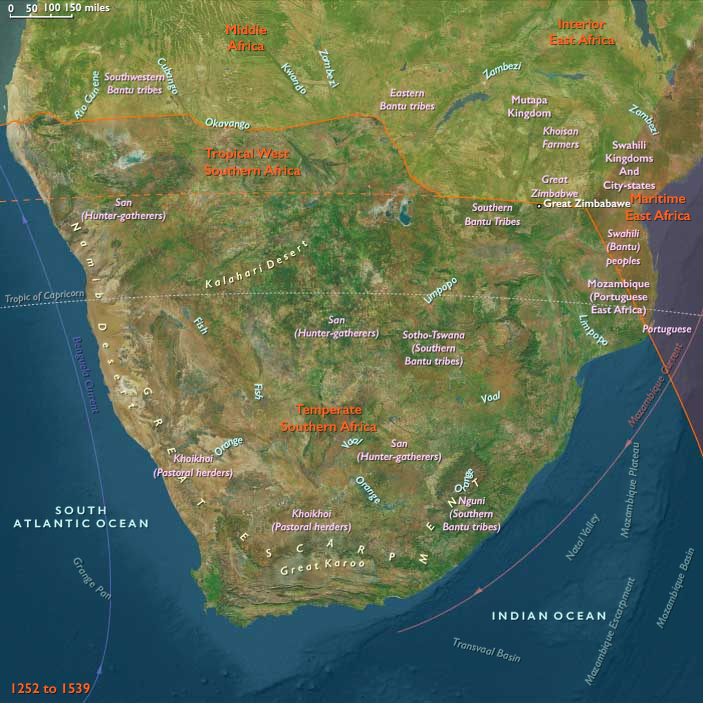
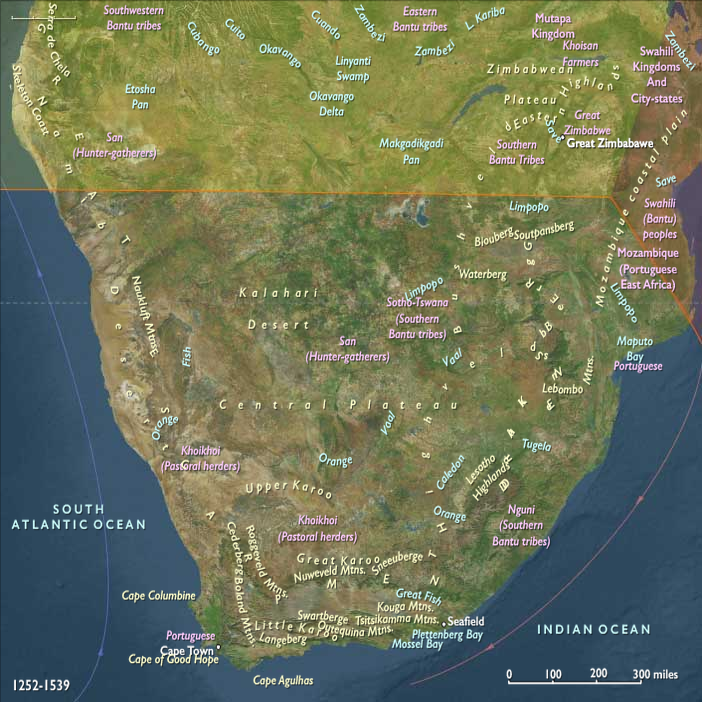
After having sailed past Angola, Dias reaches the Golfo da Conceicão (Walvis Bay) by December.
Continuing south, he discovers first Angra dos Ilheus, being hit, then, by a violent storm.
Thirteen days later, from the open ocean, he searches the coast again to the east, discovering and using the westerly winds—the ocean gyre, but finding just ocean.
Having rounded the Cape of Good Hope at a considerable distance to the west and southwest, he turns towards the east, and taking advantage of the winds of Antarctica that blow strongly in the South Atlantic, he sails northeast.
After thirty days without seeing land, he enters what he names Aguada de São Brás (Bay of Saint Blaise)—later renamed Mossel Bay—on February 4, 1488.
Dias's expedition reaches its furthest point on March 12, 1488, when they anchor at Kwaaihoek, near the mouth of the Bushman's River, where a padrão—the Padrão de São Gregório—is erected before turning back.
Dias wants to continue sailing to India, but he is forced to turn back when his crew refuses to go further.
It is only on the return voyage that he actually discovers the Cape of Good Hope, in May 1488.
Dias names the promontory the Cape of Storms, but King John will soon rename it the Cape of Good Hope after the riches of Asia that begin flowing around it to Portugal.
Locations
People
Groups
Topics
Commodoties
Subjects
Regions
Subregions
Years: 1480 - 1491
Locations
People
Groups
Topics
Commodoties
Subjects
Regions
Subregions