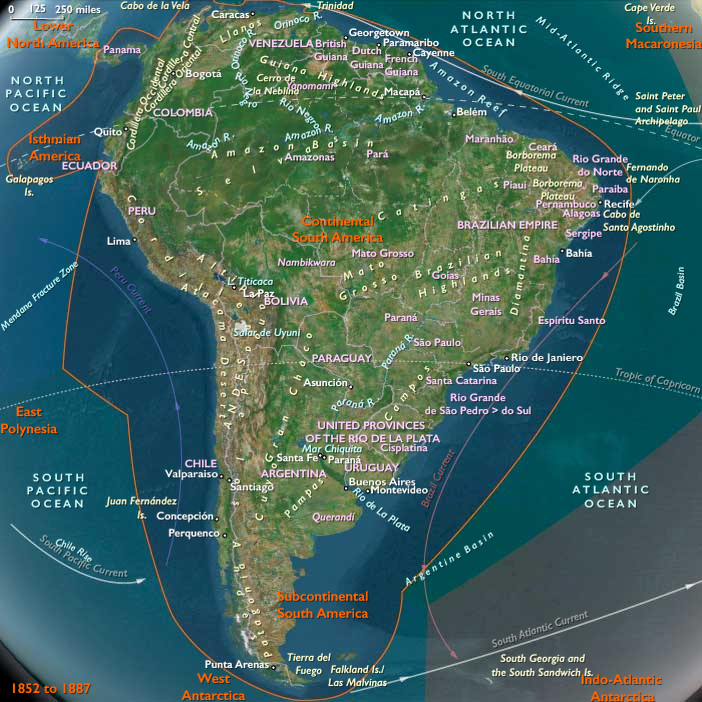
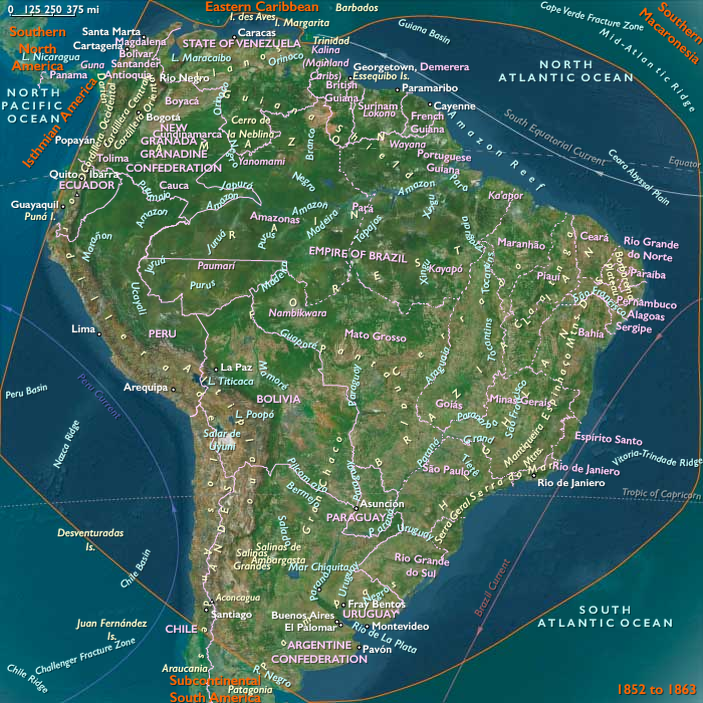
The southern state of Cauca secedes from …
Years: 1860 - 1860
May
Locations
Groups
Topics
Subjects
Regions
Subregions
Related Events
Filter results
Showing 10 events out of 15018 total
The Maori still own most of the land of the North Island, but a large increase in the number of immigrants in the 1850s has led to demands for greatly increased land purchase by the government.
Many Maori are determined not to sell, but Pokikake Te Teira, a minor chief of the Te Atiawa iwi, offers to sell some six hundred acres of land known as the Pekapeka block at Waitara to the British.
However, the sale is vetoed by the paramount chief of the tribe, Wiremu Kingi.
Despite knowing this, the Governor of the Colony, Thomas Gore Browne, accepts the purchase and tried to occupy the land.
The real issue is sovereignty.
The Treaty of Waitangi had given the Māori Chiefs and the British Government equal sovereignty over the land of New Zealand, and by 1860 it is tacitly recognized that British Law prevails in the settlements and Māori Custom elsewhere.
The British had accepted this situation for twenty years but are finding it increasingly irksome.
The European settlers now outnumber the Māori whose population is declining due to disease and low birth rates.
They are convinced that the British system represents the best that civilization has to offer and see it as both their duty and their right to impose it on other peoples.
On March 5, 1860 Governor Browne orders Colonel Gold, commanding the 65th Regiment, the militia and the Taranaki Rifle Volunteers to occupy the disputed block of land at Waitara.
In response, Wiremu Kingi hastens to the block and with about eighty men hastily built a Pā, or defensive strong point, on a nearby headland and refused to evacuate it, beginning the first of two Taranaki War, in which only the extremist wing of the King Movement participates.
At the time of the conflict the main European settlement is at New Plymouth and much of the fighting takes place within twenty-five kilometers of the town.
The war consists essentially of a series of generally successful sieges of Maori pas (fortified villages) by British troops and militia employing a sap trench procedure.
The British are defeated during an attack (June 1860) on Puketakauere pa when the Maori execute a surprise counterattack; but the Maori are defeated at Orongomai in October and Mahoetahi in November.

Robert O’Hara Burke and William John Wills lead a-well provisioned fifteen hundred mile (twenty-four hundred kilometer) four-man expedition using camels from Melbourne to the Gulf of Carpenteria in 1860, crossing the continent from south to north in six months.
On the mismanaged return journey, both Burke, an Irish immigrant and Wills, a British astronomer, surveyor, and explorer, die of starvation at the abandoned Cooper Creek station in Central Australia in 1861.
Only one of the ill-fated expedition’s members, John King, survives.
All the Australian colonies save Western Australia have implemented representative and responsible forms of government by 1860, using the Australian Colonies Government Act of 1850 to do so.
Mongkut signs treaties with the Netherlands in 1860.
China’s ratification of the Treaties of Tianjin in 1860 ends the Anglo-French War, or Second Opium War.
The Treaties open of all China to Western diplomatic, commercial and missionary representatives and allow Britain seven eighths of the China trade.
Hong Rengan had been elevated to prime minister of the Taiping state soon after his arrival at the Taiping camp.
In this position he has tried to introduce his program, which includes railroad construction, telegraph facilities, modern banks and hospitals, and reform of the administration along Western democratic lines.
His suggestions have aroused the jealousy of many of the older Taiping leaders, however, and they refuse to cooperate.
Moreover, the Western countries, having forced the Chinese government to grant their trade concession to them in the “Arrow” War, have thrown their support to the dynasty in the suppression of the rebels.
Rengan's policies have therefore failed, and he is demoted.
From 1860, with the Taipings beset by internal dissension, poor leadership, and corruption, the military and administrative genius of General Li Xiucheng keeps the movement going.
The Green Standard Army twice attempts to besiege Nanjing, capital of the Taiping Heavenly Kingdom, but is unable to break through.
The British import 58,681 chests of opium into China in 1860.
The Nien, numbering from thirty thousand to fifty thousand soldiers and organized into five armies, begin to conduct raids into adjacent regions.
Li Xiucheng, military leader of the Taiping Rebellion from 1860, tries to expand the Taiping conquests by taking the large North China trading city of Shanghai.
As a result, Western forces based in the city began to aid the Imperial government.
With Taiping forces about to take the city, Frederick Townsend Ward, a twenty-nine-year-old American adventurer, organizes a force of foreign mercenaries and helps to save the city.
At this time, the Western powers are still attempting to maintain neutrality in the civil war, and the British arrest Ward to halt his military aid to the dynasty.
He escapes, however.
The Qing court needs, besides Western help, an army stronger and more popular than the demoralized imperial forces to defeat the Taiping rebellion.
Zeng Guofan, a scholar-official from Hunan Province, is appointed imperial commissioner and governor-general of the Taiping-controlled territories in 1860 and placed in command of the war against the rebels.