
The Defeat of …
Years: 448 - 459
The Defeat of Attila in Gaul
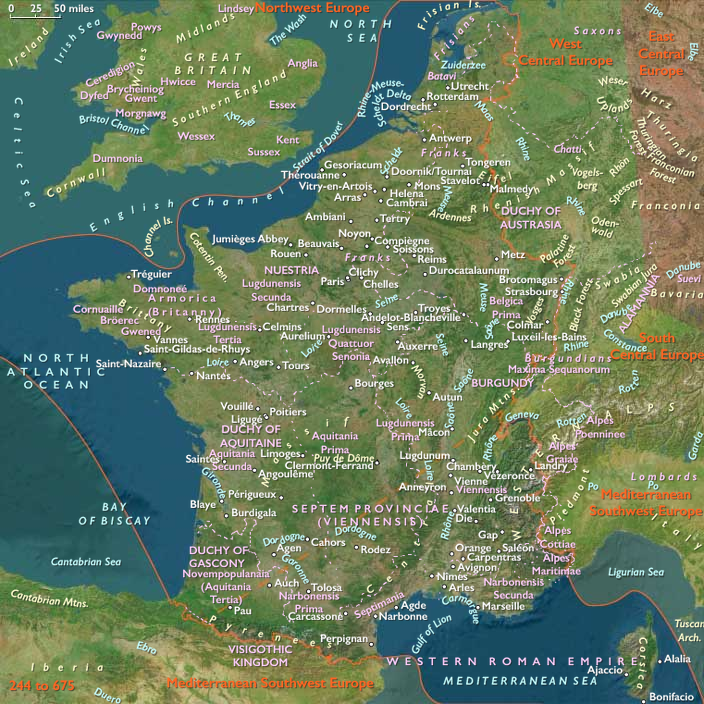
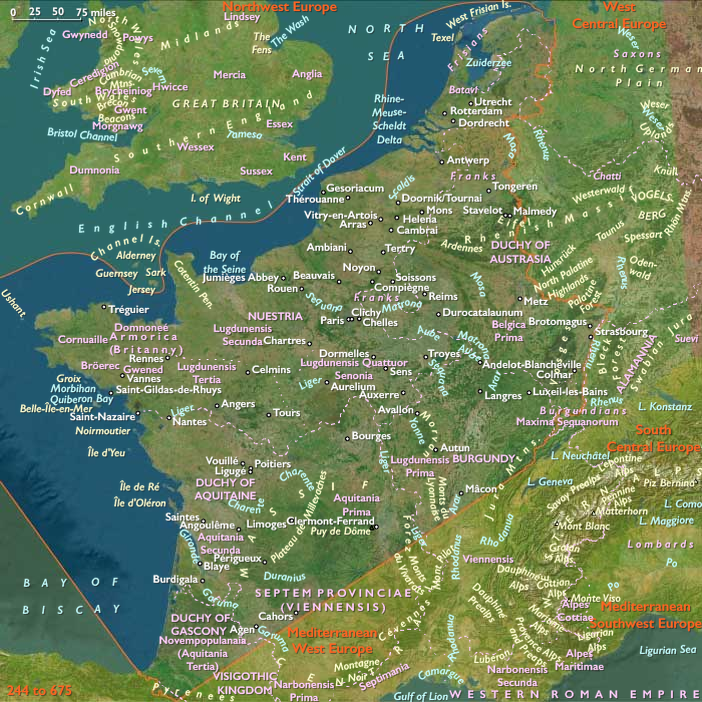
By the mid-fifth century, Attila, the formidable Hunnic leader, has unified the Huns and incorporated various Germanic allies, including Ostrogoths, Gepids, and Alans, into a massive westward invasion of Gaul. His campaign, launched in 451 CE, threatens to overwhelm the Western Roman provinces, as his forces ravage cities and press toward Orléans.
The Roman-Visigothic Alliance
Recognizing the existential threat Attila poses, Flavius Aetius, the magister militum of the Western Roman Empire, assembles a coalition army that includes:
- Roman troops
- Visigoths under King Theodoric I
- Burgundians and other federates
This rare display of unity between Romans and Visigoths results in the Battle of the Catalaunian Plains (also called the Battle of Châlons) in June 451 CE. The battle is one of the most significant clashes of Late Antiquity, as it halts Attila’s westward expansion.
The Battle and Its Aftermath
Though Attila's Huns and Germanic allies prove fearsome in combat, the coalition army, led under a single command, manages to drive them from Gaul. The battle results in heavy casualties on both sides, and Theodoric I is killed in the fighting. However, the victory prevents Attila from establishing a permanent foothold in Western Europe.
While Attila will return in 452 CE to invade Italy, his failure in Gaul marks the beginning of the end for Hunnic dominance. Within a few years, Attila will die in 453 CE, and his empire will quickly disintegrate, freeing Western Europe from the Hunnic threat and reshaping the power dynamics of the post-Roman world.
People
Groups
- Germans
- Huns
- Hunnic Empire
- Roman Empire: Theodosian dynasty (Constantinople)
- Roman Empire, Western (Ravenna)
- Visigothic Kingdom of Toulouse
- Roman Empire, Eastern: Leonid dynasty
Topics
- Migration Period
- Hun Raids on the Roman Empire
- Fall of the Western Roman Empire
- Catalaunian Plains, Battle of the
Subjects
Regions
Subregions
- East Central Europe
- Eastern Southeast Europe
- Mediterranean Southwest Europe
- Atlantic West Europe
- West Central Europe
Related Events
Filter results
Showing 10 events out of 58768 total
Hawaiʻiloa, a Polynesian chief, is said to have discovered what will be called the Hawaiian Islands, according to one legend, sailing across twenty-four hundred miles of open water from the island of Raiatea, near Tahiti.
He settles on Hawaii, named in his honor.
The story of Hawaiʻiloa is attested, however, only by such late sources as the antiquarians Abraham Fornander and Thomas George Thrum.
As they did not give their original Hawaiian sources, but only digests and compilations, we cannot be sure that the tale has not been slanted towards proof of Fornander's now discredited migration theories, or that it has not been elaborated by nineteenth-century Hawaiians eager to stress the validity of their own beliefs.
Hawaiʻiloa is not mentioned in early Hawaiian sources like David Malo or Samuel Kamakau.
Malo says that there are many stories of the origin of the Hawaiians, and cites some migration tales, some legends of indigenous origin.
He does not mention Hawaiʻiloa.
Kamakau says that the first man and woman were Hulihonua and Keakahuilani, and that they were created on Oʻahu.
The Widespread Adoption of Metal Horseshoes
By the mid-fifth century, the use of metal horseshoes becomes increasingly widespread across the Near East, Middle East, and Europe, revolutionizing agriculture, transportation, and warfare. While earlier civilizations had used rawhide or bronze hoof coverings, the more advanced nailed iron horseshoe provides significant advantages in traction, durability, and hoof protection, allowing horses to be used more effectively across varied terrains.
Impact on Agriculture and Trade
- Improved Traction – Horses equipped with iron horseshoes can more easily navigate muddy, rocky, and uneven ground, making them more reliable for plowing fields and hauling goods.
- Enhanced Durability – The protection offered by metal horseshoes extends the working life of horses, reducing injuries and making them a more valuable agricultural asset.
- Expansion of Trade Routes – As horses become better suited for long-distance travel, merchants and caravans benefit from greater efficiency in overland trade, strengthening economic networks across Europe and the Middle East.
Military Advancements
- Greater Mobility – Armies using horses for scouting, cavalry charges, and mounted archery see improved performance on diverse terrains, from marshy lowlands to mountainous regions.
- Increased Horse Longevity – With better hoof protection, cavalry units maintain their horses in better condition, reducing the need for constant replacements.
- Strategic Flexibility – Horseshoes contribute to the rise of heavily armored cavalry, paving the way for the later dominance of knights and cataphracts in medieval warfare.
A Lasting Innovation
The widespread adoption of metal horseshoes marks a crucial technological shift, supporting economic growth, agricultural efficiency, and military effectiveness. This innovation will continue to shape transportation and warfare throughout the medieval period, playing a foundational role in the expansion of medieval societies across Eurasia.
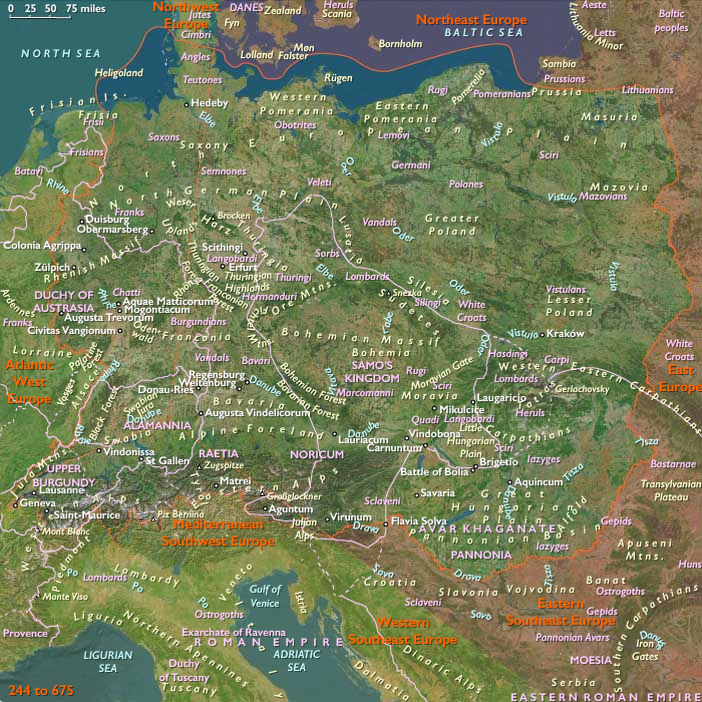
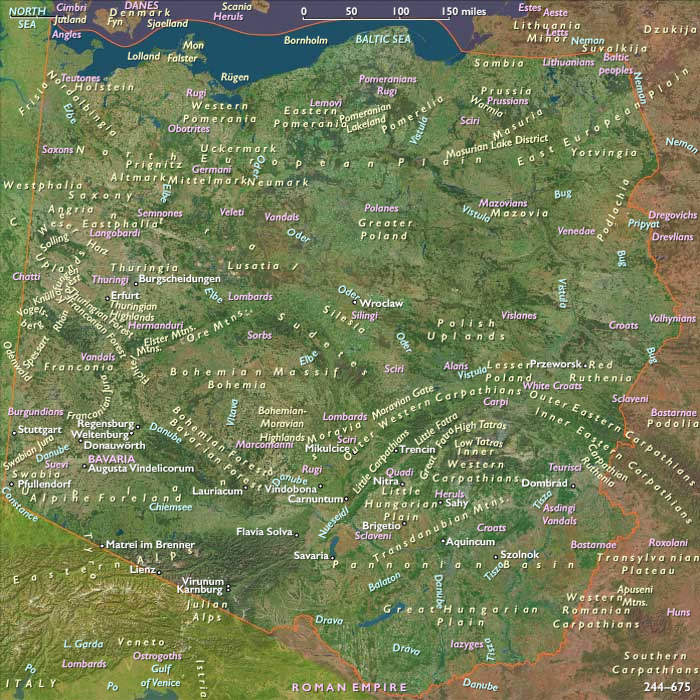
East Central Europe (448–459 CE): Attila’s Campaigns, Hunnic Collapse, and Regional Realignments
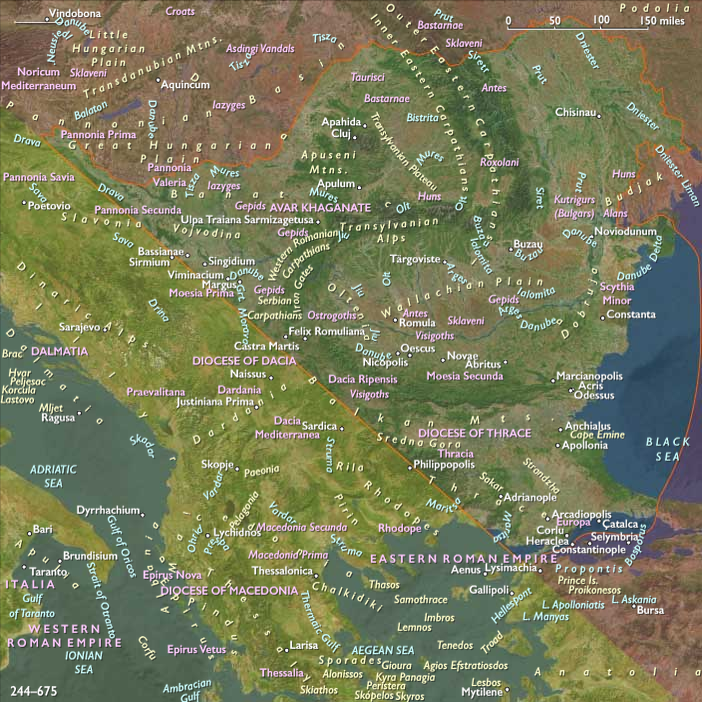
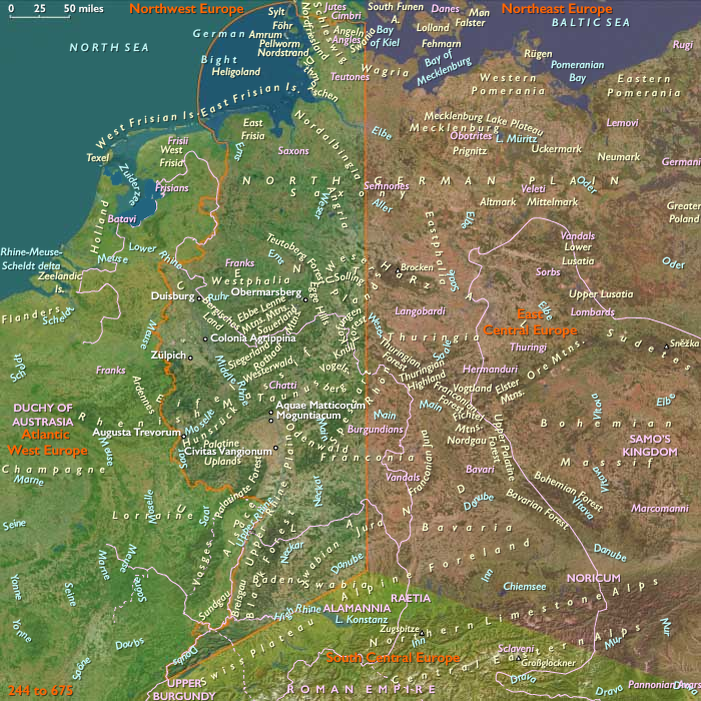
Between 448 and 459 CE, East Central Europe—including Poland, Czechia, Slovakia, Hungary, and those portions of Germany and Austria lying east of 10°E and north of a line stretching from roughly 48.2°N at 10°E southeastward to the Austro-Slovenian border near 46.7°N, 15.4°E—experienced profound transformations triggered by Attila the Hun’s ambitious campaigns against the Western Roman Empire and the subsequent rapid collapse of Hunnic authority after his death in 453 CE. The sudden vacuum of power led to extensive regional realignments, the resurgence of tribal independence, and renewed instability along the Roman frontier. Amid these dramatic shifts, the Rugii skillfully maintained their stability along the upper Tisza, while the proto-Slavic communities continued to display notable resilience, preserving their traditional social and cultural cohesion.
Political and Military Developments
Attila’s Western Campaigns and Death (453 CE)
-
Attila’s aggressive western campaigns—including his invasions of Gaul (451 CE) and Italy (452 CE)—marked the peak of his expansive ambitions, briefly projecting Hunnic power far beyond East Central Europe.
-
Attila’s sudden death in 453 CE precipitated rapid internal fragmentation among the Huns, resulting in the swift dissolution of their unified power and leaving a significant political vacuum across the region.
Fragmentation of Hunnic Empire and Regional Instability
-
Following Attila’s demise, internal divisions led to a rapid fragmentation of Hunnic dominance. Various Germanic and tribal groups, previously subjugated or allied with the Huns, reasserted their autonomy, sparking extensive regional realignments and renewed conflicts.
-
The collapse intensified instability in Roman provinces along the Danube, as former Hunnic territories descended into competing tribal factions.
Rugian Stability Amidst Turmoil
-
The Rugii, strategically positioned along the upper Tisza, leveraged their diplomatic acumen to retain stability and regional influence, successfully navigating the chaotic aftermath of Attila’s death.
Economic and Technological Developments
Economic Fragmentation and Localized Adaptation
-
With the breakdown of Hunnic authority and regional order, economic structures further fragmented into localized agricultural production, pastoralism, and village-based trade networks.
Infrastructure Neglect and Further Decay
-
Roman-built infrastructure and fortifications deteriorated significantly amid the rapid regional destabilization, with little investment in repair or improvement due to persistent uncertainty and lack of central governance.
Cultural and Artistic Developments
Shifts in Cultural Influence
-
The collapse of centralized Hunnic control allowed local cultural identities to reassert themselves, albeit reflecting significant hybridization from previous decades. Artifacts from this era—metalwork, pottery, jewelry—continued to show Hunnic stylistic influence blended with revived Germanic and Roman traditions.
Proto-Slavic Cultural Continuity
-
Proto-Slavic populations maintained their cohesive cultural and social structures, largely unaffected by broader regional upheavals, underscoring their enduring resilience and stability.
Settlement and Urban Development
Continuing Decline of Roman Settlements
-
Roman frontier settlements (Carnuntum, Vindobona, Aquincum) remained severely diminished, surviving primarily as small-scale military outposts and local trade hubs amid broader regional disorder.
Stable Rugian Communities
-
Rugian settlements continued to thrive along the upper Tisza region, maintaining their local economic strength and strategic significance through diplomatic neutrality and adaptive governance.
Social and Religious Developments
Rugian Leadership Diplomacy
-
Rugian tribal leaders maintained their autonomy and internal cohesion through careful diplomacy, successfully managing relationships with surrounding tribal factions, Roman remnants, and emerging post-Hunnic powers.
Proto-Slavic Social Resilience
-
Proto-Slavic communities continued their stable social hierarchies and traditional religious practices, maintaining internal coherence despite the external instability accompanying the Hunnic collapse.
Long-Term Consequences and Historical Significance
The era 448–459 CE was pivotal in East Central Europe, marking the dramatic end of Attila’s expansive Hunnic empire and initiating a complex period of regional realignment. The fragmentation of Hunnic authority significantly reshaped local power dynamics, redefined tribal autonomy, and created lasting geopolitical shifts. The Rugian and proto-Slavic communities’ resilience provided important continuity amidst instability, setting the stage for the new tribal and cultural landscapes that would dominate the region’s subsequent historical development.
The Decline of Urban Life and the Rise of a Barter Economy
As barbarian raids intensify across the Western Roman Empire, many Romans and provincial citizens begin abandoning towns and cities in favor of the countryside, where they are less vulnerable to attacks. This gradual urban exodus signals a profound economic and social transformation, as the empire’s once-thriving commercial networks deteriorate and centralized governance weakens.
The Collapse of Urban Centers
For centuries, Roman cities had been the economic and administrative hubs of the empire, relying on long-distance trade, taxation, and monetary exchange. However, by the mid-fifth century:
- Repeated invasions and sackings—by groups such as the Visigoths, Vandals, and Huns—leave cities damaged, depopulated, or abandoned.
- Public infrastructure deteriorates, including roads, aqueducts, and marketplaces, making it harder to sustain urban economies.
- Imperial authority weakens, leaving many regions without effective governance, law enforcement, or protection from raiders.
The Shift Toward a Rural Economy
As Roman cities decline, economic activity shifts to rural estates, particularly villae owned by the aristocracy. These self-sufficient agricultural estates become the primary centers of production and survival, marking the early foundations of the feudal system that will dominate the medieval world.
The Rise of Barter and Localized Trade
With the collapse of long-distance monetary trade and the breakdown of centralized coin-based economies, a barter system gradually replaces organized commerce:
- Local exchanges of goods and services become the primary means of trade, as coins lose circulation and value.
- Landowners, peasants, and craftsmen rely on in-kind payments, exchanging crops, livestock, and handmade goods rather than currency.
- Luxury goods and imports from the Eastern Mediterranean become increasingly rare, isolating the Western provinces from Byzantine and Middle Eastern markets.
A Defining Moment in Rome’s Transformation
This shift from an urban, market-driven economy to a localized, agrarian barter economy marks a defining moment in the decline of the Western Roman Empire. As cities empty and commerce fades, the structure of society increasingly revolves around rural estates and localized power, setting the stage for the emergence of medieval feudalism.
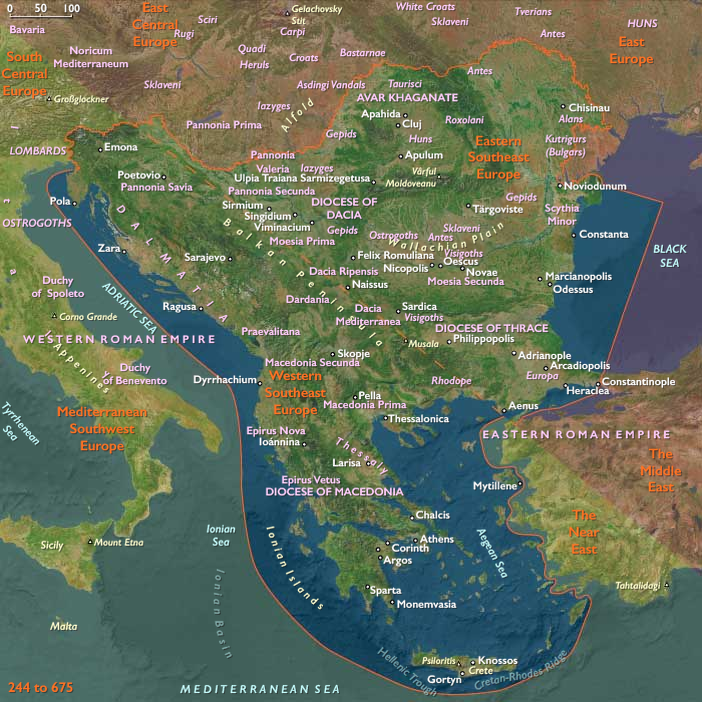
Eastern Southeast Europe (448–459 CE): Recovery, Consolidation, and Continued Vigilance
Settlement and Migration Patterns
Post-Hunnic Stabilization
Between 448 and 459 CE, Eastern Southeast Europe began recovering from the severe disruptions caused by the devastating Hun invasions under Attila. Gradual restoration of stability allowed settlements and urban centers to regain strength, reorganizing demographic distributions and reviving social structures.
Consolidation of Defensive Settlements
Major cities, particularly Constantinople and Philippopolis, continued to enhance defensive infrastructures. Urban fortifications were reinforced and expanded, ensuring greater protection against potential future threats and fostering regional stability.
Economic and Technological Developments
Economic Recovery and Continuity
Regional economies began a cautious recovery from previous upheaval, benefiting from improving security conditions. Agricultural productivity resumed, and urban commerce gradually re-established trade links, facilitating regional economic stabilization.
Technological and Defensive Innovations
Advancements in military and defensive technology continued to develop, particularly in improved fortification systems, armament manufacturing, and logistical management. These innovations significantly increased the region's defensive capacity and military preparedness.
Cultural and Artistic Developments
Cultural Continuity and Revitalization
Cultural and artistic activities flourished despite earlier disruptions, reflecting ongoing resilience and adaptability. Public art, religious architecture, and urban monuments combining classical and Christian themes continued to be actively maintained and expanded.
Educational and Intellectual Resilience
Institutions of learning preserved and promoted classical knowledge, demonstrating intellectual vitality despite challenging conditions. Scholarly endeavors adapted to the evolving regional contexts, thereby maintaining a continuous cultural heritage.
Social and Religious Developments
Administrative Strengthening
Provincial governance systems further solidified their administrative effectiveness, improving local governance, military oversight, and civic management. This strengthening of administration significantly contributed to the region's enduring stability.
Further Expansion of Christianity
Christianity continued expanding its influence deeply into regional culture, society, and politics. Religious institutions increased their roles in societal guidance and community cohesion, reinforcing stability amid ongoing challenges.
Long-Term Consequences and Historical Significance
The period from 448 to 459 CE marked a crucial phase of regional recovery and defensive consolidation. The reinforced fortifications, economic revival, cultural resilience, and improved governance significantly shaped Eastern Southeast Europe’s stability, laying foundations essential for its continued historical trajectory toward Byzantine dominance.
The Middle East: 448–459 CE
Religious Policy and Internal Struggles in the Sassanian Empire
The era from 448 to 459 CE in the Middle East is characterized by continued internal struggles within the Sassanian Empire under Yazdegerd II (438–457 CE). Yazdegerd II, having previously enforced a policy of religious persecution, notably against Christians and Jews, attempts to consolidate Zoroastrian orthodoxy to unify his diverse and often fractious empire. However, these policies heighten tensions among minority communities, particularly within Armenia and the Jewish communities in Babylonia.
Armenian Resistance and Cultural Resilience
In 451 CE, Yazdegerd II intensifies his efforts to impose Zoroastrianism in Armenia, sparking widespread resistance among the Christian population. This culminates in the Battle of Avarayr (451 CE), a critical confrontation in which Armenian forces, led by Vardan Mamikonian, fiercely defend their right to practice Christianity. Although the Persians achieve a tactical victory, Armenian resilience ultimately compels the Sassanians to allow a measure of religious freedom, underscoring Armenia’s enduring cultural identity and steadfast adherence to Christianity.
The Armenian Church emerges strengthened despite political adversity, cementing its role as the guardian of national identity and unity, particularly through literature and theological scholarship.
Jewish Communities: Continued Cultural and Intellectual Vitality
Jewish communities in Babylonia, though occasionally facing religious pressures under Sassanian policies, continue to flourish intellectually and culturally. Rabbinical academies remain centers of vibrant debate and learning, further developing the ethical and theological discussions recorded in the Talmud. The earlier measures against predicting the arrival of the Messiah remain influential, guiding communal practices and ensuring spiritual stability amidst ongoing external uncertainties.
Succession and Stability in the Sassanian Empire
Upon Yazdegerd II’s death in 457 CE, the throne passes to his son Hormizd III, whose brief reign is swiftly challenged by his younger brother, Peroz I. Civil war ensues, reflecting underlying tensions within the empire’s ruling elite. By 459 CE, Peroz I successfully secures the throne, but the internal conflict significantly weakens central authority and highlights the fragile nature of Sassanian political cohesion.
Despite internal challenges, the period sees continued artistic and cultural advancements across Persian territories, reflecting the robust nature of Persian cultural expression even amidst political and religious upheaval.
Continued Frontier Stability with Rome
Throughout this period, the frontiers between the Roman and Persian empires remain relatively stable, largely due to the mutual interest in avoiding protracted warfare. Minor skirmishes and diplomatic maneuvers occur, but major confrontations are notably absent. This stability allows urban centers, especially in Roman-controlled Syria, to sustain their economic and cultural vitality.
Thus, 448 to 459 CE encapsulates a dynamic period of intensified religious conflict, cultural resilience, internal Sassanian struggles, and sustained intellectual vigor, reflecting the complexity of life in the Middle East during the mid-fifth century.
The Panchatantra, an ancient Indian interrelated collection of animal fables in verse and prose, in a frame story forma, is compiled in about 450.
The original Sanskrit work, which some scholars believe was composed in the third century BCE, is attributed to Vishnu Sharma.
Mediterranean Southwest Europe (448–459 CE): Artistic Masterpieces in Ravenna and Rome
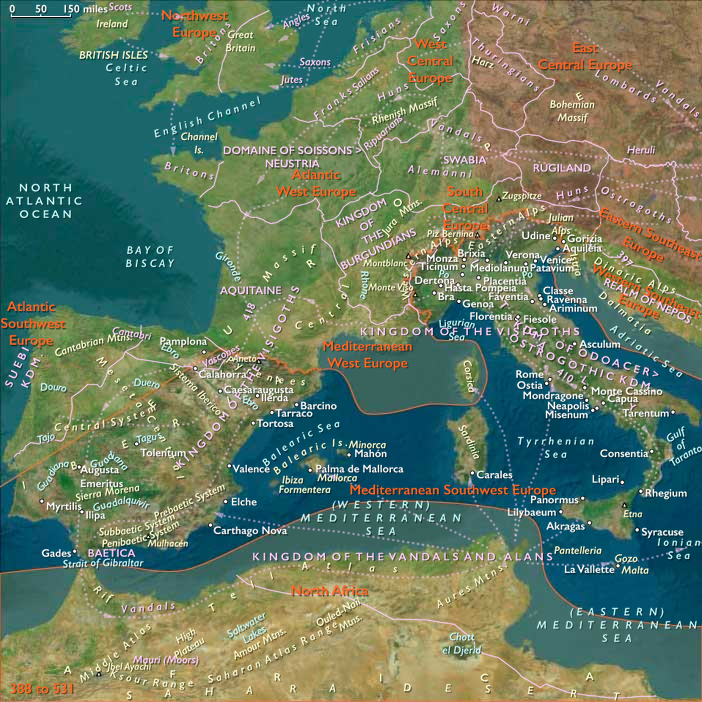
The era 448–459 CE in Mediterranean Southwest Europe is distinguished by extraordinary artistic and architectural achievements, reflecting the growing prominence of Christian symbolism and imperial patronage, even amid the political fragmentation of the Western Roman Empire.
The Mausoleum of Galla Placidia in Ravenna
In Ravenna, the small, cruciform mausoleum traditionally associated with Aelia Galla Placidia, mother of Emperor Valentinian III, houses some of the era's most stunning examples of Byzantine mosaic art. The celebrated lunette mosaic titled “The Good Shepherd” portrays Christ as a youthful, beardless figure, evoking classical Hellenistic imagery and demonstrating the fusion of traditional pagan iconography with Christian theology.
The mausoleum’s central dome is adorned with representations of heaven and symbols of the four evangelists, surrounded by figures of the apostles, vividly illustrating early Christian cosmology.
Saint Lawrence and Iconographic Richness
Facing the “Good Shepherd” lunette is another impressive mosaic portraying Saint Lawrence, identified by the symbol of his martyrdom. The scene features a book cabinet holding the four Gospels, symbolizing the centrality of scriptural authority in the early Christian Church. The mausoleum’s walls and vaults exhibit intricate naturalistic and geometric designs, exemplifying the artistic sophistication of the period.
Rome’s Continued Ecclesiastical Development
In Rome, Pope Sixtus III’s continued patronage—highlighted by the completion of the great basilica Santa Maria Maggiore—further demonstrates the era’s flourishing artistic and architectural activity. Rome's religious architecture and art increasingly reflect the integration of imperial prestige with ecclesiastical authority, emphasizing Christianity’s dominant cultural position.
Urban Artistic Workshops and Cultural Vitality
The exquisite mosaics in Ravenna and Rome, alongside surviving artistic evidence from Naples and Milan, suggest that high-quality artistic workshops operated widely across major cities. These workshops contributed significantly to maintaining urban cultural vitality and artistic excellence despite broader political uncertainties.
Legacy of the Era
The era 448–459 CE leaves a profound artistic legacy, represented most vividly by the mosaics of Ravenna’s mausoleum and Rome’s ecclesiastical architecture. These artistic achievements symbolize Christianity’s maturity as a central cultural force, deeply shaping the aesthetic and religious landscape of Mediterranean Southwest Europe for generations.
“The Good Shepherd,” one of two superb lunette mosaics in the cross-arms of the small, cruciform mausoleum built in Ravenna for Galla Placidia, Valentinian III’s mother, features Christ as a Hellenistic, beardless youth.
Heaven and the symbols of the four evangelists are represented in the central dome.
The figures of the apostles decorate the walls of the dome around the windows.
The lunette facing “The Good Shepherd” portrays Saint Lawrence with the symbol of his martyrdom and a book cabinet holding the four Gospels.
Rich naturalistic and geometric decoration covers the vaults, the arches, and the other two lunettes.
North Africa (448–459 CE)
Vandal Expansion, Maritime Dominance, and Religious Persecution
Between 448 and 459 CE, the Vandal Kingdom under Genseric firmly establishes itself as a significant Mediterranean power, marking a distinct shift from Roman influence toward Vandal dominance.
During this era, Genseric skillfully consolidates Vandal authority throughout North Africa, strategically reorganizing the region's economy and governance. Carthage, now the capital of the Vandal Kingdom, thrives under his control, serving as a vibrant maritime and commercial hub. From this advantageous position, Genseric launches maritime expeditions across the Mediterranean, significantly disrupting Roman maritime communications, commerce, and security. The Vandals extend their influence to the islands of Sicily, Sardinia, Corsica, and the Balearics, demonstrating formidable naval strength and challenging Roman dominance at sea.
Religious tensions escalate further during these years. As a committed adherent of Arian Christianity, Genseric intensifies persecution of the orthodox Christian population. Orthodox clergy face severe suppression, including exile, confiscation of property, imprisonment, and forced conversions to Arianism. Nevertheless, orthodox Christian communities remain resilient, often maintaining secret worship and quietly preserving their doctrinal traditions despite harsh repression.
Economically, the Vandals increasingly integrate North African agricultural production—especially grain and olive oil exports—into their broader Mediterranean commercial network. Yet, this integration involves harsh measures: lands formerly held by Roman aristocrats are extensively expropriated and redistributed to Vandal elites and their supporters, profoundly altering the social fabric of the region.
Urban centers such as Leptis Magna and Caesarea (Cherchell) adapt to new political realities, maintaining local commerce and cultural life under more direct Vandal oversight. Though economically resilient, these cities experience significant demographic and social transformations as Vandal authority reshapes their governance structures and elite composition.
Rural and frontier areas continue experiencing fragmented control and periodic instability. Local Berber tribes, leveraging weakened central authority and security, assert increasing autonomy or outright independence, causing persistent disruptions and complicating Vandal territorial administration.
By the close of 459 CE, North Africa is fully integrated into the expanding Vandal Kingdom. Roman political authority is effectively extinguished, religious persecution reshapes social dynamics, and regional governance now firmly reflects the Vandals' political and military objectives. Despite ongoing tensions and disruptions, this period decisively cements North Africa’s transformation from a Roman province to a distinct and influential Vandal domain.
Years: 448 - 459
People
Groups
- Germans
- Huns
- Hunnic Empire
- Roman Empire: Theodosian dynasty (Constantinople)
- Roman Empire, Western (Ravenna)
- Visigothic Kingdom of Toulouse
- Roman Empire, Eastern: Leonid dynasty
Topics
- Migration Period
- Hun Raids on the Roman Empire
- Fall of the Western Roman Empire
- Catalaunian Plains, Battle of the
Subjects
Regions
Subregions
- East Central Europe
- Eastern Southeast Europe
- Mediterranean Southwest Europe
- Atlantic West Europe
- West Central Europe