
A type of distilled liquor designated by …
Years: 1751 - 1751
A type of distilled liquor designated by the Russian word vodka had come to Russia in the late fourteenth century.
In 1386, the Genoese ambassadors had brought the first aqua vitae ("the water of life") to Moscow and presented it to Grand Duke Dmitry Donskoy.
The liquid obtained by distillation of grape must was thought to be a concentrate and a "spirit" of wine (spiritus vini in Latin), from where came the name of this substance in many European languages (like English spirit, or Russian спирт, spirt).
According to a legend, around 1430, a monk named Isidore from Chudov Monastery inside the Moscow Kremlin made a recipe of the first Russian vodka.
Having a special knowledge and distillation devices, he became the creator of a new, higher quality type of alcoholic beverage.
This "bread wine", as it was initially known, was for a long time produced exclusively in the Grand Duchy of Moscow and in no other principality of Rus' (this situation persisted until the era of industrial production).
Thus, this beverage was closely associated with Moscow.
Until the mid-eighteenth century, the drink had remained relatively low in alcohol content, not exceeding 40% ABV.
Multiple terms for the drink are recorded, sometimes reflecting different levels of quality, alcohol concentration, filtering, and the number of distillations; most commonly, it is referred to as "burning wine", "bread wine", or even in some locations simply "wine".
In some locations, grape wine may have been so expensive that it was a drink only for aristocrats.
Burning wine is usually diluted with water to 24% ABV or less before drinking.
It is mostly sold in taverns and is quite expensive.
At the same time, the word vodka is already in use, but it describei herbal tinctures (similar to absinthe), containing up to 75% ABV, and made for medicinal purposes.
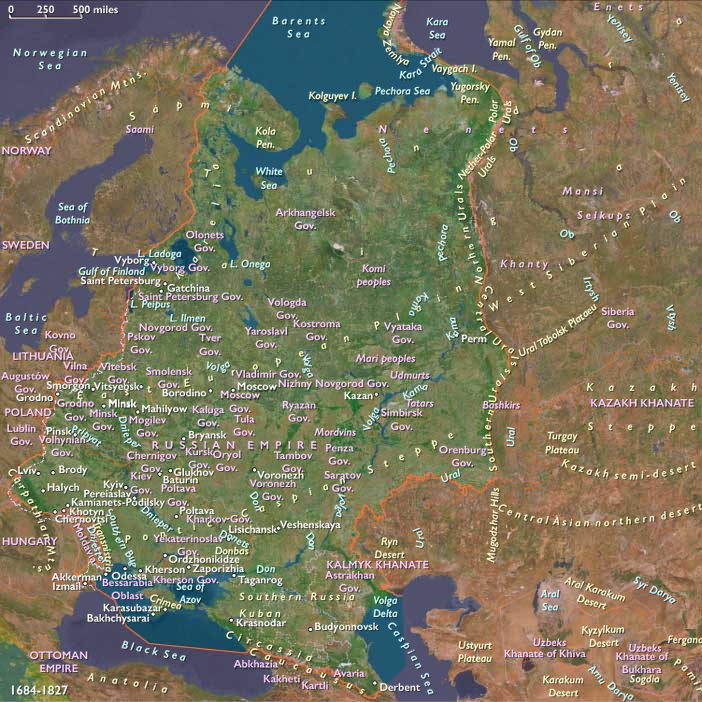
The first written usage of the word vodka in an official Russian document in its modern meaning is dated by the decree of Empress Elizabeth of June 8, 1751, which regulats the ownership of vodka distilleries.
Locations
People
Groups
Commodoties
Subjects
Regions

Subregions
Years: 1751 - 1751
Locations
People
Groups
Commodoties
Subjects
Regions
Subregions