
Bardaisan shows great literary activity against Marcion …
Years: 227 - 227
Bardaisan shows great literary activity against Marcion and Valentinus, the Gnostics of the day.
Bardaisan mixes his Babylonian pseudo-astronomy with Christian dogma and originates a Christian sect, which is vigorously combated by St. Ephrem.
Various opinions have been formed as to the real doctrine of Bardesanes.
As early as Hippolytus (Philosoph., VI, 50) his doctrine was described as a variety of Valentinianism, the most popular form of Gnosticism.
Adolf Hilgenfeld in 1864 defended this view, based mainly on extracts from St. Ephrem, who devoted his life to combating Bardaisanism in Edessa.
The strong and fervent expressions of St. Ephrem against the Bardaisanites of his day are not a fair criterion of the doctrine of their master.
The extraordinary veneration of his own countrymen, the very reserved and half-respectful allusion to him in the early Church Fathers, and above all the "Book of the Laws of the Countries", suggest a milder view of Bardaisan's aberrations.
He cannot be called a Gnostic in the proper sense of the word.
Like the Early Christians, he believes in an Almighty God, Creator of heaven and earth, whose will is absolute, and to whom all things are subject.
God endowed man with freedom of will to work out his salvation and allowed the world to be a mixture of good and evil, light and darkness.
All things, even those we now consider inanimate, have a measure of liberty.
In all of them the light has to overcome the darkness.
After six thousand years this earth shall have an end, and a world without evil shall take its place.
However, Bardaisan also thinks the sun, moon and planets are living beings, to whom, under God, the government of this world is largely entrusted; and though man is free, he is strongly influenced for good or for evil by the constellations.
Bardaisan's catechism must have been a strange mixture of Christian doctrine and references to the signs of the Zodiac.
Led by the fact that "spirit" is feminine in Syriac, he seems to have held unorthodox views on the Trinity.
He apparently denies the Resurrection of the Body, but thinks Christ's body was endowed with incorruptibility as with a special gift.
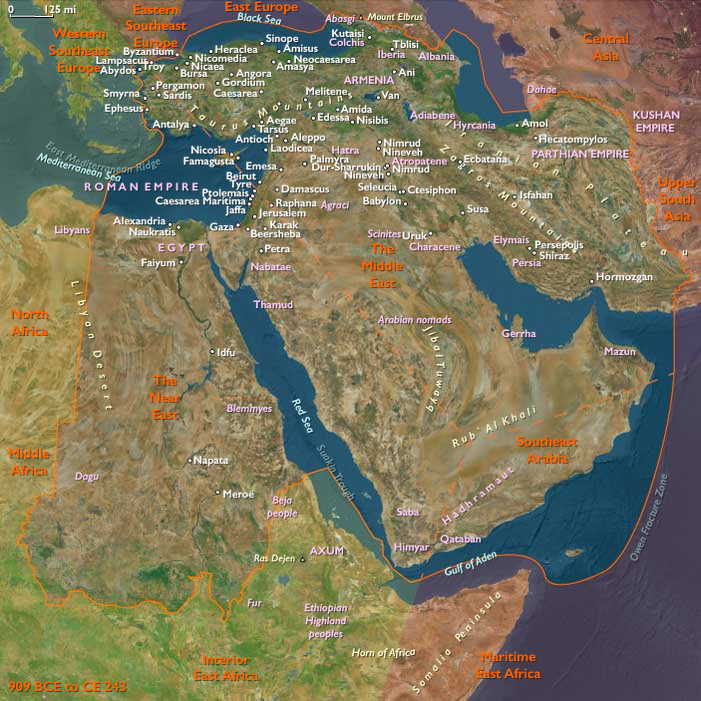
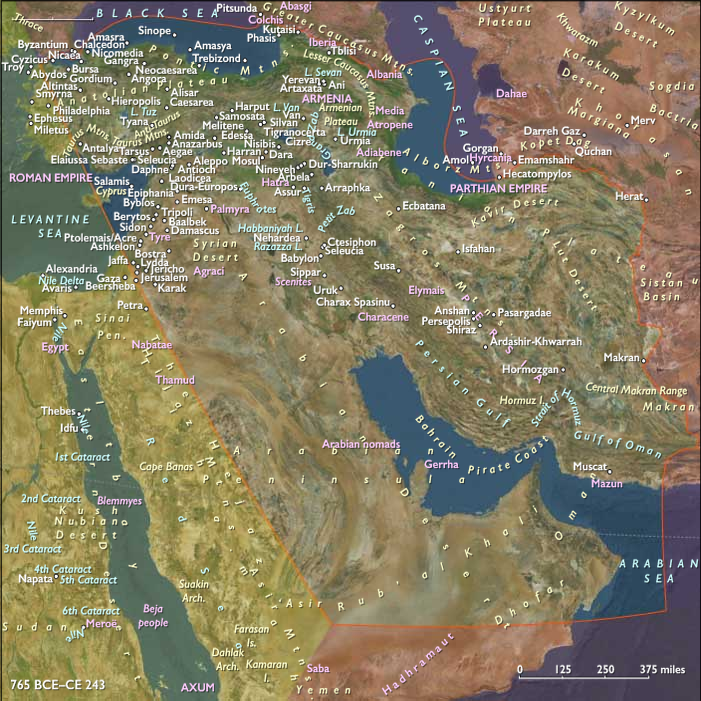
The Romans under Caracalla, taking advantage of the anti-Christian faction in Edessa, capture Abgar IX and send him in chains to Rome.
Thus the Osrhoenic kingdom, after 353 years' existence, comes to an end.
Though he is urged by a friend of Caracalla to apostatize, Bardaisan stands firm, saying that he fears not death, as he would in any event have to undergo it, even though he should now submit to the emperor.
Locations
People
Groups
Topics
Subjects
Regions
Subregions
Related Events
Showing 10 events out of 60621 total
Years: 227 - 227
Locations
People
Groups
Topics
Subjects
Regions
Subregions