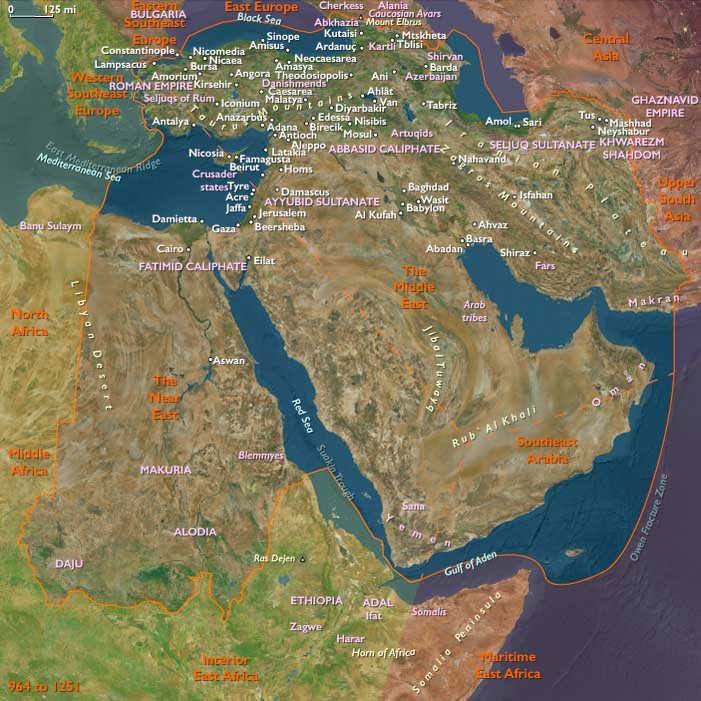
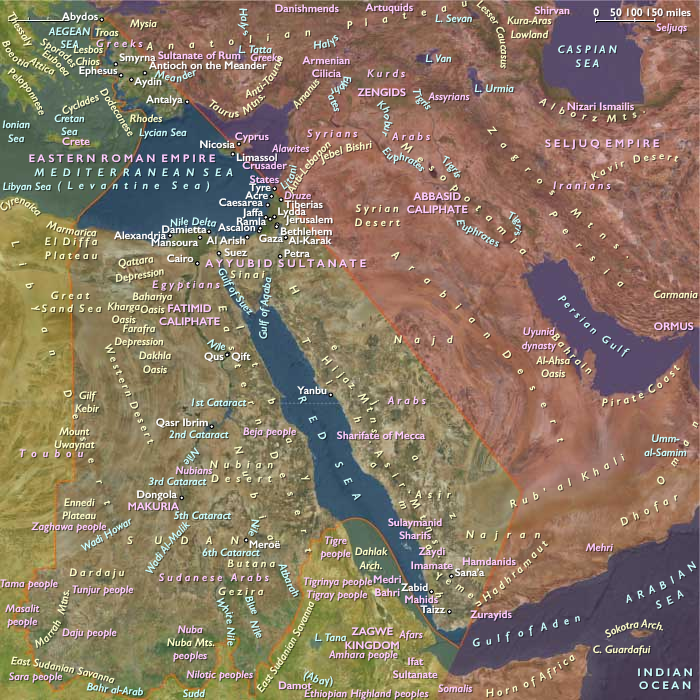
Baldwin also besieges the ancient fortress city …
Years: 1111 - 1111
Baldwin also besieges the ancient fortress city of Tyre, but is pushed back by a Muslim force under Toghtekin of Damascus.
Locations
People
Groups
- Muslims, Sunni
- Muslims, Shi'a
- Ismailism
- Flemish people
- Norway, independent Kingdom of
- Turkmen people
- Fatimid Caliphate
- French people (Latins)
- Christians, Roman Catholic
- Jerusalem, Latin Kingdom of
- Damascus, Burid Emirate of
Topics
Commodoties
Subjects
Regions
Subregions
Related Events
Filter results
Showing 10 events out of 49513 total
Vladislav I, despite his victory, remains under Polish pressure and is forced to recognize a younger brother, Sobeslav, as subordinate ruler of Moravia in Znojmo (Znaim) from 1111.
Vladislav I rules in a difficult time with considerable success.
Although he continues to acknowledge the suzerainty of the Holy Roman Empire, he weathers the interventions of Poland into Bohemian affairs, conflicts with his kinsmen in Moravia, and undertakes offensive campaigns against both Poland and Austria.
In 1110–1111, Vladislav accompanies Emperor Henry V on his Italian expedition, and he encourages continued German settlement into Bohemia's border regions.
Sigurd the Crusader, leaving men and his entire fleet in Constantinople as a gift to Emperor Alexios I Komnenos, returns overland to his Norwegian kingdom in 1111.
Almoravid Conquests in Portugal: The Fall of Santarém and Sintra (1111 CE)
In 1111 CE, the Almoravid forces under the command of General Sir ibn Abi Bakr launch a major offensive into central Portugal, successfully capturing Santarém and ...
...Sintra.
These conquests:
- Reverse Christian advances in the region, rolling back the gains of Afonso Henriques’ predecessors.
- Strengthen Almoravid control over the western Iberian Peninsula, reinforcing their dominance south of the Tagus River.
- Secure Santarém and Sintra as key defensive and administrative centers for the Almoravid empire in Gharb al-Andalus.
Although Christian forces will later reconquer these cities, the Almoravid victories in 1111 mark a high point in Muslim military strength in Portugal, delaying the Christian push southward for several decades.
The Almoravid Sack of Coimbra and the Urban Rebellion (1117 CE)
In 1117 CE, the Berber Almoravid forces, continuing their efforts to regain lost territory, sack Coimbra, one of the key Christian strongholds in central Portugal.
Notably, in the same year, Coimbra experiences the only recorded urban rebellion against its lord in medieval Portugal. The precise reasons for the uprising are unclear, but it likely stems from:
- Discontent among the city’s inhabitants, possibly due to heavy taxation or military obligations.
- Tensions between local Christian elites and the ruling authority over governance.
- Fear and instability caused by the ongoing Almoravid offensives.
Despite the sack of the city, Coimbra remains a vital Christian stronghold, and its eventual reconquest and fortification will play a significant role in the expansion of Portugal southward during the later phases of the Reconquista.
The Coronation of Alfonso VII as King of Galicia (1111 CE)
In 1111 CE, Diego Gelmírez, Bishop of Santiago de Compostela, along with Count Pedro Froilaz de Traba, crowns and anoints Alfonso Raimúndez as King of Galicia in the Cathedral of Santiago de Compostela.
At the time of his coronation, Alfonso is still a child, but his mother, Queen Urraca of León-Castile-Galicia (who had inherited the united kingdom in 1109), seeks to secure his future rule by giving him formal recognition as king in Galicia. This move is intended to:
- Strengthen Alfonso’s legitimacy as heir to the throne of León and Castile.
- Ensure Galician loyalty in the face of political instability and conflicts with her estranged husband, Alfonso I of Aragon.
- Establish Diego Gelmírez and the powerful House of Traba as key allies in Alfonso’s eventual succession to the greater kingdom.
Though initially King of Galicia, Alfonso will later ascend to the throne of León and Castile as Alfonso VII, eventually becoming the self-proclaimed Emperor of Spain.
The Death of Robert II of Flanders and the Revolt Against Henry I (1111 CE)
In 1103, Robert II of Flanders forged an alliance with King Henry I of England, agreeing to provide one thousand cavalry in exchange for an annual tribute. However, when Henry refused to pay, Robert II shifted his allegiance to his nominal overlord, King Louis VI of France, aligning himself with the growing Capetian resistance to Norman and Angevin power.
This realignment intensified French hostilities toward Normandy, as Robert II actively supported Louis VI’s campaigns against Henry I.
Revolt and the Siege of Meaux (1111 CE)
With Henry I preoccupied with defending Normandy, the French barons, led by Theobald IV of Blois, seized the opportunity to rise in rebellion against the Capetian monarchy. The House of Blois, a powerful rival to the Capetians, had long sought to challenge the growing influence of the French crown.
In support of Louis VI, Robert II of Flanders led an army to besiege Meaux, a stronghold within Theobald IV’s domains. However, during the campaign, Robert II suffered a fatal accident:
- Near Meaux, he was wounded in battle, losing control of his horse.
- He fell into the Marne River and drowned, bringing an abrupt end to his military leadership.
Consequences and Aftermath
- Robert II’s death weakened the Franco-Flemish alliance, as his successor, Baldwin VII of Flanders, lacked his predecessor’s political and military standing.
- Theobald IV’s revolt posed a serious internal challenge to Louis VI, but without Robert’s military support, the rebellion ultimately failed to overthrow Capetian authority.
- Henry I’s position in Normandy remained strong, as the internal divisions among the French nobility distracted Louis VI, preventing him from mounting a coordinated campaign against Normandy.
Despite his untimely death, Robert II of Flanders had played a crucial role in destabilizing Henry I’s continental position, contributing to the ongoing power struggles between the Capetians, Normans, and Angevins in the early 12th century.

The Romanesque Elegance of Cîteaux: The 1111 Illuminated Moralia in Job
The artistic refinement of Romanesque illuminated manuscripts is exemplified in a 1111 CE copy of the Moralia in Job by Pope Gregory the Great, produced at the Abbey of Cîteaux in France. This manuscript, created within the influential Cistercian monastic tradition, stands as a testament to the elegant and imaginative craftsmanship of Romanesque book illumination.
Stylistic Features and Artistic Innovations
- Ornate Human and Animal Forms – The initials are intricately shaped by fantastically stylized human figures, dragons, and mythical creatures, a hallmark of Romanesque manuscript art.
- Intricate Lettering – The elongated, intertwined figures serve as decorative initials, transforming the written word into visual splendor, blending text and image seamlessly.
- Dynamic Movement and Expression – The creatures and human forms exhibit exaggerated poses and fluid gestures, imbuing the manuscript with a sense of animated elegance.
- Vibrant Colors and Contrast – The use of rich pigments, such as deep blues, reds, and gold, enhances the manuscript’s visual impact, drawing attention to its elaborate compositions.
The Cistercian Influence on Romanesque Illumination
The Abbey of Cîteaux, founded in 1098, became the heart of the Cistercian movement, which emphasized simplicity and austerity. Yet, in the early 12th century, Cistercian scriptoria still produced lavishly illuminated manuscripts, such as this copy of the Moralia in Job.
- A Departure from Cluniac Ornamentation – While Cluniac art was often highly elaborate, early Cistercian manuscripts retained a restrained yet sophisticated beauty, balancing elegance with clarity.
- Symbolism and Spirituality – The manuscript’s elaborate initials reflect a deeply symbolic artistic language, where fantastical creatures and contorted human forms serve not only as decoration but as spiritual metaphors.
Legacy and Artistic Significance
This 1111 manuscript from Cîteaux represents one of the finest Romanesque illuminated texts, bridging the grandeur of Cluniac traditions with the emerging Cistercian aesthetic. Its intricate designs and vibrant ornamentation continue to be celebrated as a high point of medieval book art, preserving the elegant beauty and creative ingenuity of Romanesque illumination for future generations.
Henry V, on returning from Italy to Germany, seeks to strengthen his power by granting privileges to the inhabitants of the region of the upper Rhine, along which the largest cities are Basel, Mulhouse, Strasbourg, Mannheim, Ludwigshafen and Mainz.
Years: 1111 - 1111
Locations
People
Groups
- Muslims, Sunni
- Muslims, Shi'a
- Ismailism
- Flemish people
- Norway, independent Kingdom of
- Turkmen people
- Fatimid Caliphate
- French people (Latins)
- Christians, Roman Catholic
- Jerusalem, Latin Kingdom of
- Damascus, Burid Emirate of