
Aboriginal people inhabited the territory of what …
Years: 1492 - 1503
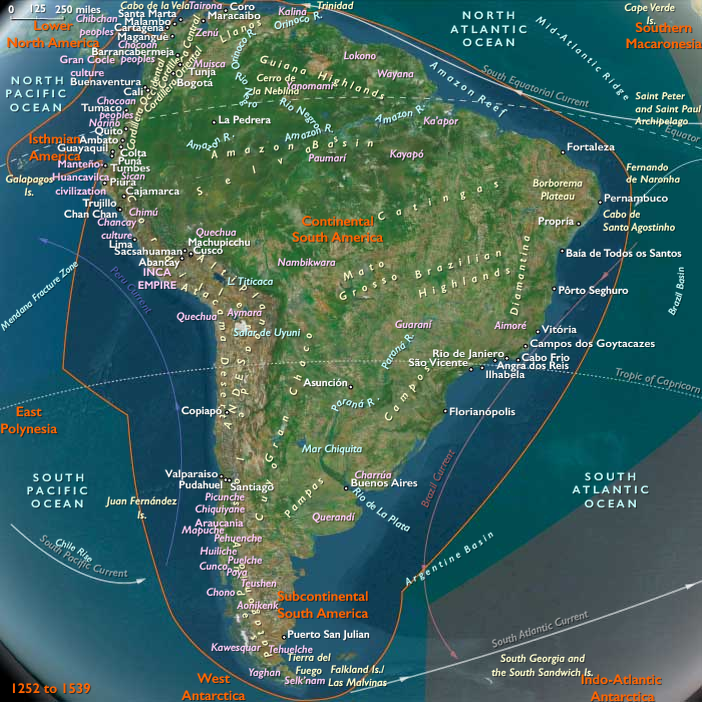
Aboriginal people inhabited the territory of what is now Colombia by 10,500 BCE.
Nomadic hunter-gatherer tribes existed near present-day Bogotá (at El Abra and Tequendama sites) which traded with one another and with cultures living in the Magdalena River Valley.
Between 5000 and 1000 BCE, hunter-gatherer tribes transitioned to agrarian societies; fixed settlements were established, and pottery appeared.
Beginning in the first millennium BCE, groups of natives including the Muisca, Quimbaya, and Tairona develop the political system of cacicazgos with a pyramidal structure of power headed by caciques.
The Muiscas inhabit mainly the area of what is now the Departments of Boyacá and Cundinamarca high plateau (Altiplano Cundiboyacense).
They farm maize, potato, quinoa and cotton, and trade gold, emeralds, blankets, ceramic handicrafts, coca and salt with neighboring nations.
The Taironas inhabit northern Colombia in the isolated Andes mountain range of Sierra Nevada de Santa Marta.
The Quimbayas inhabit regions of the Cauca River Valley between the Occidental and Central cordilleras.
The Incas expand their empire on the southwest part of the country.
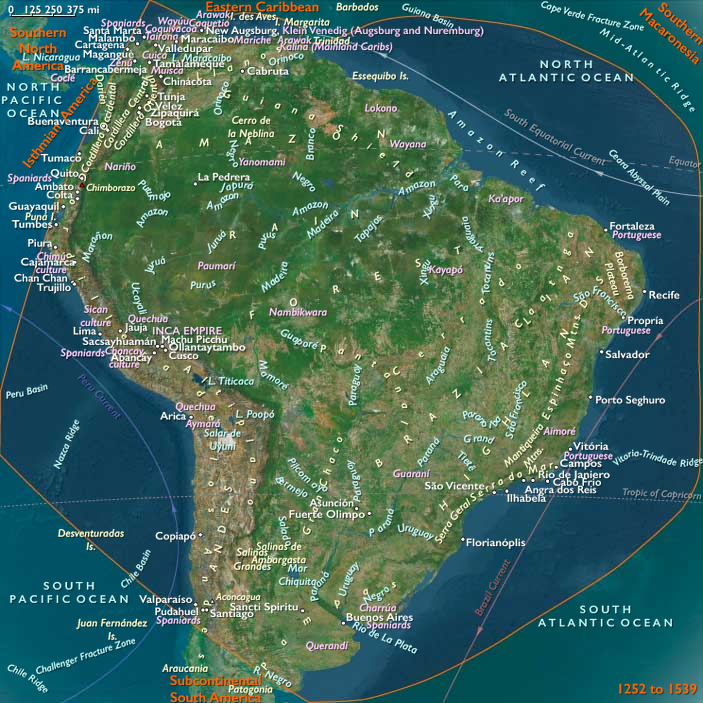
Alonso de Ojeda (who had sailed with Columbus) had reached the Guajira Peninsula in 1499.
Spanish explorers, led by Rodrigo de Bastidas, had made the first exploration of the Caribbean littoral in 1500.
Christopher Columbus navigates near the Caribbean in 1502.
People
Groups
Topics
Commodoties
Subjects
Regions
Subregions
Years: 1492 - 1503
People
Groups
Topics
Commodoties
Subjects
Regions
Subregions