Bairam Khan reaches the port city of …
Years: 1561 - 1561
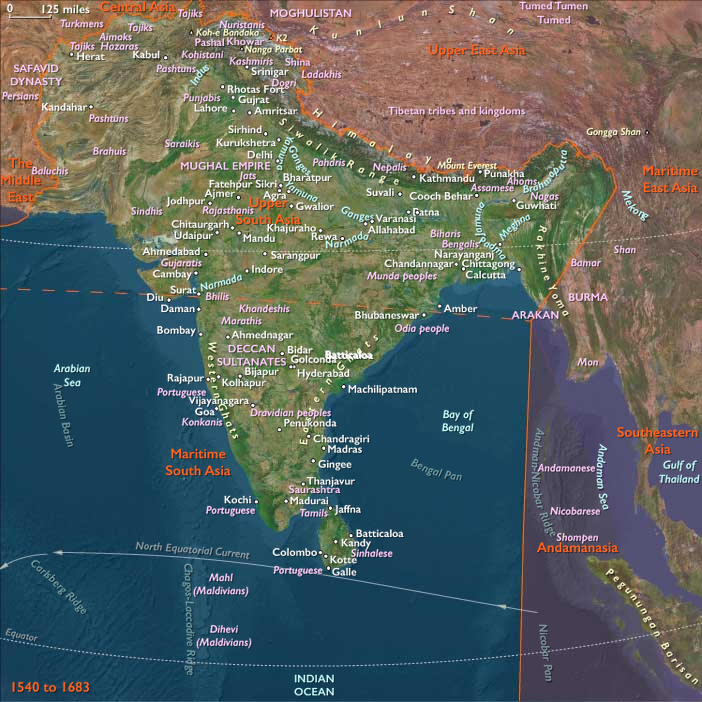
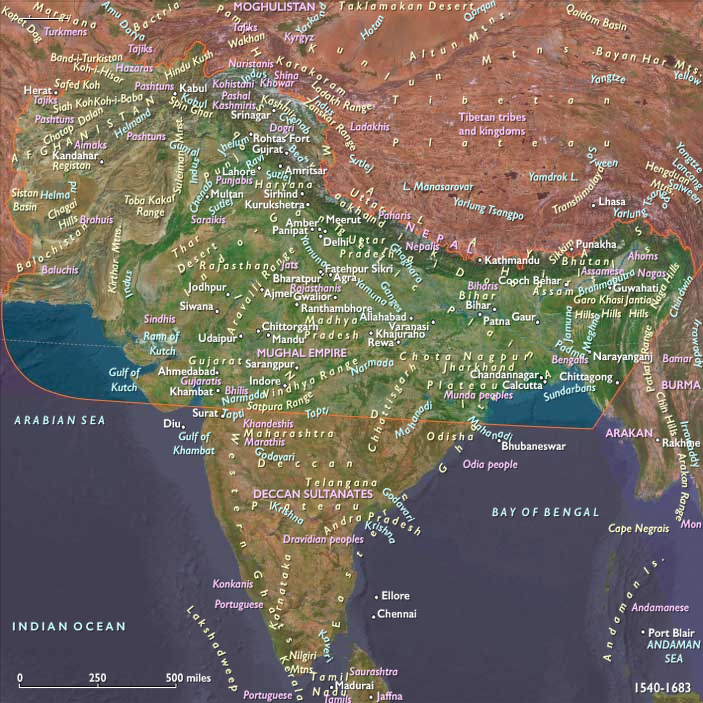
Bairam Khan reaches the port city of Cambay shortly after beginning his Hajj journey, and encounters an Afghan whose father had been killed five years earlier in a battle led by Bairam.
The Afghan, seeing a chance to reap vengeance, promptly stabs Bairam, who dies on January 31, 1561.
Locations
People
Groups
Subjects
Regions
Subregions
Related Events
Filter results
Showing 10 events out of 35870 total
Tsar Ivan has celebrated his victories over Kazan and Astrakhan by building several churches with oriental features, most famously Saint Basil's Cathedral on what is today Red Square in Moscow.
The site of the cathedral had been, historically, a busy marketplace between the St. Frol's (later Savior's) Gate of the Moscow Kremlin and the outlying posad, or settlement.
The center of the marketplace is marked by the Trinity Church, built of the same white stone as the Kremlin of Dmitry Donskoy (1366–1368) and its cathedrals.
Tsar Ivan IV has marked every victory of the Russo-Kazan War by erecting a wooden memorial church next to the walls of Trinity Church; by the end of his Astrakhan campaign, it is literally shrouded within a cluster of seven wooden churches.
According to the sketchy report in Nikon's Chronicle, in the autumn of 1554 Ivan had ordered construction of a wooden Church of Intercession on the same site, "on the moat".
One year later Ivan had ordered construction of a new stone cathedral on the site of Trinity Church that will commemorate his campaigns.
Dedication of a church to a military victory is a major innovation for Muscovy.
The placement of the church outside of the Kremlin walls is a political statement in favor of posad commoners, and against hereditary boyars.
The cathedral, completed in 1561, marks the geometric center of the city and the hub of its growth since the fourteenth century.
The original building, known as "Trinity Church" and later "Trinity Cathedral", contains eight side churches arranged around the ninth, central church of Intercession.
The building's design, shaped as a flame of a bonfire rising into the sky, has no analogues in preceding, contemporary or later Russian of Byzantine architecture, even remote.
Foundations, traditional to medieval Moscow, are built of white stone, while the churches themselves are built of red brick (28×14×8 centimeters), a relatively new material (the first attested brick building in Moscow, the new Kremlin Wall, was constructed in 1485).
Hungary's first printing press is established in 1561 at Debrecen, whose inhabitants are mainly Hungarian Calvinists.
The Tekkiye Mosque, a mosque complex in Damascus, Syria, located on the banks of the Barada River, has been designed by the architect Mimar Sinan on the orders of Suleiman the Magnificent.
Built between 1554 and 1560, the complex is composed of a large mosque on the southwest side of a courtyard, flanked by a single line of arcaded cells, and a soup kitchen across the courtyard to the northwest.
The Persian shah, who has harbored Selim, delivers his brother and rival Bayezid in 1561 to executioners sent by Selim with the approval of Suleiman, who rewards the shah handsomely for this service.
The Hindu princes of central and western India, having achieved autonomy during the long absence of Mughal emperor Humayun from India, have formed a loose alliance known collectively as Rajasthan or Rajputana.
The kingdoms of Rajasthan, now fairly strong, threaten the economic stability of the restored Mughal empire.
Akbar, applying to the problem a twin diplomatic and military strategy, dispatches an imperial army against Malwa, situated north of the Deccan region, conquering that central kingdom in 1561.
Maham Anga sees an opportunity for herself with the demise of Bairam Khan, and attempts to wrest the control that Bairam had over Akbar.
Her son Adham is sent in February 1561 to capture the sultanate of Malwa, which is being incompetently ruled by Miyan Bayezid Baz Bahadur.
Baz Bahadur is a talented musician but has no ability to govern, and many of the people of the area have fled to Mughal territories, alerting the Mughals to the possibility of taking the area.
Baz Bahadur flees as the army of Adham Khan approaches, leaving behind his wealth and his wives in their harem, and instructions that they are to be killed if the city of Sarangpur falls to the Mughals.
However, despite the best attempts by the eunuch in charge of the harem, many of the women survive; even Rupmati, who had gained fame through many of Baz Bahadur’s songs for her beauty, survives multiple slash wounds to be captured by the invading Mughals.
As the senior members of the invading army imbibe alcohol and opium pellets, generally treating the event as a festive occasion, the least attractive women are brought before them and killed.
In addition, according to Abdul Qadir Badauni, "Sayyids and Sheikhs came out to meet him with their Qur'ans in hand, but Khan put them all to death and burnt them".
Badauni records that on at least one occasion, members present tried to stop the slaughter but were shackled.
Adham keeps the vast majority of the wealth and captives for himself, sending a mere three elephants to his Emperor.
Along with the elephants, Akbar receives word of Adham’s deeds, becomes enraged, and decides to ride out to Malwa himself, together with a small band of loyal soldiers, racing and beating a group of courtiers sent by Maham Anga to warn Adham of Akbar's rage.
Adham becomes terrified when confronted and quickly begs for Akbar's forgiveness.
Akbar forgives him and receives the booty he had seized.
However, Adham secretly keeps for his own harem two of the women he had found most attractive.
When Akbar discovers this, Maham Anga kills the women, fearing what they might reveal about Adham to Akbar.

Ibrahim Qutb Shah, the ruler of Golconda, now allies himself with ...
...Ahmadnagar against Bijapur.
Rama Raya, in response, allies Vijayanagar with ...
...Bijapur to soundly defeat the aggressors.